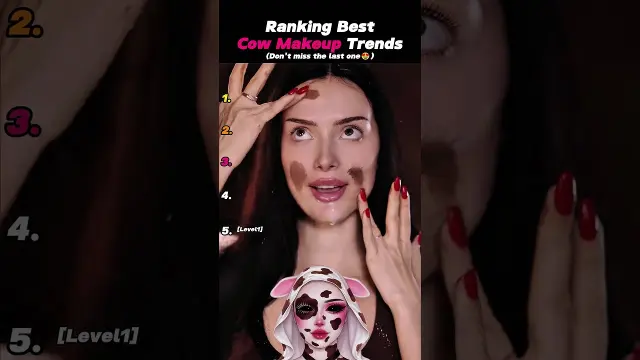
 Ranking the Best Looks From the Cow Makeup Trend
#Animal Print Makeup
1 ideas
Ranking the Best Looks From the Cow Makeup Trend
Get new #Animal Print Makeup ideas by email
Every Thursday: the week's best ideas, with the newest from #Animal Print Makeup.
Related tags
Animal Print Makeup: A Guide to Leopard, Zebra and Snake Looks
Animal print makeup is the use of patterns borrowed from the animal world — the rosettes of a leopard, the stripes of a zebra, the scales of a snake, the patches of a cow — as decoration for the eyes, cheeks, lips or nails. It sits somewhere between cosmetics and face painting: the point is not to look natural but to wear a motif, the way a fabric can be printed with it.
The idea has deep roots. Animal skins have been worn as clothing and as marks of status for a very long time, and the fashion world made "animalier" prints a recurring theme through the twentieth century, first in fur and fabric, then in accessories. Makeup followed the same path: once a pattern becomes familiar on a handbag or a scarf, it is only a short step to painting it around an eye. Because the source is pattern rather than colour, animal print adapts easily to different palettes, from warm browns and golds to black and white, or to bright, deliberately artificial shades.
The main kinds of pattern
Leopard print is the most recognisable: small dark rosettes with a lighter centre, scattered over a warm caramel or tan base. It is forgiving to draw, because no two spots need to match.
Read more
Zebra print depends on contrast and rhythm — black stripes of varying width over white or cream, curving with the shape of the face rather than running perfectly straight.
Snake or reptile print is finer and more graphic: a network of small scales, often in greens, olives and metallics, built up with tiny diamond or oval shapes.
Cow print is the simplest of all, made of irregular black or brown patches on a pale base, with generous space between them.
Tiger, cheetah and giraffe patterns are variations on the same logic — stripes, solid spots, or a patchwork of angular shapes.
How it is done
There are three broad approaches. Stickers, stencils and stamping tools give a clean, repeatable pattern and are the easiest way in. Freehand painting with a fine liner brush or a small pointed brush offers the most control over placement and scale. Negative-space techniques — cutting shapes out of a block of colour with concealer or a clean brush — create a lighter, more modern version of the same idea.
Most looks start with a smooth, set base, because pattern reads best on an even surface. Placement matters more than precision: a cluster of spots at the outer corner of the eye, a single stripe along the lash line, or a few scales on the brow bone often looks more considered than an all-over covering.
If you are starting out
Begin with one small area and one pattern, and practise on the back of your hand before going near your eye. Keep the scale of the motif in proportion to the space — tiny spots on a small eyelid, larger patches on a cheek. Use a light hand with colour and let the outline do the work. Work in thin layers, and keep a little concealer and a pointed cotton bud nearby for tidying edges, since animal print is rarely improved by over-correcting. Remove eye makeup gently and give your skin a rest afterwards; patterns are fun, but the skin around the eyes is delicate.
Worn subtly it is a graphic accent; worn boldly it is a costume in itself. Either way, the charm lies in the irregularity — a machine-perfect repeat is not the goal.
Videos come from YouTube and posts from Instagram; titles and summaries are our own. All rights belong to their creators.