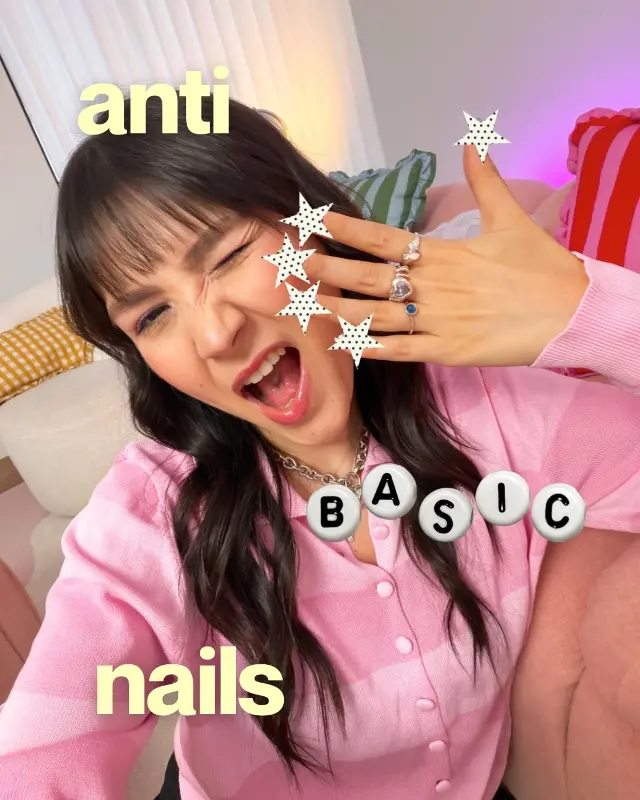
 Anti-Basic Nail Art Look With a Playful Hardware Twist
#Anti Basic Nails
1 ideas
Anti-Basic Nail Art Look With a Playful Hardware Twist
Get new #Anti Basic Nails ideas by email
Every Thursday: the week's best ideas, with the newest from #Anti Basic Nails.
Related tags
Anti-Basic Nails: A Guide to Unpredictable Nail Art
Anti-basic nails are less a single design than a stance. The term describes a manicure that deliberately refuses the plain, uniform polish job — one colour, one finish, neatly filed, nothing else going on — and replaces it with something the eye has to work a little harder to read. Where a classic manicure aims for polish that recedes, anti-basic nails aim for a set that holds attention: a stud where you expect none, a matte nail among glossy ones, a line that stops short on purpose.
The impulse comes out of the broader custom-nail tradition, where a set is built rather than simply painted. As nail art became a normal part of salon work rather than a special occasion, a quiet counter-current formed: people who had tried the minimal look and found it flat. The label itself is playful, adopted by wearers rather than codified by anyone, and it covers a wide range of styles rather than one fixed recipe.
What it looks like
- Mixed finishes within one hand: glossy next to matte, or a single matte accent nail against a satin base.
- Hardware as ornament: small studs, rings, fine chains or flat-backed shapes set into the polish or gel.
- Asymmetry: designs that run off-centre, occupy only part of a nail, or repeat unevenly across the fingers.
- Layered texture: chrome or mirror effects, magnetic finishes, flocking, fine glitters suspended in a clear layer.
- Hand-painted detail: tiny motifs, negative-space lines, colour-blocked sections, deliberate imperfection.
Read more
None of these are required. The through-line is contrast and intent: something in the set should feel chosen rather than default.
Where to start
Pick one disruptive element and let the rest stay calm. A clean base with a single hardware piece on one nail reads as deliberate; five competing ideas read as noise. Decide the palette first — two or three tones, one of which is usually neutral — then decide the accent.
If you do your nails at home, hardware and layered texture are the hardest parts to get durable, because anything raised catches on hair and clothing. Flat-backed pieces sit lower than domed ones and last longer. Set them while the top layer is still tacky, then seal the edges, and keep the seal thin so the piece stays flush. Thin lines and negative space are easier to control with a fine brush and a steady resting hand than with a full-width brush.
In a salon, bring references and be specific about placement, not just colour. A good technician will tell you what will survive daily life on your hands and what will lift within days.
Living with them
Anti-basic sets are more fragile than plain polish, mostly at the raised points. Wear gloves for washing up and cleaning, dry your hands after washing rather than leaving them damp, and treat a lifted edge early — catching it before it tears takes minutes, repairing it afterwards takes longer. Keep the cuticle area moisturised, since textured polish tends to look dry at the edges first.
The point is not maximalism for its own sake. It is the small deliberate wrongness — the detail that makes someone look twice at your hands.
#Anti Basic Nails: frequently asked questions
What exactly are anti-basic nails, and how do I know if I want them?
They are a manicure that deliberately steps away from the single-colour, uniform polish look and adds something the eye has to pause on — a mixed finish, an off-centre line, a small piece of hardware. The style is a stance rather than a fixed recipe, so it suits anyone who finds plain polish a little flat and wants a set that reads as chosen. If you like your nails quiet and receding, this probably isn't your look.
How should I start if I've never done an anti-basic set before?
Choose one disruptive element and let everything else stay calm, so the detail reads as intentional rather than accidental. Settle the colour palette first and pick the accent afterwards, since a restrained base is what makes the unusual touch land. Doing too many things at once is the fastest way to make the set look busy instead of considered.
What do I actually need to create anti-basic nails at home?
Beyond your usual base and top coat, the essentials are a fine detailing brush for thin lines and negative space, and flat-backed hardware pieces if you want studs or shapes rather than domed ones. Flat-backed pieces sit lower and survive daily wear better, and setting them while the top layer is still tacky helps them bond. A steady resting hand matters more than an expensive brush.
Which style of anti-basic nail should I pick?
Start from the effect you want people to notice: mixed finishes and a single matte accent if you like subtle contrast, hardware and layered texture if you want something tactile, hand-painted lines and negative space if you prefer drawn detail. Skin tone and nail length aren't rules here — placement is what carries the look. Bring references to a salon and be specific about where the design should sit, not just which colours you want.
How do I keep anti-basic nails from lifting or catching on things?
The raised points are the weak spots, so wear gloves for washing up and cleaning and dry your hands properly rather than leaving them damp. Deal with a lifted edge as soon as you spot it, because sealing it early is quick while repairing a torn one takes far longer. Keep the cuticle area moisturised, since textured polish tends to look dry at the edges first.
What are the most common mistakes with this kind of manicure?
Cramming several competing ideas onto one hand, so the deliberate detail turns into noise. Another is applying the seal too thickly over hardware, which makes the piece sit proud and catch on hair and clothing instead of lying flush. Expecting plain-polish durability is the third — a set with texture and raised elements needs a little more care and earlier repair.
Videos come from YouTube and posts from Instagram; titles and summaries are our own. All rights belong to their creators.