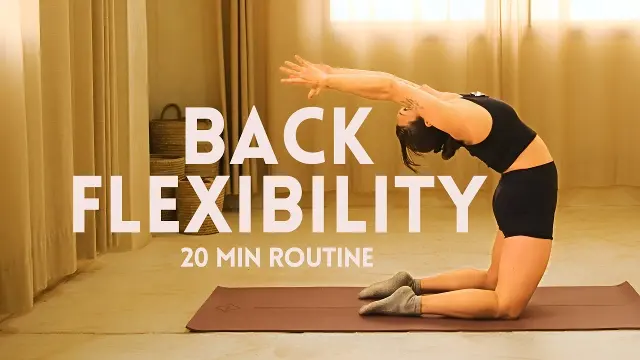
 Twenty Minute Back Flexibility and Spinal Mobility Routine
#Backbends
1 ideas
Twenty Minute Back Flexibility and Spinal Mobility Routine
Get new #Backbends ideas by email
Every Thursday: the week's best ideas, with the newest from #Backbends.
Related tags
Backbends: A Gentle Guide to Opening the Front Body
A backbend is any movement that extends the spine — arching it backwards rather than folding forward or twisting. You will find them in yoga, in gymnastics, in contemporary dance, and in the simple stretch you do without thinking when you have been hunched over a desk. What looks like a bend of the back is really a whole-body shape: the spine extends, the chest opens, the shoulders rotate, the hip flexors lengthen and the legs or arms do some of the work of holding you up.
Where they come from
Backbends have been part of Indian yoga for centuries, where they are grouped among the backward-bending postures and often described in terms of opening the front of the body and strengthening the back. Gymnastics and dance developed their own vocabulary — bridges, arches, cambrés — with an emphasis on shape and line. Modern mobility training borrows from all of them, treating spinal extension as one direction of movement that deserves the same attention as folding forward.
The main kinds
Read more
- Prone backbends, done lying on your belly, such as a gentle cobra or sphinx shape.
- Kneeling backbends, where you sit back on your heels and lift the chest.
- Standing backbends, from a simple upward reach to deeper arches.
- Supported backbends over a bolster, blanket or chair, which let gravity do the work.
- Full bridges, where hands and feet are on the floor and the whole body curves — best approached gradually.
What beginners should know
The most common mistake is putting all the bend into the lower back. Spread the curve: lengthen the tailbone, lift through the chest, and let the upper back and shoulders take their share. Before you arch, warm up with a few rounds of cat-cow and some shoulder rolls, and spend a little time on the hip flexors and thighs, which often restrict the shape more than the spine does.
Breathe. A held breath usually means you have gone past what your body is ready for. Come out of the pose sooner than you think you need to, and rest in a forward fold or lying on your back afterwards to let the spine settle.
Practical tips
- Practise on a firm, non-slip surface, and keep a wall or a chair nearby if balance feels uncertain.
- Move slowly enough to notice where the bend is happening.
- Consistency beats intensity: short, regular sessions do more than occasional deep ones.
- Skip deep backbends if you feel sharp pain, numbness or tingling, and check with a qualified teacher or health professional if something doesn't feel right.
- If you are pregnant or recovering from an injury, ask for individual guidance rather than following general instructions.
Done with patience, backbends are a way of reminding the body that it can move in more than one direction.
#Backbends: frequently asked questions
How do I start learning backbends safely as a beginner?
Begin with gentle shapes that open the chest without forcing the spine, like cobra, sphinx, or a supported arch over a cushion. Warm up first with cat-cow, shoulder rolls, and hip flexor stretches, then move slowly and stop before the bend feels strained.
What do I need for a backbend practice at home?
A firm, non-slip surface is the most important thing, along with a bit of open floor space. A wall, chair, bolster, or folded blanket can also help you feel steadier and make the pose more comfortable.
Which type of backbend is best to choose first?
For most people, prone or supported backbends are the easiest starting point because they let you explore spinal extension with less load. Kneeling and standing backbends can come later, while full bridges usually need more preparation and control.
What are the most common mistakes when doing backbends?
A frequent mistake is collapsing the bend into the lower back instead of spreading it through the chest, shoulders, and upper back. Another is holding the breath or pushing too far too soon, which often means the body is asking for less intensity.
What kinds of occasions or photo ideas work well with backbend poses?
Backbends can create a graceful, dramatic look for yoga-inspired photos, dance poses, editorial fashion shots, or creative portraits. Supported versions work well when you want an elegant shape with a softer, more relaxed feel.
Videos come from YouTube and posts from Instagram; titles and summaries are our own. All rights belong to their creators.