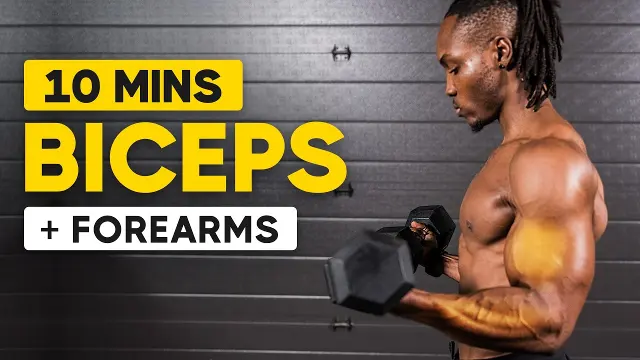
 Ten-Minute Light Dumbbell Biceps and Forearm Session
#Biceps
1 ideas
Ten-Minute Light Dumbbell Biceps and Forearm Session
Get new #Biceps ideas by email
Every Thursday: the week's best ideas, with the newest from #Biceps.
Related tags
Biceps: A Beginner's Guide to Training Your Arms
The biceps brachii is the muscle that runs along the front of your upper arm, from two points near the shoulder down to a single tendon at the elbow. That "two heads" arrangement is where the name comes from — bi, for two. It works together with the brachialis underneath it and the brachioradialis in the forearm, and together they bend the elbow and turn the palm upward. Whenever you lift a bag of shopping, pull yourself out of a chair or carry a child, you are using them.
What the biceps actually do
Most people think of the biceps as a lifting muscle, and elbow flexion is indeed their most obvious job. Less obvious is their role in turning the forearm so the palm faces up, which is why a curl with the palm turned upward feels harder than one with the palm facing in. They also assist at the shoulder, which is why a curl done with the elbows drifting forward changes the way the movement feels.
The main kinds of curl
Read more
There is no single "best" biceps exercise, only variations that shift the emphasis:
- Standard curls with a barbell or dumbbells, done standing, are the foundation.
- Hammer curls, with the palms facing each other, bring the brachialis and forearm into the work.
- Incline or preacher variations change the angle of the shoulder and make the stretched position more demanding.
- Cable and band curls keep tension on the muscle through a wider range.
- Pull-ups and rows, done with an underhand grip, train the biceps alongside the back.
What beginners should know
Start lighter than you think you need to. The biceps are a small muscle group and respond quickly to fatigue, so a weight you can control for eight to twelve smooth repetitions is plenty at first. Keep your elbows close to your sides rather than swinging them forward, and lower the weight slowly — the return phase is where a lot of the work happens. Avoid rocking your torso to get the weight up; if you need momentum, the weight is too heavy.
Two or three short sessions a week is enough for most people, with a rest day between them. Soreness in the days after is normal when you are starting out; sharp pain in the elbow or shoulder is not, and it is worth stopping and letting it settle.
Practical tips
Warm up with a few minutes of easy movement and a light set before your working weight. Keep your wrists straight and your shoulders relaxed rather than hunched. Give the biceps a full range of motion — all the way down as well as all the way up — instead of stopping short. And remember that arms grow as part of a whole-body routine: pulling movements, pressing movements and enough rest all contribute more than any single exercise.
Progress comes slowly and steadily. Add a little weight or a repetition when the current ones feel comfortable, and give it weeks rather than days before you judge the results.
#Biceps: frequently asked questions
How do I start training my biceps if I've never done it before?
Begin with a weight light enough that you can move it smoothly and still control it on the way down. Keep your elbows close to your ribs instead of letting them drift forward, and lower the weight slowly rather than letting it drop. A few short sessions each week, with a rest day in between, is plenty while you are learning the movement.
What equipment do I actually need for biceps work?
You can start with a single pair of dumbbells, or even a resistance band if space is tight. A bar is useful later for standard curls, and a pull-up bar or a sturdy table edge lets you train the biceps alongside your back with an underhand grip. None of it is essential — the movement pattern and the control matter more than the kit.
Which kind of curl should I choose?
There is no single best version; the variations simply shift which part of the arm does more of the work. A standard curl with the palms turned up is the natural starting point, hammer curls with the palms facing each other bring in the forearm, and incline or preacher positions make the stretched part of the movement harder. Cable and band curls are handy for keeping tension on the muscle throughout.
What mistakes should I watch out for?
The most common one is going too heavy and rocking the torso to swing the weight up — if you need momentum, it is too heavy. Stopping short at the bottom, hunching the shoulders, and bending the wrists back are also easy habits to pick up. Cutting the range short and rushing the lowering phase quietly robs you of much of the benefit.
How long does it take to see a difference, and how should I look after my arms between sessions?
Progress in the arms is gradual, so judge it over weeks rather than days and add a little resistance only when the current work feels comfortable. Warm up with easy movement and a light set before your working weight, and stretch out the return phase of every repetition. Mild soreness afterwards is normal when you are new to it, but sharp pain in the elbow or shoulder means stop and let it settle.
Can I get a useful biceps session in when I only have a few minutes?
Yes — a short block of light dumbbell curls mixed with hammer curls and a few wrist and forearm movements covers the main jobs the muscle does. Keep the rest between sets brief and focus on smooth, full repetitions rather than volume. It works best as a top-up to a whole-body routine that already includes pulling and pressing movements.
Videos come from YouTube and posts from Instagram; titles and summaries are our own. All rights belong to their creators.