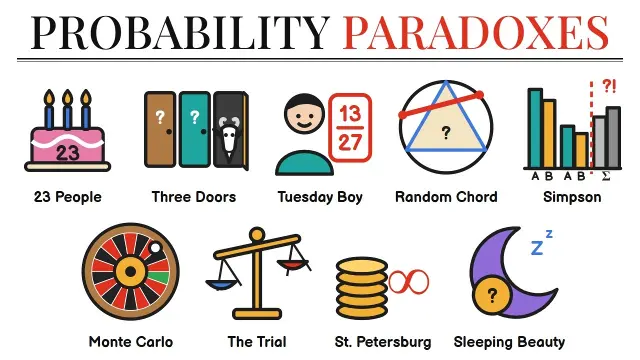
 Nine Probability Paradoxes That Fool Our Intuition, Explained
#Birthday Paradox
1 ideas
Nine Probability Paradoxes That Fool Our Intuition, Explained
Get new #Birthday Paradox ideas by email
Every Thursday: the week's best ideas, with the newest from #Birthday Paradox.
Related tags
The Birthday Paradox: Why Shared Birthdays Are Common
Ask most people how large a group needs to be before two members probably share a birthday, and the answer you get is usually somewhere in the hundreds. The actual number is 23. That gap between expectation and reality is the whole reason this little piece of probability has a name: the birthday paradox.
What the question really asks
The puzzle is not about someone sharing your birthday. It is about any two people in the group matching each other, whichever pair that turns out to be. That shift matters, because the two questions are not equally hard. Asking whether anyone in the room shares your own date is the demanding version: you are the only reference point, and everyone else has to land on one particular day. Asking whether any two people happen to coincide is far more forgiving, since every person can match every other person. Most of the confusion comes from answering the first question while thinking you were asked the second.
Why the intuition fails
Read more
When you picture a room of 23 people, you instinctively compare each one to a single reference point: yourself, or one chosen date. Twenty-three comparisons against one target is a small number, so a match feels unlikely.
But the group does not work that way. Every person can be paired with every other person, and the number of possible pairs grows much faster than the number of people. With 23 people there are 253 distinct pairs. Each pair is a small chance, roughly one in 365, but you are taking 253 of those small chances at once, and small chances add up when you multiply them by hundreds.
The easiest way to see the arithmetic is to work backwards. The first person can have any birthday. The second must avoid that one date; the third must avoid both; and so on. Multiplying those shrinking fractions gives the chance that everyone in the group is different, and that number falls away quickly. By the time you reach 23 people, it has dropped just below half. Push the group to around 70 and the chance of a shared birthday is close to certainty. Once you count 366 people, and there are only 365 dates to go round, a match is guaranteed beyond any doubt.
The assumptions worth knowing
The classic figures assume that every date is equally likely and that birthdays are independent of one another. Real calendars are slightly lumpy, with certain months producing more births than others, and that unevenness nudges the true probability a little higher rather than lower. Leap days are usually ignored, which is why the tidy guarantee arrives at 366 rather than 367. Twins are another wrinkle: if a group contains identical twins, a shared birthday is not a coincidence at all, and counting them as one makes the puzzle less interesting.
Where the same logic appears
This is not only a parlour trick. Whenever you generate short random identifiers and ask how likely a collision is, you are asking the birthday question in another costume. The same reasoning underlies how systems choose the length of hash values, why random sampling can produce surprising duplicates, and why matching fingerprints or genetic profiles in large databases raises questions that a single comparison never would. The maths is identical; only the labels change.
Trying it yourself
Shuffle a list of birthdays, or simply survey a few real groups, and the pattern shows up faster than you expect. The lesson is worth carrying around: when you are counting pairs rather than people, your intuition is quietly answering a different question than the one you asked.
Videos come from YouTube and posts from Instagram; titles and summaries are our own. All rights belong to their creators.