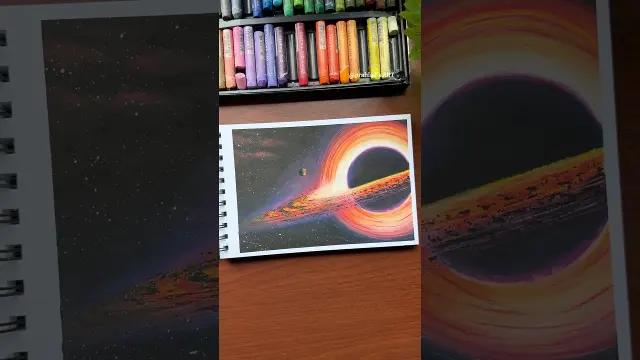
 Easy Black Hole and Cosmic Space Art with Oil Pastels
#Black Hole
1 ideas
Easy Black Hole and Cosmic Space Art with Oil Pastels
Get new #Black Hole ideas by email
Every Thursday: the week's best ideas, with the newest from #Black Hole.
Related tags
Black Holes Explained
What a black hole is
A black hole is a region of space where gravity is so strong that nothing, not even light, can escape once it gets too close. It is not a hole in the usual sense, but a very compact object formed when matter is squeezed into an extremely small space. Because light cannot leave it, a black hole itself cannot be seen directly. Instead, astronomers study the way it affects nearby stars, gas, and light.
Black holes are one of the most fascinating ideas in astronomy because they test the limits of what we know about space, time, and gravity. They are found throughout the universe, often in places where massive stars once lived or at the centers of galaxies.
How black holes form
Read more
Many black holes form when a very massive star runs out of fuel and can no longer support itself. The outer layers may be thrown outward, while the core collapses inward under its own gravity. If the remaining core is massive enough, it becomes a black hole.
There are also larger black holes at the centers of galaxies. These are called supermassive black holes. Scientists know they exist because of the strong influence they have on nearby stars and gas, even though the exact way they first formed is still studied.
Main parts and ideas
A black hole has a few important features:
- The event horizon is the boundary around the black hole. Once something crosses it, it cannot return.
- The singularity is the central point where matter is thought to be compressed extremely tightly. This is a theoretical idea, and physicists are still working to understand it fully.
- The accretion disk is a hot ring of gas and dust that can form around a black hole. Friction and gravity heat this material, making it glow brightly.
Not every black hole has a visible disk. Some are quiet and hard to detect unless they interact with nearby matter.
What black holes are used for in science
Black holes are not used as tools in everyday life, but they are very important for science. They help astronomers learn about gravity, the life cycle of stars, and the structure of galaxies. By studying them, researchers can test ideas from physics under extreme conditions that cannot be reproduced on Earth.
What beginners should know
If you are new to the topic, the most important thing is that black holes do not “suck in” everything nearby like a cosmic vacuum cleaner. Their gravity works like the gravity of any other object: if the Sun were replaced by a black hole of the same mass, planets far away would not suddenly be pulled in differently. The danger comes only when you get very close.
It also helps to remember that black holes are not empty spaces. They are objects with mass, gravity, and a powerful effect on their surroundings. Much of what we know about them comes from careful observation and mathematics, not direct visual seeing.
A simple way to think about them
A black hole is best understood as an extreme result of gravity. It shows how matter, light, and space can behave in ways that are very different from everyday experience. That is what makes black holes both challenging and endlessly interesting.
#Black Hole: frequently asked questions
How do I start learning about black holes if I'm a complete beginner?
Start with the basic idea that a black hole is an extremely compact object whose gravity is strong enough that light cannot escape it. From there, get comfortable with a few key terms — event horizon, singularity, accretion disk — because most explanations of black holes lean on them. Reading about how massive stars collapse at the end of their lives is usually the easiest entry point, since it connects the idea to something familiar.
What do I actually need to observe or study black holes?
You cannot see a black hole directly, so everything comes from indirect evidence: the motion of nearby stars, glowing gas, and light bent by gravity. That means the real tools are telescopes that look at many kinds of radiation and a lot of patient mathematical work rather than a single photograph. For a hobbyist, a basic telescope and an interest in following how astronomers interpret that indirect data is a good place to begin.
Which kind of black hole should I learn about first?
Stellar-mass black holes are the friendliest starting point, because they come from a clear story: a very massive star runs out of fuel and its core collapses. Supermassive black holes, the ones sitting at the centers of galaxies, are the next step — they are grander in scale and their formation is still an open question, which makes them interesting but messier to explain. Once those two make sense, the smaller theoretical categories are easier to place.
How do I care for the topic — meaning, how do I keep learning without getting lost?
Treat it like any science subject: revisit the fundamentals of gravity and light often, and be skeptical of dramatic claims you see online. A useful habit is to separate what is well established from what is still theoretical, since the interior of a black hole is genuinely unresolved. Keeping a notebook of questions to look up later stops the topic from feeling like an avalanche of strange facts.
What are some ideas for turning black holes into space art?
The classic look is a dark field with a glowing swirl of gas around a dark center, which maps neatly onto oil pastels — layering deep blues and purples, then adding bright streaks for the disk. You can smudge the edges of the glow to suggest light bending around the object instead of stopping sharply. Stars scattered around the edge help sell the sense of scale.
What mistakes do people usually make when first reading about black holes?
The biggest one is imagining a black hole as a cosmic vacuum cleaner that sucks in everything around it, when its gravity actually behaves like any other object's of the same mass. Another common slip is picturing it as empty space rather than as an object with real mass and a strong effect on its surroundings. Assuming we can see one directly, rather than inferring it from how it distorts nearby matter and light, is the third.
Videos come from YouTube and posts from Instagram; titles and summaries are our own. All rights belong to their creators.