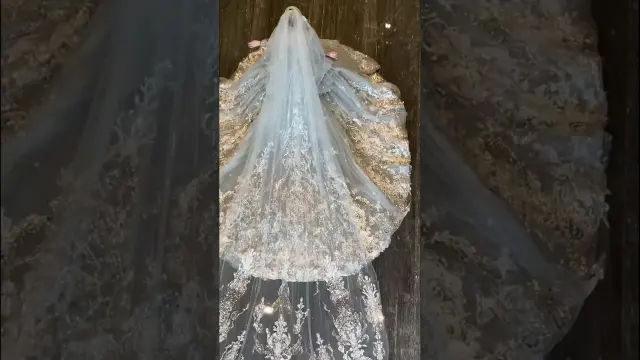
 Royal Wedding Dresses with Long Trains and Intricate Embroidery
#Bridal Embroidery
1 ideas
Royal Wedding Dresses with Long Trains and Intricate Embroidery
Get new #Bridal Embroidery ideas by email
Every Thursday: the week's best ideas, with the newest from #Bridal Embroidery.
Related tags
Bridal Embroidery: Traditions, Techniques and Ideas
Embroidery has decorated wedding clothes for as long as people have married in their best garments. Long before dresses were bought ready-made, a bride's outfit was often the most heavily worked piece of clothing she would ever own — stitched by her mother, her aunts or a village of women, and kept afterwards as an heirloom. The impulse behind bridal embroidery is simple: to mark one garment as different from every other, and to put into it the hours and care that a celebratory occasion deserves.
A craft that travels
Nearly every textile tradition has a wedding version. In South Asia, metallic thread and sequins are worked densely over silk and velvet. In parts of Eastern Europe and the Mediterranean, white-on-white stitching covers sleeves and cuffs. Chinese bridal costume has historically used auspicious motifs in red and gold, while Palestinian and other Levantine traditions pass down regional stitch patterns that identify a place and a family. What these share is a belief that decoration carries meaning, and that certain motifs — vines, flowers, paired birds, knots — speak of continuity and good fortune.
The main techniques
Read more
Hand embroidery covers a wide family of methods: surface stitches such as satin and stem stitch for drawing lines and filling shapes; whitework, which relies on texture and shadow rather than colour; goldwork, where metal threads are couched onto the surface for a raised, reflective finish; beadwork and pearl work for sparkle; and appliqué, in which a cut motif is stitched onto the gown. Machine embroidery can imitate many of these and is far quicker and cheaper, so much of what you see on the high street is machine-worked. Both are legitimate; they simply answer different questions about time and cost.
Where it goes
Think of embroidery as a way of guiding the eye. A bodice, a shoulder, a cuff or the edge of a train will draw attention to the parts of a silhouette you want seen, while a scattered motif over tulle feels lighter and more modern. Veils are a favourite canvas because the embroidery reads as a soft haze against the face. Many brides add initials, a date or a small personal symbol somewhere discreet — a private detail rather than a public one.
Practical advice
If you are commissioning work, ask to see the embroiderer's own samples rather than photographs alone, and discuss thread colours in daylight against your fabric. Hand work takes weeks or months, so begin early and allow time for fittings. If you are stitching it yourself, practise on a scrap of the same fabric first, keep your tension even, and use a hoop to stop the cloth puckering. And when the day is over, have the piece cleaned and stored flat in acid-free tissue, away from sunlight — embroidery is delicate, and it is also the part of the dress most likely to be kept for the next generation.
#Bridal Embroidery: frequently asked questions
How do I start learning bridal embroidery if I've never embroidered before?
Begin with the foundational surface stitches — satin, stem and back stitch — on ordinary cloth until your tension is steady, then move on to the technique that matches the look you want, whether that is whitework, goldwork or beadwork. Practise on a scrap of fabric as close as possible to your actual gown material, because silk, velvet and tulle each behave differently under the needle. Working through a small sampler before you touch the real garment is the surest way to build confidence.
What do I need to begin a bridal embroidery project?
You need an embroidery hoop to hold the cloth taut and prevent puckering, a range of fine needles, threads suited to your fabric, small sharp scissors and a marking tool that lifts or washes out. Add a scrap of the same fabric for practice, and if you plan beadwork or metal threads, a suitable needle and a way to couch the heavier elements down. Daylight is worth arranging too, since thread colours and metallic sheens look quite different under a lamp.
Should I choose hand embroidery or machine embroidery for a wedding dress?
Neither is inherently better — they answer different questions about time, budget and the feel of the finished piece. Hand work gives depth and irregularity that reads as precious, but it takes weeks or months and must be planned well ahead of fittings. Machine work is quicker and more affordable and can reproduce many effects convincingly, so it suits larger areas or tighter timelines, though it usually looks flatter up close.
Where should the embroidery go on a wedding outfit?
Treat it as a way of guiding the eye: a bodice, shoulder, cuff or the edge of a train pulls attention to the parts of the silhouette you want noticed, while scattered motifs over tulle read lighter and more contemporary. Veils are a favourite because the stitching appears as a soft haze against the face. Many brides also tuck initials, a date or a small personal symbol somewhere discreet, as a private detail rather than a public one.
What mistakes do people make with bridal embroidery?
The common ones are starting late, skipping a practice piece on the real fabric, and letting tension vary so the cloth puckers or the surface pulls. Choosing thread colours under artificial light, or from photographs rather than the embroiderer's own samples, is another frequent regret. If you are commissioning the work, ask to see finished samples in person and look at the threads against your fabric in daylight before anything is stitched.
How should embroidered wedding pieces be cared for afterwards?
Have the piece professionally cleaned once the occasion is over, then store it flat rather than hanging, wrapped in acid-free tissue and kept away from sunlight and damp. Direct light fades threads and metalwork tarnishes, while folding along the same line for years weakens both cloth and stitching. Handled this way, embroidery is the part of the dress most likely to survive as an heirloom for the next generation.
Videos come from YouTube and posts from Instagram; titles and summaries are our own. All rights belong to their creators.