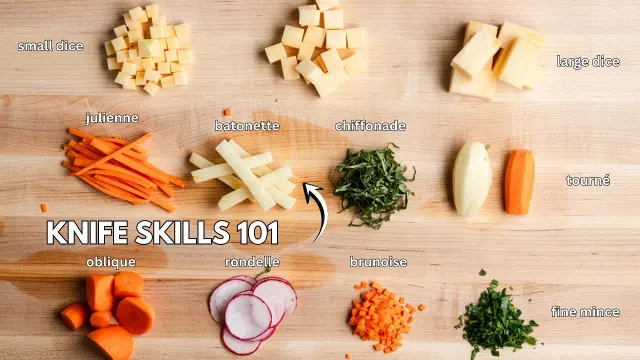
 Ten Professional Knife Cuts Taught in Culinary School
#Brunoise
1 ideas
Ten Professional Knife Cuts Taught in Culinary School
Get new #Brunoise ideas by email
Every Thursday: the week's best ideas, with the newest from #Brunoise.
Related tags
Brunoise: The Fine Art of the Tiny Dice
Brunoise is one of the fundamental knife cuts of Western professional cooking, and one of the smallest. The word comes from French, where it describes something cut into very fine pieces, and it names a cube measuring roughly one to two millimetres on each side — neat enough to sit on a spoon without crowding, small enough to disappear into a sauce while still leaving a trace of texture.
It belongs to a family of cuts that French kitchens codified over generations as a shared vocabulary. Alongside julienne (matchsticks), chiffonade (fine ribbons) and the larger paysanne and macedoine, brunoise gave cooks a way to describe consistency precisely, so that a dish looked and cooked the same whoever prepared it. A brunoise is, in effect, the smallest dice in that system.
How it is made
The cut is built in stages, never attempted in one pass. First the vegetable is trimmed into flat-sided blocks. Those blocks are sliced into thin even planks, the planks into thin even sticks, and only then are the sticks turned and cut crosswise into cubes. Each stage depends on the one before it: uneven planks produce uneven sticks, and no amount of care at the end will correct them.
Read more
The practical requirements are a sharp, straight-edged knife, a stable cutting board, and a vegetable that will not slide. Flat surfaces are everything — a rounded carrot or onion must first be given a flat side to rest on. Many cooks square off the vegetable before starting, setting the trimmings aside for stock or soup rather than wasting them.
What it is used for
Because the pieces are so small, brunoise cooks almost instantly and blends into whatever surrounds it. It is used where a fine, smooth result matters: in consommés and clear broths, in sauces and stuffings, in duxelles, in the classic garnish for soups, and in dishes where the vegetable should contribute flavour and colour rather than bulk. Carrots, celery, leeks, onions, turnips and peppers are the usual candidates; firmer vegetables hold the shape most reliably.
The same logic transfers outside French cooking. A fine dice appears in salsas, in stuffings, in dumpling fillings and in salads where a small, uniform texture is wanted.
What beginners should know
Expect it to take time. Brunoise is one of the slower cuts in the repertoire, and speed comes only after the geometry is reliable. Practise on inexpensive vegetables such as carrots and onions rather than on anything costly or delicate.
Work with small quantities, keep the knife sharp, and resist the urge to press down; the blade should slice, not crush. A common early mistake is cutting pieces that are too large to be a true brunoise and simply calling them one — measure a few against a ruler or a known reference until your eye adjusts.
Above all, accept that uniformity matters more than smallness. A slightly larger but even brunoise will cook and look better than a fine one that is irregular.
#Brunoise: frequently asked questions
How do I start learning brunoise?
Begin by practising the cut in stages rather than trying to produce cubes straight away: trim the vegetable into flat-sided blocks, slice those into even planks, then into sticks, and finally cut the sticks crosswise. Speed will come on its own once the geometry is consistent, so focus on making each stage even before moving to the next. Inexpensive vegetables are ideal for repeated practice.
What equipment do I actually need for a brunoise?
The essentials are a sharp, straight-edged knife and a stable cutting board that will not shift under pressure. The knife should slice cleanly rather than crush, so a dull blade is the main thing to avoid. Beyond that, a vegetable with a flat side to rest on does the rest of the work.
Which vegetables work best for this cut?
Carrots, celery, leeks, onions, turnips and peppers are the usual choices, with the firmer ones holding their shape most reliably. Rounded vegetables need a flat side cut first so they stop rolling, and squaring off the vegetable before starting makes the rest of the process far easier. Keep the trimmings for stock or soup instead of discarding them.
What is brunoise used for?
It suits dishes where a fine, smooth texture matters: clear broths and consommés, sauces, stuffings, duxelles and the classic garnish for soups. Because the pieces cook almost instantly, the vegetable adds flavour and colour rather than bulk. The same fine dice also works in salsas, dumpling fillings and salads.
What mistakes do beginners make most often?
The most common is cutting pieces too large to be a true brunoise and simply calling them one, so check a few against a ruler until your eye adjusts. Pressing down on the knife instead of letting it slice is another frequent habit, as is working with too much at once. Uniformity matters more than smallness — a slightly larger but even cut will cook and look better than an irregular fine one.
Does the cut transfer beyond French cooking?
Yes. The same staged approach to a fine, even dice appears in salsas, salads, stuffings and dumpling fillings, wherever a small uniform texture is wanted. The technique is really a way of thinking about consistency, so it adapts to whatever cuisine you are cooking.
Videos come from YouTube and posts from Instagram; titles and summaries are our own. All rights belong to their creators.