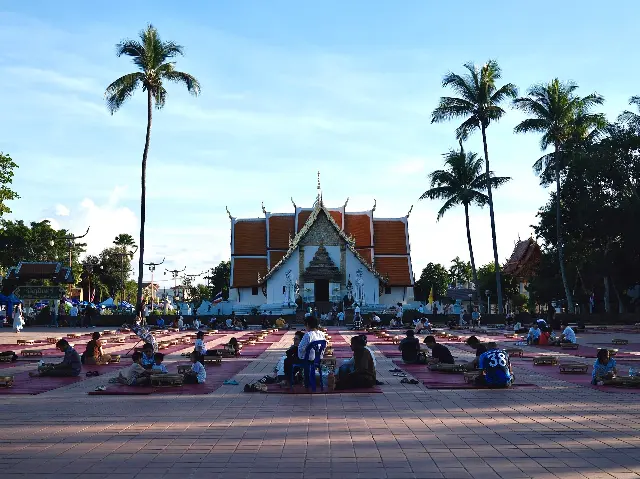
 Wat Phumin and Lanna temple architecture in northern Thailand
#Buddhism
1 ideas
Wat Phumin and Lanna temple architecture in northern Thailand
Get new #Buddhism ideas by email
Every Thursday: the week's best ideas, with the newest from #Buddhism.
Related tags
Buddhism: Teachings, Practice and Art
Buddhism is a tradition of teaching and practice that began in northern India roughly two and a half thousand years ago, when Siddhartha Gautama, a prince who left a sheltered life to seek an answer to suffering, is said to have awakened under a tree and became known as the Buddha — the awakened one. It spread from India across Asia along trade routes and pilgrimage paths, taking root in Sri Lanka, Southeast Asia, Tibet, China, Korea and Japan, and in each place it took on the colour of the local culture.
What it teaches
At the centre are the Four Noble Truths: that dissatisfaction and unease are part of life; that they arise from craving and clinging; that they can cease; and that there is a path leading to that cessation — the Noble Eightfold Path of right understanding, intention, speech, action, livelihood, effort, mindfulness and concentration. These are not commandments handed down from above but practical instructions to be tested. The tradition also holds the Three Jewels: the Buddha, the teaching, and the community of practitioners, which together form the refuge many people begin with.
Buddhism is not centred on belief in a creator god. It emphasises impermanence — that everything conditioned keeps changing — and the idea that actions have consequences, so the way you think, speak and act matters more than what you declare.
Read more
The main branches
Theravada, the tradition of the Pali canon, is rooted in Sri Lanka and Southeast Asia, with a strong emphasis on monastic discipline and insight meditation. Mahayana, which developed later and spread through China, Korea, Japan and Vietnam, stresses compassion and the ideal of the bodhisattva, who stays in the world to help others; Zen and Pure Land are among its best-known forms. Vajrayana, associated with Tibet and the Himalayan region, makes use of ritual, mantra and visualisation alongside study and meditation.
Practice
There is no single way, but most traditions combine ethical conduct, meditation and learning. Sitting meditation may follow the breath, watch thoughts without chasing them, or cultivate kindness toward oneself and others. Walking meditation, chanting, offerings, and periods of quiet retreat are common. Lay people may keep a few precepts, visit a temple on festival days, or maintain a simple home altar with a Buddha image, candles and flowers.
For beginners
Take it slowly. Reading and talking with experienced practitioners helps, as does sitting for a short time each day rather than waiting for a long session that never comes. Try more than one teacher or style before settling. Much of this is gentle attention rather than achievement, so being patient and a little kind with your own wandering mind is not a setback; it is the practice.
#Buddhism: frequently asked questions
How do I start practising Buddhism if I know almost nothing about it?
Begin with the basics the tradition itself treats as practical: read a little about the Four Noble Truths and the Eightfold Path, then try sitting quietly for a short stretch each day rather than waiting for a long session that never comes. Visiting a local temple or group and talking with people who have practised for a while will answer far more than reading alone. Think of it as gentle attention rather than achievement — a wandering mind is not a failure, it is the thing you are learning to notice.
Do I need a shrine or special equipment at home?
No. A simple corner with an image, a candle and fresh flowers is enough for most lay practitioners, and many people simply sit on a cushion in an ordinary room. What matters is a stable, quiet spot you return to, not the objects themselves. Offerings such as flowers are traditionally there to remind you of impermanence, since they fade.
Which branch or style should I choose?
The broad families differ mainly in emphasis: one leans on monastic discipline and insight meditation, another on compassion and the bodhisattva ideal, and another on ritual, mantra and visualisation alongside study. Because the essential framework of ethics, meditation and learning runs through all of them, the best test is not doctrine but fit. Try more than one teacher or style before settling, and let your own experience decide.
Is Buddhism a religion or a philosophy — and do I have to believe in a god?
It is both, and it is not centred on belief in a creator god. The teachings are presented as instructions to be tested rather than commandments handed down from above, so doubt and enquiry are part of the method rather than obstacles to it. What the tradition does stress is that actions have consequences, which makes how you think, speak and act more important than what you declare.
What are the most common mistakes beginners make?
Expecting quick results, sitting too long too soon, and treating a busy mind as proof that you are doing it wrong are the usual traps. Another is jumping between teachers and techniques so often that nothing has time to settle. Patience with your own wandering attention is not a setback — it is the practice.
Videos come from YouTube and posts from Instagram; titles and summaries are our own. All rights belong to their creators.