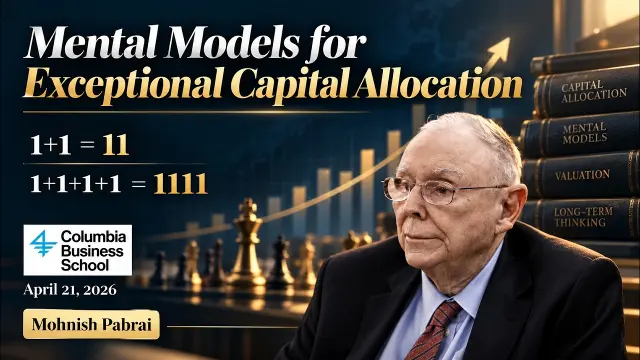
 Mohnish Pabrai on Mental Models for Exceptional Capital Allocation
#Capital Allocation
1 ideas
Mohnish Pabrai on Mental Models for Exceptional Capital Allocation
Get new #Capital Allocation ideas by email
Every Thursday: the week's best ideas, with the newest from #Capital Allocation.
Related tags
Capital Allocation: How Businesses Decide Where Money Goes
Capital allocation is the discipline of deciding where a company's money should go. Every business generates cash, borrows it, or raises it from owners, and someone has to choose what happens next. That choice — reinvest, buy something, pay down debt, return it to shareholders, or simply let it sit — is capital allocation, and over long periods it shapes what a company becomes far more than most day-to-day decisions do.
Why it matters
A business can be excellent at making its product and still disappoint its owners if the cash it produces is repeatedly spent on poor uses. The reverse is also true: a modest operation run by someone who understands where returns come from can compound steadily. Capital allocation is the bridge between operating a business and owning one, which is why investors pay close attention to it even though it rarely appears on an income statement.
The main levers
Read more
Most capital allocation decisions come down to a handful of options, and they compete with each other for the same pool of money.
- Reinvest in the existing business: new capacity, equipment, marketing, research, or hiring. This is usually the most natural choice, and the question is whether each pound, dollar or euro put back earns a decent return.
- Acquire another company: buying growth or capability outright. Acquisitions are the most common way value gets destroyed, largely because buyers overpay or misjudge what they are integrating.
- Repay debt: reduces risk and interest costs, and is often the quietest form of value creation.
- Pay dividends: hands cash to owners directly, useful when the business has more money than profitable uses for it.
- Buy back shares: reduces the number of shares outstanding, which raises each remaining owner's claim on future earnings — but only if the shares are bought at a sensible price.
What good allocation looks like
Good allocators are consistent rather than clever. They compare every use of cash against the same yardstick — the return they expect — and they are honest when the answer is "we have nothing better to do with this than return it." They resist the temptation to keep expanding simply because expansion feels like progress, and they treat the share price as a factor in buyback decisions rather than a signal of success.
A useful habit is to ask, for any large outlay, what the expected return is, how confident anyone can reasonably be, and what happens if it goes wrong. Vague answers are themselves information.
For beginners
Start by learning to read a cash flow statement before an income statement; allocation is about cash, not accounting profit. Then look at a company's history of big decisions and ask whether the money spent produced more than it cost. You do not need a finance degree to notice a pattern of expensive acquisitions followed by write-downs, or of steady reinvestment at high returns.
Finally, remember that doing nothing is a decision too. Cash held indefinitely is a choice with its own cost, and the discipline of capital allocation is largely the discipline of choosing deliberately.
#Capital Allocation: frequently asked questions
What does capital allocation actually mean in plain terms?
It is the practice of deciding where the cash a business generates, borrows or raises should go next. Every option — putting money back into operations, buying another company, paying down debt, paying owners, repurchasing shares, or holding the cash — draws from the same pool, so the choices compete rather than stand alone. Over time these decisions do more to determine what a company becomes than most of its everyday operating choices.
How should someone new to the subject get started?
Begin with the cash flow statement rather than the income statement, because allocation is about real cash moving rather than reported profit. Then trace a company's large past decisions and ask whether what was spent produced more than it cost. You do not need a finance background for this — a repeated pattern of costly purchases followed by write-downs, or of steady reinvestment that pays off, is visible to any careful reader.
How does a company decide which use of cash comes first?
The sound approach is to hold every option to the same yardstick: the return expected from it, weighed against how confident anyone can reasonably be and what happens if it disappoints. Options that clear that bar get funded, and the rest of the cash goes back to owners or toward reducing risk. Vague answers about expected returns are themselves a meaningful signal.
What are the most common mistakes in allocating capital?
The biggest is continuing to expand simply because expansion feels like progress, without checking what the money earns. Overpaying for acquisitions, or misjudging what has to be integrated afterward, is another frequent source of destroyed value. Buying back shares at a high price rather than treating the share price as one input among several is a third.
Is holding on to cash a decision, or just the absence of one?
It is a decision with its own cost, since cash parked indefinitely earns little while other uses go unfunded. Keeping a buffer can be sensible when genuine opportunities or risks are near, but holding without a reason is usually hesitation wearing the label of patience. The discipline of capital allocation is largely the discipline of choosing deliberately.
Why do investors pay so much attention to this when it rarely shows up on financial statements?
Because it is the bridge between running a business and owning one — a company can be excellent at making its product and still leave its owners worse off if the cash it produces is repeatedly spent badly. The reverse also holds: a modest operation guided by someone who understands where returns come from can compound steadily. That gap between operating skill and ownership outcomes is what investors are trying to read.
Videos come from YouTube and posts from Instagram; titles and summaries are our own. All rights belong to their creators.