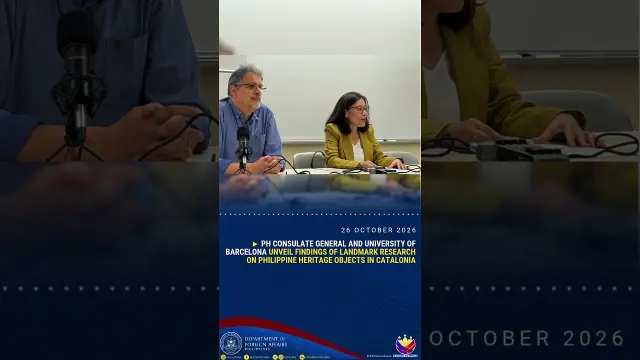
 796 Philippine Objects Documented in Catalonia's Museums
#Catalonia
1 ideas
796 Philippine Objects Documented in Catalonia's Museums
Get new #Catalonia ideas by email
Every Thursday: the week's best ideas, with the newest from #Catalonia.
Related tags
Catalonia: Culture, Landscape and Traditions
Catalonia is a region in the northeast of Spain, bordered by France to the north, the Mediterranean to the east and the Pyrenees along its northern edge. Barcelona is its capital and largest city, but the region stretches far beyond it, from coastal towns and fishing harbours to inland plains, vineyards and mountain valleys. It has its own language, its own parliament and a strong sense of cultural identity, and much of what makes it distinctive is visible in everyday life rather than in monuments alone.
Language and identity
Catalan is spoken alongside Spanish and is the region's own language, with a long literary history going back to the medieval period. Place names, street signs, menus and radio are frequently in Catalan, and visitors who learn a few words — a greeting, a thank you, a request for the bill — tend to find them warmly received. The Catalan flag, the senyera, with its four red stripes on gold, appears on balconies and public buildings, and the traditional dance, the sardana, is still performed in town squares on weekends, with people joining the circle as they arrive.
Landscape and history
Read more
The region's geography is unusually varied for its size. The Costa Brava and Costa Daurada run along the coast; inland, the terrain rises through pine woods and farmland toward the Pyrenees, where Romanesque churches with slender bell towers stand in small villages. Further south, the Ebro delta forms wetlands important for birds. Roman remains at Tarragona and the medieval old quarters of Girona and Barcelona layer centuries on top of one another, and the region's textile and industrial past shaped many of its towns.
Festivals and traditions
Catalan festes are loud, communal and rooted in local custom. Castells — human towers built by groups called colles — are the most striking example, with participants climbing onto one another's shoulders to raise a small child to the top. Fire runs, or correfocs, fill streets with drumming and sparks, while giant figures and big-headed puppets parade at many town festivals. On Sant Jordi's Day, in April, streets fill with book and rose stalls, and at Christmas the nativity scene traditionally includes the caganer, a small cheeky figure tucked into the corner.
Food and crafts
Catalan cooking is built on olive oil, tomatoes, garlic, bread and fish. Pa amb tomàquet — bread rubbed with ripe tomato — appears at nearly every meal, and calçots, grilled spring onions eaten with a nut sauce, are the centre of lively outdoor gatherings in winter. Markets such as the great covered halls in the cities sell cured sausages, cheeses, honey and dried fruit. Craft traditions include ceramics, espadrilles woven from rope and canvas, glass and basketwork, and the region's long-standing strength in design and printing.
Practical notes
If you visit, plan around meals: lunch is the main meal and is eaten late, and many small shops close in the early afternoon. Learn a few Catalan words, ask before photographing people at festivals, and remember that summer heat inland is strong — carry water and walk early. Whether you come for the coast, the mountains, the food or the festivals, the region rewards slower travel and curiosity about the local language.
#Catalonia: frequently asked questions
What should I know before a first visit to Catalonia?
Expect the daily rhythm to run later than in many other places: lunch is the big meal of the day, dinner comes late, and smaller shops often shut for a stretch in the early afternoon. Carry water and start walks early if you are heading inland in summer, since the heat there is intense.
Should I base myself on the coast, in the mountains, or in a city?
It depends what you want the trip to be — the coastline suits swimming and harbour towns, the inland valleys and foothills suit walking and quiet Romanesque villages, and the cities suit markets, old quarters and design. Many people combine two of these rather than trying to cover everything from one base.
How do I take part in the local festivals without getting it wrong?
Festivals here are communal rather than staged, so the best approach is to watch first, follow what locals do, and join in only where it is clearly open to everyone. Always ask before photographing people, especially during human towers or fire runs, and keep well back from sparks and crowds with children.
What food and crafts are worth seeking out?
Look for the everyday things rather than the showpieces: bread with tomato and olive oil, grilled spring onions eaten outdoors with a nut sauce, and market stalls selling cured sausage, cheese and honey. For crafts, ceramics, rope-soled shoes, glass and basketwork are the traditional strengths, and the region's design and printing heritage shows up in its stationery and paper goods.
Is it worth learning a few words of Catalan?
Yes — Catalan is the region's own language rather than a dialect of Spanish, and it appears on signs, menus and radio throughout the day. A greeting, a thank you or a request for the bill is usually received warmly, and it signals that you see the place on its own terms.
What mistakes do visitors most often make?
The common ones are treating the region as a single city break, scheduling meals at the wrong hours, and rushing between sights instead of allowing time for markets, squares and long lunches. Assuming Spanish alone will do everywhere, or photographing people mid-festival without asking, tends to land badly.
Videos come from YouTube and posts from Instagram; titles and summaries are our own. All rights belong to their creators.