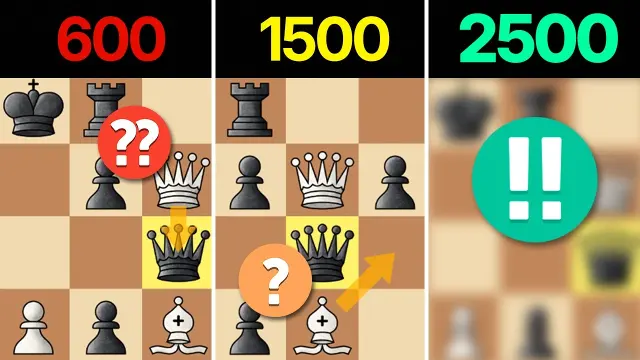
 How Beginner, Intermediate and Grandmaster Players Think in Chess
#Chess Training
1 ideas
How Beginner, Intermediate and Grandmaster Players Think in Chess
Get new #Chess Training ideas by email
Every Thursday: the week's best ideas, with the newest from #Chess Training.
Related tags
Chess Training: How to Improve Your Game Steadily
Chess training is the deliberate work a player does away from casual games in order to play better. The game itself is centuries old, spreading from India and Persia through the Arab world into Europe, and so is the habit of studying it: players have long copied out games, worked through combinations and tested themselves against rivals. What has changed over time is mainly how easily material can be shared. The principles of improvement have stayed remarkably stable.
Playing is not the same as training
A player can spend years moving pieces without getting much stronger, because a game only shows what you already do. Training means isolating a weakness and working on it on purpose. It helps to keep these separate: play to test yourself, study to change yourself. Beginners in particular get a great deal from a small, regular study habit, even twenty minutes at a time.
The core areas of study
Read more
Most training falls into a few buckets, and a balanced routine touches all of them.
- Tactics: puzzles and combinations that train pattern recognition. The single most efficient use of a beginner's study time.
- Endgames: basic checkmates, king and pawn play, and the small set of positions that decide real games.
- Openings: enough theory to reach a playable middle game with a plan, not a memorised catalogue of moves.
- Strategy: pawn structure, piece activity, weak squares and the question of what a position actually wants.
- Calculation: the discipline of looking ahead a few moves and checking what the opponent can do back.
Analysing your own games
This is where most improvement hides. After a serious game, go back through it without an engine first, note the moments you were unsure, and only then check what you missed. Keep a short written record of recurring mistakes. Patterns repeat, and a list of your own tells is worth more than any general advice.
How to structure a session
A workable routine mixes a few minutes of puzzles to warm up, some focused study of one topic, and a little time on your openings. Vary the difficulty: puzzles slightly too hard teach more than ones you always solve. Study grandmaster games with a board in front of you, guessing the next move and comparing your choice with what was played, and read the annotations rather than just the moves.
Practical tips
Play slow games far more often than fast ones; speed hides thinking errors instead of correcting them. Write down your thinking in a notebook when a position puzzles you. Revisit old puzzles after a few weeks, since spaced repetition is what makes a pattern stick. Sleep on a difficult idea rather than grinding at it for hours. And if you can, play people slightly stronger than you and ask them afterwards what they saw.
The most useful habit of all is patience. Improvement in chess arrives in uneven steps, with long plateaus that often end just before a jump. Keep the routine modest and regular, and it will carry you further than bursts of enthusiasm ever do.
#Chess Training: frequently asked questions
How should a complete beginner start training chess?
Begin with short, regular study sessions rather than long bursts, and keep playing and studying as two separate activities — games show you what you already do, study changes it. Simple tactics puzzles are the most efficient use of a beginner's time, and slow games give you real positions to learn from. Patience matters more than intensity, since progress arrives in uneven steps.
What do I actually need to train chess at home?
Very little: a board or a chess app, a supply of puzzles, and a notebook for writing down what confuses you. A physical board is genuinely useful when you study other people's games, because guessing the next move and comparing it with what was played teaches more than reading moves passively. No special equipment or expensive course is required, since the principles of improvement have stayed stable for a very long time.
Should I study openings or tactics first?
Tactics come first, because pattern recognition decides most games at the improver level and pays off immediately. Openings only need enough theory to reach a playable middle game with a plan — memorising long move sequences without understanding the resulting positions is effort spent in the wrong place. Once your calculation and endgame basics are more solid, opening study becomes far more useful.
How do I analyse my own games properly?
Go back through a serious game on your own first, without an engine, and mark the moments where you felt unsure; only then check what you missed. Keep a short written list of the mistakes that keep recurring, because your own patterns repeat and that list is worth more than generic advice. This step is where most real improvement hides.
What are the most common training mistakes?
Playing fast games far more often than slow ones is the big one, since speed hides thinking errors instead of correcting them. Others are memorising openings without understanding them, only solving puzzles that are already easy, and grinding at one difficult idea for hours instead of sleeping on it and returning later. Revisiting old puzzles after a while matters too, because that is what makes a pattern stick.
How do I know whether my training is actually working?
Improvement in chess comes in uneven steps, with long plateaus that often end just before a visible jump, so a flat stretch is not a sign of failure. Watch for smaller signals instead: fewer repeats of your recorded mistakes, more confidence in positions that used to puzzle you, and finding the right move in puzzles you once needed help with. A modest routine kept regularly will carry you further than bursts of enthusiasm.
Videos come from YouTube and posts from Instagram; titles and summaries are our own. All rights belong to their creators.