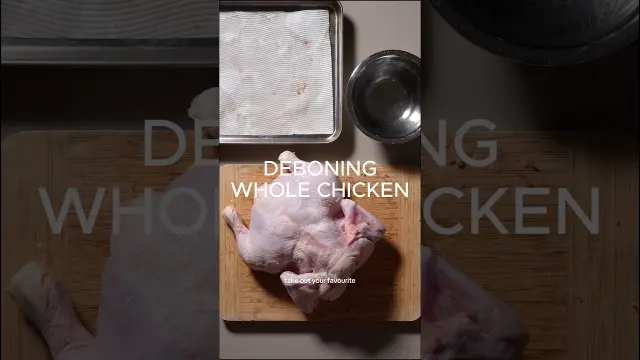
 A Short Kitchen Hack for Deboning a Whole Chicken
#Chicken Deboning
1 ideas
A Short Kitchen Hack for Deboning a Whole Chicken
Get new #Chicken Deboning ideas by email
Every Thursday: the week's best ideas, with the newest from #Chicken Deboning.
Related tags
Chicken Deboning: A Beginner's Guide to Taking Apart a Bird
Deboning a chicken means separating the meat from the bones before cooking rather than after. It is one of the oldest practical skills in a home kitchen, and it turns a single whole bird into cutlets, thighs for stuffing, meat for stir-fries and a carcass that still has plenty of flavour left in it. Many cooks learn it not for elegance but for economy: a whole chicken usually costs less per pound than the same amount of pre-cut pieces, and doing the cutting yourself means nothing is wasted.
Why bother
Boned chicken cooks faster and more evenly, because there is no bone to slow the heat in the centre. Flat pieces brown better in a pan. Meat that has been freed from the frame can be rolled, stuffed, poached or grilled without the awkwardness of carving around joints. And the bones you remove are not rubbish: simmered with water, an onion and a carrot, they become stock, which is the base of soups, risottos and sauces.
The tools
Read more
You do not need much. A thin, flexible boning knife is the classic choice, though a small sharp paring knife works fine on a bird. Kitchen shears are helpful for cutting through the ribs and backbone, and a sturdy cutting board that will not slide is essential. Keep a bowl nearby for bones and another for the meat. Sharpening matters more than the price of the knife: a dull blade slips and tears where a sharp one glides along the bone.
What comes apart first
Most people work in a sensible order. Remove the legs first by pulling them away from the body and cutting through the skin and the soft tissue at the hip, then finding the joint and cutting through it rather than forcing it. Next take the wings, again cutting at the joint. Then separate the breast meat from the breastbone, sliding the knife flat against the ribs and letting the blade follow the bone rather than sawing at the meat. Finally, if you want a flat bird for roasting, cut out the backbone.
Tips for beginners
Chill the chicken before you start. Cold meat is firmer and easier to control than meat at room temperature. Follow the seams: a chicken is built in sections, and there is usually a soft line of connective tissue that shows you where one piece ends and the next begins. Let the knife do the work and resist pulling with your hands. Work slowly the first few times; speed comes with repetition, and a neat job is worth more than a fast one.
Keeping it safe
Raw chicken should stay cold until the moment you begin, and everything it touches, board, knife, hands and counter, needs washing with hot soapy water afterwards. Keep raw meat away from anything you will eat uncooked. If you are not cooking the deboned meat straight away, refrigerate it promptly and use it within a day or two, or freeze it in portions.
#Chicken Deboning: frequently asked questions
How do I start deboning a chicken if I've never done it before?
Begin with a whole bird that has been kept cold, since chilled meat holds its shape and is far less slippery under the blade. Work in sections rather than trying to free everything at once, starting at the legs and wings and finishing at the breast and backbone, and cut through the joints instead of forcing them apart. Expect your first attempts to look ragged; neatness arrives with repetition, so give yourself the time.
What equipment do I actually need for deboning chicken?
A thin, sharp knife is the heart of the job, with a small paring knife doing perfectly well if you don't own a dedicated boning blade. Add kitchen shears for the ribs and backbone, a board that grips the counter, and a couple of bowls so bones and meat stay separate as you go. A blade that has been honed recently matters far more than an expensive one, because a dull edge skids and shreds.
Should I learn on a whole chicken or buy pieces to practise with?
A whole bird is the better teacher, because you see how the parts connect and you end up with both meat and bones for stock. Buying pre-cut pieces skips exactly the part you're trying to learn, and it usually costs more for less. If a whole chicken feels intimidating, work on the legs and thighs first and leave the breast for another session.
What are the most common mistakes people make when deboning?
The classic one is a dull knife pushed through the meat instead of a sharp one guided along the bone, which tears rather than separates. Another is hauling on the chicken with your hands while the blade stays still, which bruises the meat and loses the natural seams. Keep everything cold as you work, and don't rush the last piece just because the earlier ones went well.
How do I look after deboned chicken and the bones I've removed?
Refrigerate the meat promptly if you aren't cooking it right away, or portion and freeze it so nothing is wasted, and wash the board, knife, hands and counter in hot soapy water as soon as you're done. Keep the raw meat away from anything you'll eat uncooked. The bones are worth keeping too: simmered with water and a few vegetables they turn into stock for soups and sauces.
What can I make with deboned chicken for a special occasion?
Freed from the frame, the meat can be rolled around a stuffing, poached gently, or grilled flat so it browns evenly instead of cooking unevenly around a bone. A rolled and stuffed breast sliced at the table makes a generous centrepiece without the awkwardness of carving around joints. Because boned meat cooks quickly, it suits a dinner where you want to spend the time with your guests rather than at the stove.
Videos come from YouTube and posts from Instagram; titles and summaries are our own. All rights belong to their creators.