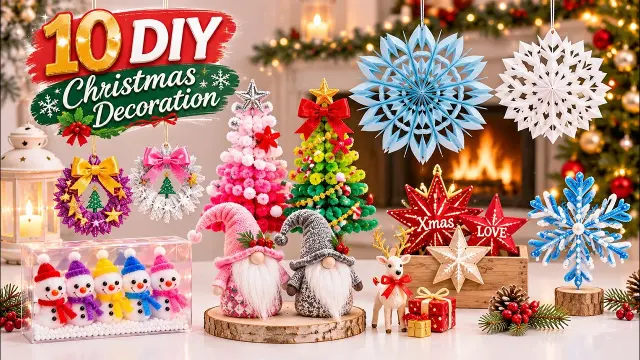
 Ten Easy DIY Christmas Decoration Ideas for the Holidays
#Christmas Decorations
1 ideas
Ten Easy DIY Christmas Decoration Ideas for the Holidays
Get new #Christmas Decorations ideas by email
Every Thursday: the week's best ideas, with the newest from #Christmas Decorations.
Related tags
Christmas Decorations: A Beginner's Guide to Festive Style
Christmas decorations are the objects and arrangements people use to mark the festive season at home, in shops and in public spaces. Their roots reach back through many European winter traditions, where evergreen branches were brought indoors to symbolise life in the darkest part of the year, and where candles and fires marked the return of light. Over time these customs mingled with religious celebration, regional folk art and the simple human pleasure of making a space feel special, and the result is the rich, varied decorating culture we know today.
The main elements
Most Christmas decorating revolves around a handful of familiar pieces. The tree is the centrepiece in many homes, whether a cut fir, a potted living tree or a small tabletop version. Wreaths and garlands bring greenery to doors, mantels and stair rails. Lights, hung indoors and out, carry the season's warmth after dark. Then come the smaller layers: ornaments, stockings, table linens, candles, nativity scenes and figures, and the door or window arrangements that greet visitors.
Colours and styles
Read more
Red and green is the most recognisable pairing, but it is far from the only one. A white and silver scheme feels quiet and wintry; gold and deep jewel tones feel rich and traditional; natural linen, wood and dried fruit suit a rustic look; and a restrained palette of one or two colours reads as modern and calm. Scandinavian-inspired decorating tends toward straw stars, wooden hearts and plenty of white light. Choose one direction and repeat it, rather than mixing every style you like.
Getting started
Begin with the room you use most and pick a single focal point — usually the tree or the fireplace — then build outward. Light strands look best layered rather than stretched in a single line, and a good rule is to add more lights than you think you need. When decorating a tree, hang ornaments in clusters and vary the size, placing the largest pieces low and deep in the branches to give depth. Step back often; distance reveals gaps that close-up work hides.
Practical tips
Real greenery lasts longer if you keep it cool and away from radiators, and if you trim the stems and stand them in water. Check that any older lights and cables are undamaged before use, keep them away from real candles and never overload sockets. If small children or pets share the home, keep fragile ornaments and small loose pieces high up, and prefer battery lights or low-heat bulbs on lower branches.
Making it last
Storage quietly decides how much you enjoy decorating next year. Wrap delicate ornaments in paper, coil lights loosely around a card, and label boxes by room or by type. Keep a note of what you used and what you ran short of. And remember that decoration is a form of storytelling: a mismatched set of ornaments collected over the years, a child's homemade star, a piece inherited from a grandparent. Those things carry more warmth than any perfectly coordinated scheme, so leave room for them.
#Christmas Decorations: frequently asked questions
How do I start decorating for Christmas without feeling overwhelmed?
Start with the room you use most and choose a single focal point, such as the tree or the fireplace, then build outward from there. Working in one area at a time keeps the process manageable, and stepping back now and then shows you where the arrangement still needs filling in.
What do I actually need to decorate a home for Christmas?
The basics are a tree or some other centrepiece, greenery like wreaths and garlands, lights for indoors and out, and a few smaller layers such as ornaments, stockings and candles. You can add table linens, figures and door or window arrangements as you go, so it is fine to build the collection gradually rather than buying everything at once.
Which colour scheme or style should I choose?
Pick a direction that suits the room and repeat it consistently rather than mixing every style you like. Red and green is the most familiar pairing, while white and silver feels wintry, jewel tones feel traditional, and natural wood, linen and dried fruit give a rustic look. A restrained palette of a colour or two reads as calm and modern.
How do I keep real greenery and lights looking good through the season?
Real greenery lasts longer when it is kept cool, away from radiators, with stems trimmed and stood in water. Before use, check that older lights and cables are undamaged, keep them clear of real candles, and never overload sockets. In homes with small children or pets, keep fragile pieces high up and favour battery lights or low-heat bulbs on the lower branches.
How should I store decorations so they survive to next year?
Wrap delicate ornaments in paper, coil lights loosely around a card so they do not tangle, and label boxes by room or by type. Jotting down what you used and what you ran short of makes the next season far easier. Proper storage is what decides how much you enjoy decorating again.
What is a common mistake people make when decorating?
One of the most frequent is stretching a single strand of lights along a surface instead of layering several, which leaves the space looking flat and dark in places. Another is hanging ornaments evenly at one size, when clustering them and varying the scale gives the tree depth. It is also easy to crowd out the personal pieces, like a child's homemade star or an inherited ornament, which carry more warmth than a perfectly matched scheme.
Videos come from YouTube and posts from Instagram; titles and summaries are our own. All rights belong to their creators.