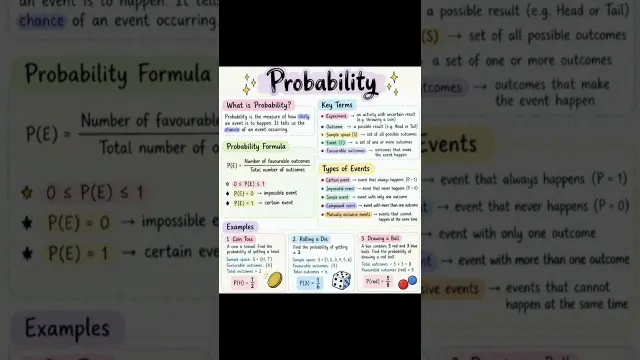
 Class 9 Maths Unit 13: Probability Made Simple
#Class 9 Math
1 ideas
Class 9 Maths Unit 13: Probability Made Simple
Get new #Class 9 Math ideas by email
Every Thursday: the week's best ideas, with the newest from #Class 9 Math.
Related tags
Class 9 Math: A Guide to the Year's Core Topics
Class 9 is the year school mathematics stops being mostly about getting the right number and starts being about why the method works. Students are usually around fourteen or fifteen, and the syllabus marks the transition from arithmetic habits to abstract reasoning. The exact list of units differs between countries and examination boards, but the shape of the year is remarkably consistent.
What the year usually covers
Most Class 9 programmes include:
- Number systems, including irrational numbers, and the rules for working with them
- Polynomials, factorisation and algebraic identities
- Linear equations in one and two variables, and their graphs
- Coordinate geometry: plotting points and reading the plane
- Geometry with reasoning: lines and angles, triangles, congruence, quadrilaterals and circles
- Constructions using compass and ruler
- Mensuration: surface area and volume of solids
- Statistics, including organising data and measures of central tendency
- An introduction to probability
Read more
Some curricula add trigonometry, sets or sequences. Treat any list as a map rather than a contract.
The real change: proof and structure
The hardest new idea is not a formula but a demand. In geometry, an answer is only acceptable if each step follows from something already established. Students meet theorems, converses and the difference between a statement that is true in a diagram and one that is true always. This is a genuine skill, and it develops slowly. Reading worked proofs, then rewriting them from memory, helps more than staring at them.
Algebra changes in a similar way. Identities such as the difference of squares or the expansion of a binomial are not tricks to memorise but patterns to recognise, and recognising them is what makes later factoring and simplification quick.
What beginners should know
Accuracy in the early steps saves time later. Sign errors, a misplaced bracket, or an unlabelled axis can ruin an otherwise correct solution. Write each line of working rather than doing several steps in your head, and keep units attached in mensuration problems.
Diagrams deserve care. A rough sketch is fine for thinking, but constructions and geometry problems need accurate figures, sharp pencils and a compass that holds its radius.
Formulas should be understood before they are memorised. Knowing why the area of a triangle is half the base times the height makes it far easier to use in unfamiliar shapes.
Practical study habits
Practice regularly rather than in long bursts before a test. Mathematics rewards frequency. Keep a single notebook of definitions, theorems and formulas, and add to it as the year goes on, so revision has a fixed place to start.
When a problem defeats you, study the solution and then close the book and reproduce it. Solving it again unaided is where the learning happens.
Finally, ask why at every opportunity. If a step feels arbitrary, it usually has a reason, and finding that reason is the whole point of the year.
#Class 9 Math: frequently asked questions
How should I start studying Class 9 Math if last year felt easy?
Start by accepting that the subject has changed shape: the goal is no longer just the right answer but a justified one. Read each worked example in your textbook slowly, then close the book and rewrite it from memory, checking where your reasoning broke down. Building that habit early makes the rest of the year far less intimidating.
What do I actually need on hand for Class 9 Math?
A geometry box you trust matters more than people expect — a compass that holds its radius and a sharp pencil will save you from figures that mislead you. Beyond that, one notebook dedicated to definitions, theorems and formulas is worth more than scattered notes, because revision then has a fixed starting point.
Why does proof feel so much harder than the calculations?
Proof is a genuinely new skill, not a formula you can memorise, and it develops slowly. Each step has to follow from something already established, so the work is in connecting statements rather than arriving at a value. Reading proofs and then reproducing them unaided is the practice that builds it.
Which topics in Class 9 Math cause the most trouble?
Geometry with reasoning, polynomials and mensuration are the usual sticking points, though the exact list varies by board. In geometry the difficulty is the reasoning, in algebra it is recognising patterns such as the standard identities, and in mensuration it is keeping units and dimensions straight. All three reward careful, line-by-line working rather than mental shortcuts.
How do I study for a math test without cramming?
Mathematics rewards frequency, so short regular sessions beat long bursts the night before. Work through problems until you can close the book and redo them from scratch, and revisit your formula notebook as the year goes on. If a step feels arbitrary, chase down the reason — that is usually where the marks hide.
What mistakes do students make most often in Class 9 Math?
Sign errors, dropped brackets and unlabelled axes quietly wreck otherwise sound solutions, and skipping written steps makes them hard to catch. Rough sketches are fine for thinking, but geometry and construction work needs an accurate figure. Memorising formulas without understanding them is the other common trap, since it collapses in unfamiliar problems.
Videos come from YouTube and posts from Instagram; titles and summaries are our own. All rights belong to their creators.