 Smart Casual Couple Outfit Color Formulas
#Color Combinations
4 ideas
Smart Casual Couple Outfit Color Formulas
 Matching Color Palette Ideas for Couple Outfits
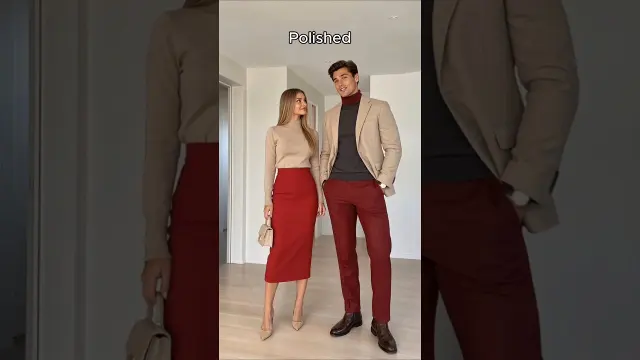 Essential Color Combinations for Couple Outfits
 Color Combination Ideas for Coordinated Couples
Get new #Color Combinations ideas by email
Every Thursday: the week's best ideas, with the newest from #Color Combinations.
Related tags
Color Combinations: How to Pair Colors with Confidence
A color combination is simply the set of colors you put side by side and decide should belong together. We make that decision constantly, usually without noticing: choosing a shirt, painting a room, laying out fabric for a quilt, arranging flowers on a table. Some pairings feel calm and inevitable, others feel loud or slightly wrong, and almost all of that comes down to a handful of principles you can learn in an afternoon.
The basics, without the jargon
Color has three qualities worth knowing. Hue is the family itself, such as blue or orange. Value is how light or dark it is. Saturation is how intense or muted it looks. Two colors of the same hue can still clash if their values fight or one is far more vivid than the other.
The color wheel gives you the vocabulary. Colors opposite each other are complementary: high contrast, energetic, best used so that one dominates and the other appears in small amounts. Colors next to each other are analogous: harmonious and easy, which is why they rarely fail. Three evenly spaced colors form a triadic scheme, bright and playful but harder to balance. A single hue in several values is monochromatic, calm and quietly elegant.
Read more
Pairings that always work
- One strong color against a neutral: navy with cream, rust with stone, forest green with oatmeal.
- Tonal layers: the same color in light, medium and dark, which reads as considered rather than flat.
- Warm against cool at a similar depth: dusty pink with slate blue, mustard with teal.
- Opposite colors, unequal in area: a large field of one, a small accent of the other.
- Two muted colors plus one bright: quiet at first glance, alive at the second.
Rules of thumb worth keeping
The most useful habit is proportion. Give one color the largest share, a second a supporting role, and a third just a trace, whether that means a scarf, a cushion or a single stripe. Repetition helps too: if a color appears in two places, it starts to look deliberate.
Light matters more than any theory. Colors that harmonize in daylight can look muddy under a warm lamp, so check fabric or paint samples in the room where they will live, and near your own skin tone if it is clothing. Texture does quiet work as well: the same pairing in wool and silk reads very differently.
If you are just starting out
Begin with two colors and one neutral. Build from something you already own or love rather than from a rule. Keep the palette small before you add a fourth color. And trust your eye over any scheme: a combination that pleases you in the mirror or the room is already working.
Coordinating with someone else
When two people dress to complement each other, the easiest approach is one shared color, echoed in different amounts, against contrasting neutrals. Exact matching head to toe is rarely necessary; a common thread is enough.
#Color Combinations: frequently asked questions
How do I start choosing color combinations for couple outfits?
Start with one color you both like, then add a neutral so the look feels balanced. Build from clothes you already own and keep the palette simple before adding more layers.
What kind of color combination works best for coordinated couples?
Shared colors echoed in different amounts usually feel the most natural. One person can wear the stronger version while the other uses the same color as a small accent, paired with contrasting neutrals.
Should couple outfits match exactly or just coordinate?
Exact matching is not necessary and can feel forced. It usually looks better when your outfits share a common thread, such as a similar tone, a repeated accent color, or a related warm or cool feel.
What are the easiest color formulas for a smart casual couple look?
A strong color with a neutral is one of the easiest formulas to get right, especially for everyday settings. You can also try two muted shades with one brighter accent if you want the outfit to feel more lively without becoming busy.
What common mistakes should I avoid with color combinations?
A common mistake is giving every color equal attention, which can make the look feel unfocused. Another is ignoring light and texture, since colors that look good on their own may clash in the same room or outfit if their depth and finish do not work together.
Videos come from YouTube and posts from Instagram; titles and summaries are our own. All rights belong to their creators.