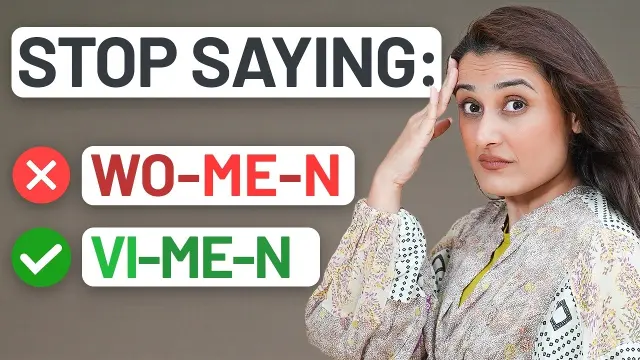
 Fifteen English Words You Are Probably Mispronouncing
#Common Mistakes
1 ideas
Fifteen English Words You Are Probably Mispronouncing
Get new #Common Mistakes ideas by email
Every Thursday: the week's best ideas, with the newest from #Common Mistakes.
Related tags
Common Mistakes: Why We Make Them and How to Learn
A common mistake is not simply a mistake that many people make. It is an error that repeats itself in a predictable pattern, for reasons that have little to do with laziness or carelessness. The same misspelled word, the same wrong turn of phrase, the same forgotten step in a recipe turns up again and again in different hands. Recognising the pattern matters, because a mistake you understand is far easier to correct than one you merely regret.
Where they come from
Most of these errors are by-products of the way attention works. When you learn something new, you give it your full focus. Once it feels familiar, your mind starts taking shortcuts, and that is exactly where slips creep in. Other common sources are over-applied rules, copying something you saw or heard without checking it, working quickly under time pressure, and simple fatigue. None of these are character flaws; they are the normal cost of a brain that likes to save effort.
Kinds worth knowing
Read more
Many common mistakes live in language: pronunciation that drifts from convention, spellings that look right but aren't, grammatical patterns borrowed from another dialect or language. Others belong to practical life: quantities guessed rather than measured, instructions skimmed instead of read, deadlines misjudged because a task felt easier than it was. There are also habits of thought, such as assuming a first impression is the whole picture or trusting a memory instead of a note.
Telling a slip from a gap
Before you try to fix anything, ask yourself a simple question: did you know better and lose focus, or did you not know the rule at all? A slip needs a small pause, a checklist or a second read. A gap needs learning, and no amount of concentration will close it. Beginners often confuse the two and feel discouraged when they keep repeating an error that actually needs study rather than attention.
Practical habits
- Keep a short list of your own recurring errors and review it from time to time; patterns become visible quickly.
- When someone corrects you, ask for the reason behind the correction, so you gain a rule rather than a single fix.
- Slow down deliberately on tasks you consider easy, since that is where autopilot does the most damage.
- Read instructions fully before starting, and measure rather than estimate when the result depends on it.
- Practise the corrected version out loud or on paper a few times instead of only noting it mentally.
- Invite feedback from someone who will tell you plainly, and don't defend the error out of habit.
Mistakes are the clearest signal you will ever get about what to work on next. Treated with curiosity rather than embarrassment, they become one of the cheapest forms of instruction available to you.
#Common Mistakes: frequently asked questions
What actually makes a mistake a "common" one?
It's an error that repeats in a recognisable pattern across different people and situations, rather than a one-off slip. The repetition usually comes from how attention works — once something feels familiar, the mind shortcuts it — not from carelessness or laziness. Seeing the pattern is what makes it fixable.
What's the best way to start working on my own recurring errors?
Begin by keeping a short running list of the errors you notice yourself repeating, and look back at it now and then so the pattern becomes obvious. Then sort each entry: was it a moment of lost focus, or something you never actually learned? The two need completely different responses, and mixing them up is why people feel stuck.
How can I tell whether I slipped or whether I have a real gap?
Ask yourself honestly whether you knew the right way and drifted, or whether you couldn't have produced the correct version at all. A slip is fixed by a pause, a checklist or a second read; a gap needs study, and no amount of concentration will close it. Beginners often assume every repeat error is a discipline problem and get discouraged for no reason.
Why do I keep messing up things I find easy?
Easy tasks are exactly where your attention switches to autopilot, and that's where the damage happens. Deliberately slowing down on the things you consider simple is more useful than concentrating hard on the difficult ones. Reading instructions all the way through and measuring instead of estimating helps for the same reason.
How do I make a correction stick instead of forgetting it straight away?
When someone corrects you, ask why — that turns a single fix into a rule you can apply elsewhere. Then practise the corrected version out loud or on paper a few times rather than filing it away mentally. It also helps to ask for feedback from someone who'll be blunt, and to resist defending the error out of habit.
Is it worth paying attention to pronunciation and spelling errors in particular?
Language is one of the richest sources of predictable errors, because spellings that look right and pronunciations that drift from convention repeat across huge numbers of people. Grammar patterns carried over from another dialect or language behave the same way. Treating them as patterns to understand rather than embarrassments to hide makes them much easier to correct.
Videos come from YouTube and posts from Instagram; titles and summaries are our own. All rights belong to their creators.