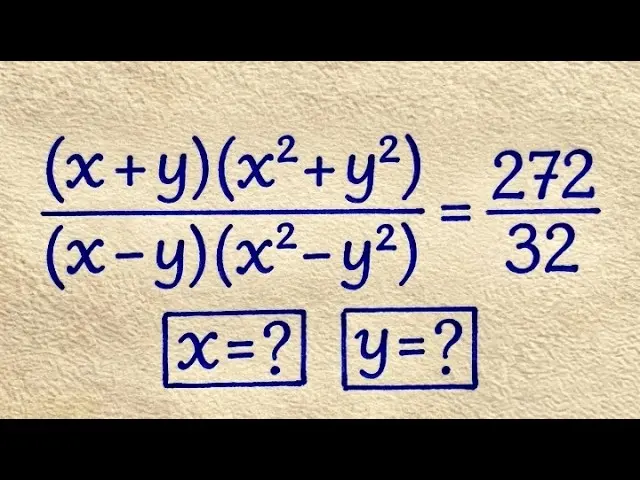
 Advanced Algebra Problem for Math Olympiad Preparation
#Competition Math
2 ideas
Advanced Algebra Problem for Math Olympiad Preparation
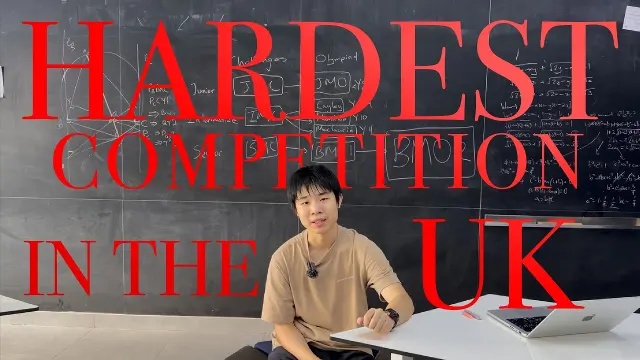 My Journey to the British Mathematical Olympiad Round 2
Get new #Competition Math ideas by email
Every Thursday: the week's best ideas, with the newest from #Competition Math.
Related tags
Competition Math Guide
Competition math is the art of solving mathematical problems that are designed to be more creative, more demanding, and more surprising than routine school exercises. It appears in contests, olympiads, team events, and entrance exams, but it is also a useful way to deepen your understanding of mathematics itself. Instead of relying only on memorised formulas, you are often asked to spot patterns, build arguments, and choose the right idea at the right time.
What competition math covers
The subject usually draws from several core areas:
- Algebra, including equations, inequalities, sequences, and functional thinking
- Number theory, such as divisibility, primes, remainders, and integer properties
- Geometry, especially angle chasing, congruence, similarity, circles, and constructions
- Combinatorics, which involves counting, arrangements, and logical casework
- Sometimes probability and basic graph ideas, depending on the contest
Read more
Some problems use only one topic, while others mix several at once. A strong competitor learns to recognise which area a problem belongs to, but also stays flexible enough to switch methods when needed.
Common styles of problems
Competition problems often ask you to prove something, find all possibilities, or prove that a certain value is impossible. Many are designed so that a direct calculation is not the best path. Instead, you may need to work backward, test small examples, look for invariants, or find a hidden structure.
Typical problem styles include:
- Proof problems, where you justify every step
- Construction problems, where you create an example with specific properties
- Puzzle-like problems, where a clever insight unlocks the solution
- Multi-step problems, where one small observation leads to the rest
How to approach them
If you are beginning, the best habit is to slow down and read carefully. Write down what is given, what is required, and any conditions that matter. Then try simple cases before attempting the general one. Many solutions begin with an example that reveals the pattern.
Useful habits include:
- Draw diagrams for geometry problems
- Check special values for algebra and number theory
- Look for symmetry, parity, and invariants
- Break a hard counting problem into smaller cases
- Keep your work neat so you can follow your own reasoning
It also helps to learn a few standard tools well, such as factoring, substitution, modular arithmetic, contradiction, induction, and basic geometric theorems. Knowing these methods is less important than knowing when to use them.
Practice and improvement
Progress in competition math comes from solving problems thoughtfully, not quickly. After you attempt a problem, compare your work with a complete solution and ask yourself why each step works. If you missed the key idea, note it and look for similar problems later. Over time, you will start to recognise common patterns and techniques.
A good practice routine mixes easy warm-up problems with harder ones. Easy problems build confidence and speed, while difficult ones train patience and creativity. If you get stuck, it is fine to pause, return later, and try a different angle.
What beginners should remember
You do not need to know every advanced trick to start. In fact, strong fundamentals matter more than a large collection of shortcuts. Focus on understanding definitions, writing clear arguments, and learning from mistakes. Competition math rewards curiosity, persistence, and the willingness to think in new ways.
Videos come from YouTube and posts from Instagram; titles and summaries are our own. All rights belong to their creators.