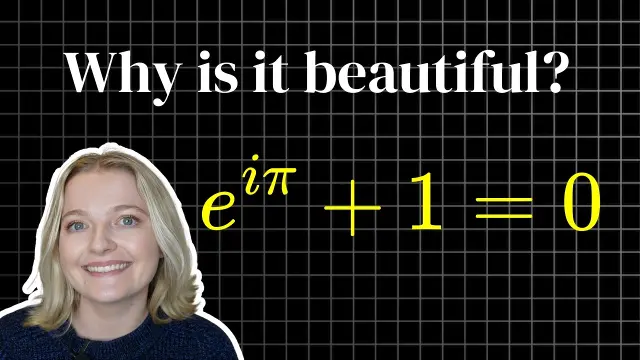
 Exploring The Beauty Of Euler's Identity
#Complex Numbers
1 ideas
Exploring The Beauty Of Euler's Identity
Get new #Complex Numbers ideas by email
Every Thursday: the week's best ideas, with the newest from #Complex Numbers.
Related tags
Complex Numbers Explained
What complex numbers are
Complex numbers are numbers made from two parts: a real part and an imaginary part. They are written in the form a + bi, where a and b are real numbers and i is the imaginary unit, defined as the square root of -1. That may sound unusual at first, but complex numbers are a natural extension of the number system you already know.
They were developed to help solve equations that have no solution among ordinary real numbers. Over time, they became a useful and elegant part of mathematics, with applications in algebra, geometry, engineering, physics, and signal processing.
Why they matter
Read more
One of the main reasons complex numbers are important is that they let us work with square roots of negative numbers in a consistent way. This opens the door to solving many equations more completely. They also provide a very useful way to describe rotation and oscillation, which makes them valuable in areas that deal with waves and repeating patterns.
Complex numbers are not just abstract symbols. They can be visualised on a complex plane, where the horizontal axis represents the real part and the vertical axis represents the imaginary part. This makes them easier to understand as points or vectors, not just as formulas.
Basic forms and ideas
There are a few common ways to think about complex numbers:
- Algebraic form: a + bi, the standard written form
- Geometric form: a point on the complex plane
- Polar form: a number described by its distance from the origin and its angle
Each form is useful in different situations. The algebraic form is best for addition and subtraction. The polar form is often more convenient for multiplication, division, and powers.
Operations with complex numbers
Working with complex numbers follows familiar rules, but with one important idea: i squared equals -1. That rule is what makes complex arithmetic different from real-number arithmetic.
When you add or subtract complex numbers, you combine the real parts and the imaginary parts separately. When you multiply them, you use the usual distributive rule and then simplify using i² = -1. Division is also possible, usually by multiplying top and bottom by the conjugate of the denominator.
A complex conjugate changes the sign of the imaginary part. For a + bi, the conjugate is a - bi. Conjugates are useful in simplifying expressions and in finding magnitudes.
What beginners should know
If you are new to complex numbers, it helps to focus on a few core ideas first:
- i is a new number with the property that i² = -1
- real numbers are still part of complex numbers
- every complex number has a real part and an imaginary part
- the complex plane gives a visual way to understand them
It is also helpful to practise moving between algebraic and geometric views. This makes the subject feel much more concrete.
Practical tips for learning
Start with simple examples and keep the rules consistent. Write out steps carefully when multiplying or dividing, especially when i appears more than once. If you can, sketch complex numbers on the plane to build intuition. That visual habit often makes later ideas much easier to follow.
Complex numbers can seem strange at first, but they form a clean and powerful system. Once you understand their structure, they become one of the most useful tools in mathematics.
Videos come from YouTube and posts from Instagram; titles and summaries are our own. All rights belong to their creators.