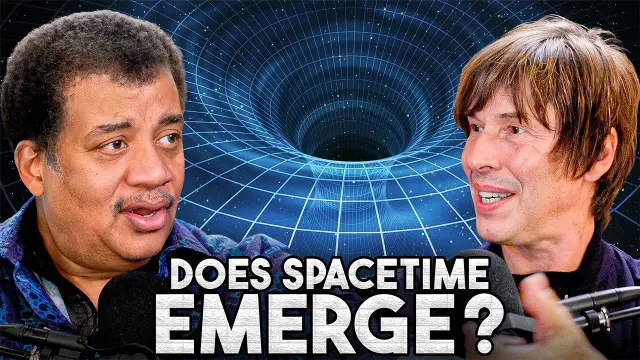
 Is Spacetime Fundamental, or is it Emergent? With Brian Cox
#Cosmology
1 ideas
Is Spacetime Fundamental, or is it Emergent? With Brian Cox
Get new #Cosmology ideas by email
Every Thursday: the week's best ideas, with the newest from #Cosmology.
Related tags
Cosmology: Understanding the Universe
Cosmology is the scientific study of the universe as a whole. It asks some of the oldest questions people have ever asked: how did the universe begin, what is it made of, how has it changed over time, and what may happen to it in the future? Unlike astronomy, which often focuses on individual stars, planets, or galaxies, cosmology looks at the biggest possible picture.
What cosmology studies
At its core, cosmology brings together physics, mathematics, and observation to explain the large-scale structure of the universe. It explores space, time, matter, energy, and the laws that govern them. Cosmologists study topics such as the expansion of the universe, the distribution of galaxies, the cosmic microwave background, dark matter, and dark energy.
The field is based on both observation and theory. Telescopes and space missions help scientists collect evidence from deep space, while physical models and equations help them interpret what they see. In this way, cosmology is both descriptive and predictive: it tries to explain the universe as it is now and reconstruct how it may have developed from earlier stages.
Read more
Where cosmology comes from
People have always tried to understand the cosmos, but modern cosmology grew out of 20th-century physics and astronomy. New instruments made it possible to observe distant galaxies and faint background radiation, and new theories of gravity and space-time offered ways to explain the data. Over time, cosmology became a precise scientific discipline rather than only a philosophical one.
Main ideas and models
Several key ideas shape modern cosmology:
- The universe is expanding, meaning distant galaxies move away from each other over time.
- The universe has a history, so it has changed from a hotter, denser state to the vast structure we see today.
- Gravity shapes large-scale structure, forming galaxies, clusters, and cosmic webs.
- Some components of the universe are not directly visible, but their effects can still be observed.
Different models help scientists describe these processes. The most widely used model today combines the expansion of space with gravity and the known contents of the universe. Even so, many questions remain open, especially about the nature of dark matter, dark energy, and the very earliest moments of cosmic history.
What beginners should know
If you are new to cosmology, it helps to keep a few things in mind:
- Cosmology is not only about the beginning of the universe; it is also about its present structure and future.
- The subject uses ideas from physics, but it is still approachable if you take it step by step.
- Many concepts are described with analogies, but no analogy is perfect.
- Some questions are still unanswered, which is part of what makes the field interesting.
A good way to start is by learning the basic vocabulary: expansion, gravity, galaxy, redshift, and cosmic background radiation. Once those ideas make sense, the larger picture becomes much clearer.
Cosmology is ultimately a search for perspective. It helps you see that the universe is not static or simple, but dynamic, structured, and full of deep questions that connect the smallest scales of physics to the largest scales imaginable.
Videos come from YouTube and posts from Instagram; titles and summaries are our own. All rights belong to their creators.