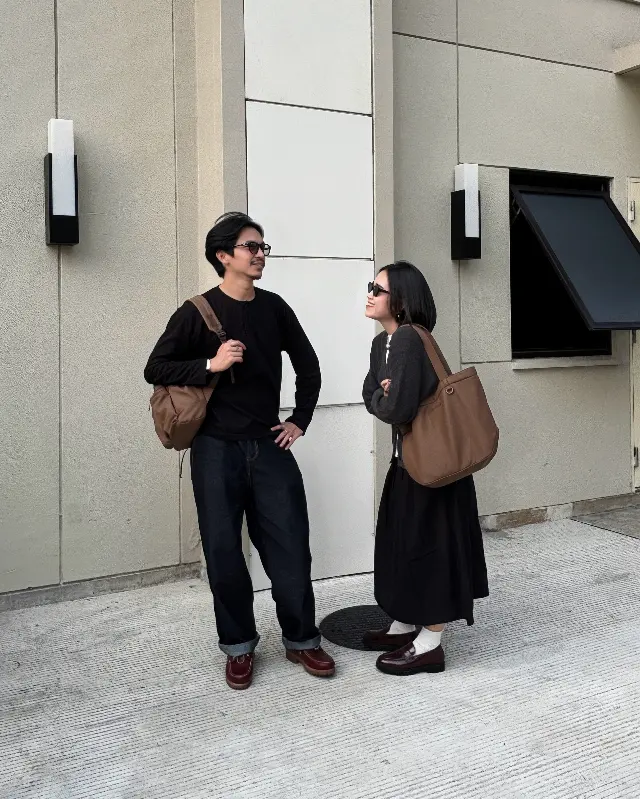
 Matching Couple Outfit Ideas for Casual Little Dates
#Couple Outfits
1 ideas
Matching Couple Outfit Ideas for Casual Little Dates
Get new #Couple Outfits ideas by email
Every Thursday: the week's best ideas, with the newest from #Couple Outfits.
Related tags
Couple Outfits: How to Coordinate Without Matching
A couple outfit is what happens when two people plan what they wear so the two looks relate to each other. It doesn't mean dressing identically. The idea is a visual conversation: a shared colour, a similar fabric, an echoed silhouette, or simply a mood that both outfits belong to. Done well, it looks like two people who happened to get dressed in the same world that morning.
Where the idea comes from
Coordinated dress is older than the phrase. Households, families and formal occasions have long used matching or tonally linked clothing to signal that people belong together, and wedding traditions in many cultures still do. The modern version grew out of the "his and hers" style of mid-century leisurewear, which paired the same print or colour across two wardrobes. Today the idea has loosened and widened: any two people can coordinate, and the point is harmony rather than duplication.
The matching spectrum
Read more
Think of coordination as a scale rather than a switch.
- Full match: the same garment or print on both people. Bold, playful, best saved for holidays, parties or photographs.
- Tonal match: different pieces in the same colour family, such as two shades of blue or a shared neutral.
- Accent match: one small repeated element — a colour in a scarf, a shoe, a jacket — doing all the work.
- Complementary contrast: outfits that oppose each other deliberately, one light and one dark, one tailored and one relaxed, yet feel balanced.
The last two usually age better than the first, because each person still looks like themselves.
Building a coordinated look
Start with one anchor: a colour, a fabric or a formality level. Then let each person dress around it in their own way. A shared palette of two or three colours is the simplest method, especially for photographs, where busy patterns and clashing tones tend to fight. Texture is a quieter tool — two people in cotton, linen or wool of different colours will still look related. Silhouette matters too: if one outfit is voluminous, a cleaner line on the other keeps the pair from looking heavy.
Practical tips for beginners
- Agree on the occasion and the weather first. Mismatched formality reads as an accident, not a choice.
- Pick the anchor before you open the wardrobe, not after.
- Let one person lead if you're short of time; the other coordinates around them.
- Keep comfort non-negotiable. An outfit that only works standing still won't survive a long day.
- Photograph the two outfits together before you leave, if the day matters. Cameras see clashes the mirror misses.
- Resist matching everything. Two or three points of contact are plenty.
Where it can go wrong
Over-matching is the usual trap: identical outfits can look like a costume and can flatten two different bodies and personalities into one shape. The other risk is treating coordination as a performance for photographs only, choosing clothes that feel wrong to wear. The most successful couple outfits are the ones you'd both have chosen anyway, with a small, deliberate nod between them.
#Couple Outfits: frequently asked questions
Does a couple outfit mean we have to wear the exact same thing?
Not at all. Wearing identical pieces is only the boldest point on the coordination scale, and it is usually reserved for parties, holidays or photos. A coordinated look simply needs something shared between the two outfits — a colour, a fabric, a similar line or even the same mood — while each person still looks like themselves.
How do we start coordinating our outfits without buying anything new?
Choose one anchor first: a colour you both like, a fabric, or how dressy the day is. Then each of you builds an outfit around that anchor from what is already in your wardrobe, which is far easier than shopping for a matched set. A shared palette or one repeated accent is usually enough to make the two looks read as related.
Which kind of coordination looks best in everyday life?
Tonal and accent matching tend to hold up best, because the connection is subtle and each person's own style survives. Full matching can be fun but quickly starts to look like a costume, and it can flatten two very different bodies and personalities into one shape. Save the strong matches for occasions where a bit of playfulness is welcome.
How should we plan outfits for a specific occasion, like a casual date?
Agree on the occasion and the weather before anything else, since a mismatch in formality or season reads as an accident rather than a choice. If time is short, let one person pick their outfit first and have the other coordinate around it. Comfort matters as much as the look — an outfit that only works while standing still will not survive a long day out.
What is the most common mistake couples make with matching outfits?
Over-matching is the usual trap: too many shared elements turn two people into a single costume rather than a pair. The other risk is choosing clothes purely for photographs and ending up uncomfortable all day. Aim for just a few points of contact, and treat the coordination as a small nod between two otherwise personal outfits.
How do we look after pieces we wear as a couple?
Treat shared garments the way you would any favourite piece: follow the care label, wash similar fabrics together and store them so they keep their shape between wears. Keeping a couple of coordinated basics in rotation and in good condition means you can reach for them whenever an occasion calls for it. Checking them before a big day is easier than discovering a problem on the morning itself.
Videos come from YouTube and posts from Instagram; titles and summaries are our own. All rights belong to their creators.