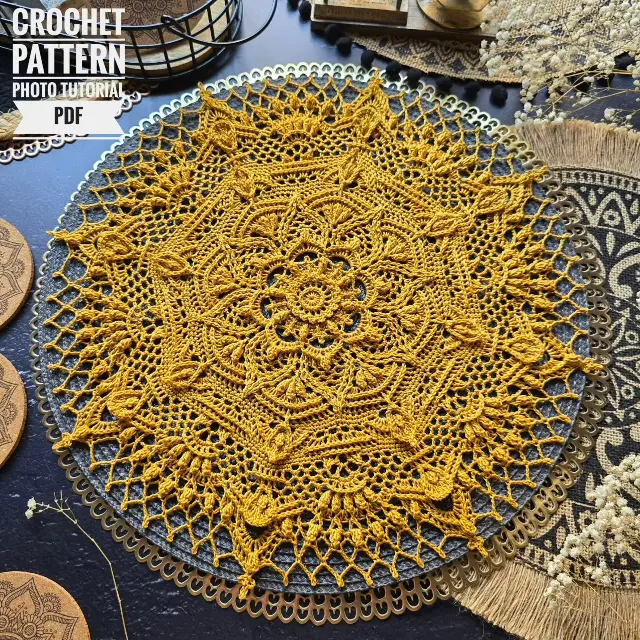
 Crocheted Sandra Doily Pattern with Charts and Photo Tutorial
#Crochet Doily
1 ideas
Crocheted Sandra Doily Pattern with Charts and Photo Tutorial
Get new #Crochet Doily ideas by email
Every Thursday: the week's best ideas, with the newest from #Crochet Doily.
Related tags
Crochet Doily Guide: History, Styles and Tips
A doily is a small, decorative mat worked in fine thread, and crochet is one of the most common ways to make one. The name comes from "doily" or "doiley," a word used in English for a small ornamental cloth, originally a linen napkin. The pieces are usually round or oval, though square and star-shaped versions exist, and they are worked outward from a centre in concentric rounds. Because the thread is thin and the hook small, a doily is a slow, precise piece of work — closer to lacemaking than to ordinary crochet.
Doilies are used as table mats under vases and bowls, as centres for larger cloths, framed as wall pieces, and increasingly as motifs sewn into garments, cushions and bags. They have also long served as a way to practise and display technique: a well-made doily shows a crocheter's tension, patience and command of the stitch pattern.
Where it comes from
Crocheted lace emerged in Europe in the nineteenth century, growing out of earlier needle lace and bobbin lace traditions, and spread widely as thread and hooks became affordable household items. Doilies became common in homes as protective and ornamental mats, and the craft travelled with migration and with printed pattern leaflets. The result is a body of technique that is shared, regional and endlessly varied — which is exactly why old patterns still work today.
Read more
Main styles and techniques
The classic doily is a flat circle in fine cotton thread, worked in rounds with a join at the end of each round. From there the variations open up:
- Pineapple and star motifs, built by repeating shaped elements around the centre
- Filet crochet, where solid and open squares form a picture or pattern on a grid
- Irish-style work, in which separate small motifs are joined into one piece
- Square and hexagonal doilies, made from repeated motifs joined as you go
Most patterns rely on a small set of stitches — chain, slip stitch, single crochet, half double, double and treble — combined with picots, shells and chain spaces to make the openwork.
What beginners should know
Start with medium thread and a hook you can see easily rather than the finest lace cotton; a piece worked in thicker thread is the same skill in a more forgiving form. Read the whole pattern before you begin, and count each round as you finish it, since a single missed stitch tends to pull the shape out of true. Blocking is not optional: pin the finished doily into shape, damp it, and let it dry flat, and the curves and points will sit properly.
Keep your tension even rather than tight — an over-tight doily curls and will not lie flat. Choose smooth cotton for definition, and remember that stitch markers at the start of a round save a great deal of counting. Finally, keep your first attempts: they show you later how far a little patience takes you.
#Crochet Doily: frequently asked questions
How do I start my first crochet doily?
Begin at the centre and work outward in rounds, joining each round before moving on to the next. Choose a medium-weight cotton thread and a hook you can see comfortably rather than the finest lace cotton, since the same stitches in thicker thread are far more forgiving. Read the pattern through once before you make a stitch, and mark the start of every round so your counting stays honest.
What do I need to make a doily?
You need crochet thread, a hook small enough to match it, a tapestry needle for weaving in ends, and something to pin the finished piece to while it dries. Smooth cotton gives the crispest stitch definition, and stitch markers at the start of a round save a great deal of recounting. A blocking surface and pins are part of the equipment, not an afterthought.
Which style of doily should I choose?
The classic flat circle in fine cotton, worked in continuous joined rounds, is the natural starting point and the base for most variations. From there you can move toward star or pineapple motifs built by repeating shaped elements, filet crochet where solid and open squares create a picture on a grid, Irish-style work joining separate small motifs, or square and hexagonal pieces made motif by motif. Pick the one whose structure you can picture clearly, since styles differ less in difficulty than in how much counting they demand.
How do I care for a finished doily?
Hand wash gently in cool water with a mild soap, rinse without wringing or twisting, and roll it in a towel to remove excess water. Then pin it back into shape on a flat surface while still damp and let it dry completely — blocking is what keeps the curves and points sitting properly. Store it flat rather than folded, since creases in fine thread are stubborn.
What can I use a crochet doily for?
Traditionally they sit under vases and bowls as protective mats, or act as the centre panel of a larger cloth. They also work beautifully framed as wall pieces, and are increasingly sewn as motifs onto garments, cushions and bags. Small ones make quick gifts, and a set worked in the same thread reads as a considered present.
What mistakes should I avoid as a beginner?
The most common are pulling the thread too tight — an over-tight doily curls and refuses to lie flat — and skipping blocking at the end, which is the step that actually makes the piece look finished. Losing count mid-round is the other frequent slip, and since one missed stitch distorts the whole circle, recount after each round rather than trusting your memory. Keep your first attempts: they show you later how much a little patience changes your work.
Videos come from YouTube and posts from Instagram; titles and summaries are our own. All rights belong to their creators.