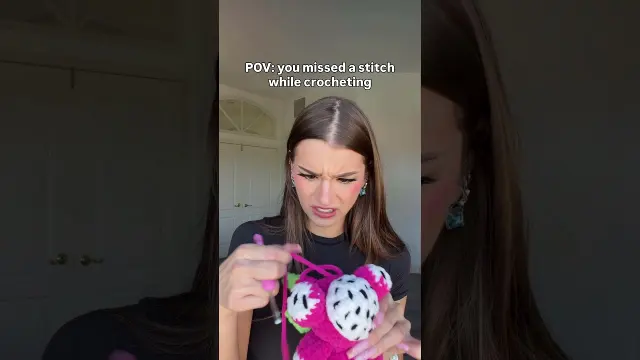
 Relatable Crochet Moment: Spotting a Missed Stitch
#Crochet Mistakes
1 ideas
Relatable Crochet Moment: Spotting a Missed Stitch
Get new #Crochet Mistakes ideas by email
Every Thursday: the week's best ideas, with the newest from #Crochet Mistakes.
Related tags
Common Crochet Mistakes and How to Fix Them
Crochet is a craft built on repetition: a handful of movements repeated until they become rhythm. That is exactly why small errors travel so far. One dropped stitch in a row of two hundred is invisible while you work and obvious once the piece is finished. Most mistakes people make are not signs of carelessness. They are simply part of learning how yarn behaves, and nearly all of them can be corrected or avoided with a little attention.
Counting and stitch markers
The single most common problem is losing track of stitch counts. Because crochet is worked from the loop on the hook, the fabric curls and turns as it grows, and edges become hard to read. Stitch markers are the simplest remedy: place one in the first and last stitch of a row, and at regular intervals in long rows so a miscount is caught early rather than several rows later. Counting aloud, or checking the count at the end of every row, prevents the slow drift that turns a rectangle into a trapezoid.
Tension and gauge
Read more
Tension is how tightly you hold the yarn, and it changes with mood, fatigue and the project itself. Too tight a tension makes stitches hard to insert and produces stiff fabric; too loose produces gaps and uneven edges. Making a small sample square before starting a large project shows whether your natural tension matches the pattern, and swapping hook size is the usual adjustment. Tension also fluctuates within a single session, so it is worth pausing to compare your current rows against earlier ones.
Misreading the pattern
Patterns are written in a shorthand that becomes readable with practice, and the mistakes here are usually about structure rather than technique. Beginners often work into the wrong loop, miss a turning chain, or misread a repeat. Reading the whole pattern through before beginning, and marking the repeats with a pen or highlighter, saves hours. When a row count does not add up, the mistake is almost always in the row just finished, not the one being worked.
Edges, turning chains and joins
Wavy edges, slanted sides and visible seams come from turning chains that are too long or too short, or from working the first and last stitches of a row inconsistently. Decide once how a turning chain will be treated and keep to it throughout. When working in rounds, a marker in the first stitch of each round keeps the join lined up instead of spiralling.
Yarn, ends and finishing
Weaving in ends properly takes patience and is often rushed. Leave a generous tail, change direction as you weave so the end locks itself in, and do not trim too close. Choosing a yarn suited to the stitch pattern matters too: highly textured stitches disappear in busy variegated yarn, while smooth light-coloured yarn makes learning to read your stitches far easier.
The useful mistake
Undoing work, sometimes called frogging, feels like failure but is really part of the process. Every experienced crocheter rips back. The practical habit is to check your work every few rows rather than at the end, to keep notes of hook size and adjustments, and to rest your hands and eyes regularly, since tired hands produce looser stitches and tired eyes miss them. Mistakes are how the craft teaches you to see.
#Crochet Mistakes: frequently asked questions
How do I stop losing count of my stitches while crocheting?
Losing track of the count is the most frequent problem because the fabric curls as it grows and the edges stop being easy to read. Place a marker in the first and last stitch of every row, and add markers at regular intervals along long rows so a miscount shows up immediately instead of several rows later. Checking the count at the end of each row, rather than waiting until the piece is finished, keeps a rectangle from quietly turning into a trapezoid.
Why does my crochet fabric look uneven, and what can I do about it?
Uneven fabric usually comes from tension that shifts as you work rather than from a lack of skill. Holding the yarn too tightly makes stitches stiff and hard to insert, while too loose leaves gaps and wobbly edges, so try working a small sample square first and adjust your hook size if your natural tension does not match the pattern. Because tension drifts with mood and fatigue, it also helps to pause now and then and compare your current rows against earlier ones.
What are the most common mistakes beginners make when following a pattern?
Most pattern errors are about structure rather than technique: working into the wrong loop, skipping a turning chain, or misreading a repeat that should have been carried across several stitches. Read the pattern all the way through before you pick up the hook and mark the repeats with a pen so your eye catches them while you work. If a row count does not add up, look at the row you just finished instead of the one in progress, since that is almost always where the problem sits.
How do I keep my edges straight and my seams from slanting?
Wavy edges and slanted sides generally trace back to turning chains that are consistently too long or too short, or to working the first and last stitch of a row differently each time. Decide once how you will treat the turning chain and stick to that choice for the whole project. When you work in rounds, a marker in the first stitch of each round keeps the join lined up instead of drifting into a spiral.
Should I undo rows when I find a mistake, or try to work around it?
Undoing work is a normal part of the craft, not a sign that something has gone wrong, and experienced crocheters rip back all the time. The practical habit is to check your work every few rows rather than at the very end, so a small error costs you a few stitches instead of hours. Keeping brief notes on your hook size and any adjustments also makes it far easier to rework a section accurately.
How should I choose yarn for a crochet project, and how do I finish the ends neatly?
Match the yarn to the stitch pattern: highly textured stitches get lost in busy variegated yarn, while a smooth light-coloured yarn makes it much easier to read your stitches while you learn. For finishing, leave a generous tail, weave the end back and forth in changing directions so it locks itself in, and resist the urge to trim it too close to the fabric. Rushing this last step is what makes ends work their way out later.
Videos come from YouTube and posts from Instagram; titles and summaries are our own. All rights belong to their creators.