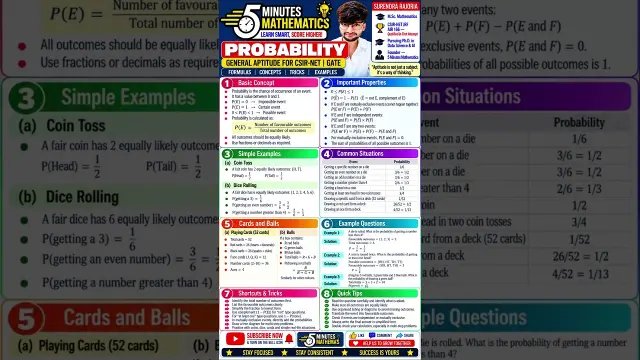
 Probability Concepts and Shortcuts for CSIR-NET and GATE
#CSIR NET
1 ideas
Probability Concepts and Shortcuts for CSIR-NET and GATE
Get new #CSIR NET ideas by email
Every Thursday: the week's best ideas, with the newest from #CSIR NET.
Related tags
CSIR NET: A Guide to India's Science Eligibility Test
If you are finishing a master's degree in science in India and want to teach or do research, the CSIR NET is one of the first doors you will knock on. Its full name is the CSIR National Eligibility Test, run by the Council of Scientific and Industrial Research, and it serves a double purpose: it certifies you as eligible for the post of Assistant Professor, and it awards a Junior Research Fellowship to those who clear the higher bar. Two outcomes, one examination, which is why so many candidates sit it more than once.
What it tests
The exam is held for a handful of broad science subjects, and you sit the paper for the one that matches your background. Each paper is set in English and Hindi. The format has been revised more than once over the years, so treat any pattern you read online as a rough sketch until you have read the official information bulletin for your round. Two things have stayed stable: it is an objective, multiple-choice test, and it mixes a general-aptitude portion with subject-heavy questions. The aptitude part covers reasoning, data interpretation, quantitative comparison and comprehension. The subject part goes deep, drawn largely from the master's-level syllabus.
Why the aptitude section matters
Read more
For many candidates this is the section that decides the outcome, and it is easy to neglect while you are absorbed in your own subject. The aptitude questions are not difficult individually, but they are set in a way that punishes slow reading and careless calculation. A little regular practice — a few questions a day, untimed at first and timed later — is worth more than a last-week cram. Learn to estimate before you compute; many items can be narrowed to one answer without a full calculation.
Preparing well
- Start from the official syllabus and mark what you have genuinely studied and what you have only seen once.
- Build a written record of standard results and derivations; the act of writing them out reveals gaps that reading does not.
- Solve previous years' papers without notes, then study the explanations for every question you missed, including the ones you guessed right.
- Revise in cycles rather than in a single sweep, so that early topics are still fresh at the end.
- Protect your sleep and your health in the final weeks; long, steady sessions beat exhausted marathons.
The longer view
The NET rewards patience. It is common for candidates to need more than one attempt, not because the syllabus is beyond them but because preparation takes time to settle into a working rhythm. Do not measure yourself against someone else's timeline. Treat each attempt as information about what to fix, keep your fundamentals moving forward, and the exam will eventually stop feeling like a wall and start feeling like a step.
#CSIR NET: frequently asked questions
How should a science postgraduate begin preparing for CSIR NET?
Begin with the official syllabus for your subject and honestly sort it into topics you have studied properly and topics you have only met once. Build your preparation outwards from that gap list rather than from a random collection of notes, and revise in repeated cycles so early chapters are still fresh near the end. Steady, regular sessions settle into a working rhythm faster than occasional long marathons.
What does the exam actually test, and why is the general aptitude part so important?
It is an objective, multiple-choice paper that combines a general-aptitude section with deep subject questions drawn largely from the master's-level syllabus. The aptitude portion covers reasoning, data interpretation, quantitative comparison and comprehension, and for many candidates it quietly decides the result because it punishes slow reading and careless arithmetic. A small daily practice habit, untimed at first and timed later, is worth far more than a cram in the final week.
Should I aim for the lectureship or the research fellowship?
The same examination certifies eligibility for the assistant professor post and, at a higher bar, awards a junior research fellowship, so the choice is really about how ambitious a score you are chasing. Decide early, because fellowship-level preparation demands deeper subject mastery and more rigorous practice than the qualifying mark alone. Many candidates sit it more than once while working towards that higher outcome.
How much time does CSIR NET preparation usually take?
There is no fixed schedule that fits everyone, and measuring yourself against someone else's timeline is the most common way to lose confidence. The examination rewards patience: preparation takes time to settle, and needing more than one attempt is normal rather than a sign that the syllabus is beyond you. Treat each attempt as information about what to fix instead of as a verdict.
What mistakes do candidates make most often?
Neglecting the aptitude section while absorbed in the subject is the classic error, along with reading about exam patterns online instead of checking the official information bulletin for the current round. Another is solving previous papers with notes open, which hides exactly the gaps the real paper exposes. Write out standard results and derivations by hand, since that reveals weaknesses that reading quietly conceals.
How should I look after myself in the final weeks before the exam?
Protect your sleep and your health rather than trading them for extra hours, because exhausted marathon sessions produce less than long, steady ones. Keep a written record of standard results and derivations so revision stays active instead of passive. On the aptitude side, practise estimating before computing, as many questions can be narrowed to one answer without a full calculation.
Videos come from YouTube and posts from Instagram; titles and summaries are our own. All rights belong to their creators.