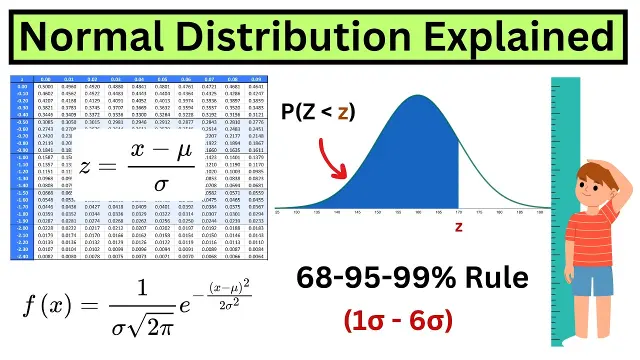
 Comprehensive Explanation of the Normal Distribution and Bell Curves
#Data Science
2 ideas
Comprehensive Explanation of the Normal Distribution and Bell Curves
Get new #Data Science ideas by email
Every Thursday: the week's best ideas, with the newest from #Data Science.
Related tags
Data Science Basics and Practical Uses
What data science is
Data science is the practice of turning raw data into useful understanding. It combines statistics, programming, subject knowledge, and clear thinking to find patterns, answer questions, and support decisions. In simple terms, it helps you make sense of information that may be too large, complex, or scattered to understand by looking at it alone.
The field grew from statistics, computer science, and data analysis, and it became more important as digital systems began producing large amounts of information. Today, data science is used in business, health care, education, science, finance, public services, and many other areas where decisions depend on evidence.
What data scientists do
Read more
A data science project usually starts with a question. That question might be about customer behavior, product quality, trends over time, or how to improve a process. The work often includes collecting data, cleaning it, exploring it, analyzing it, and then presenting the findings in a way that others can understand and use.
Common tasks include:
- finding useful data sources
- removing errors, duplicates, or missing values
- organizing information into a usable form
- making charts and summaries
- building models to identify patterns or make predictions
- explaining results clearly to non-specialists
Main parts of the field
Data science brings together several related skills. Statistics helps you describe data and test ideas. Programming helps you work with large datasets and automate tasks. Machine learning can help you build models that learn patterns from data. Data visualization helps you communicate results through graphs, dashboards, and other visual tools.
Not every data science project uses all of these at once. Some projects are mostly descriptive, showing what happened. Others are predictive, estimating what may happen next. Some are focused on recommendation, classification, or detecting unusual patterns.
Techniques and approaches
A good project usually follows a careful process:
- define the problem clearly
- gather relevant data
- clean and prepare the data
- explore it to understand the structure
- choose a suitable method
- check the results
- explain the findings and limits
Beginners often start with simple analysis before moving to more advanced modeling. Learning to ask good questions is just as important as learning tools. A model is only useful if the data is relevant and the result makes sense in context.
What beginners should know
If you are new to data science, start with the basics of data handling, statistics, and one programming language. Focus on understanding rather than rushing into advanced methods. It also helps to practice with real datasets, because real data is rarely neat or complete.
A few useful habits:
- check where data comes from
- look for missing or inconsistent values
- avoid assuming that correlation means causation
- keep your work reproducible and organized
- explain uncertainty instead of hiding it
Why it matters
Data science is valuable because it helps people make better decisions with evidence instead of guesswork. Used well, it can reveal opportunities, improve services, and clarify complicated problems. Used carelessly, it can mislead, so careful thinking, honesty, and context are always important.
Videos come from YouTube and posts from Instagram; titles and summaries are our own. All rights belong to their creators.