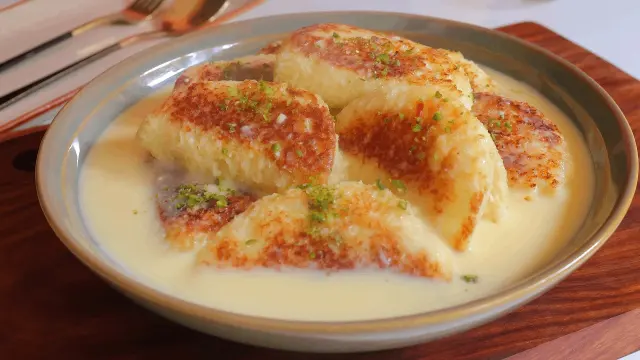
 Diwali Special Festive Bread Custard Puli Recipe
#Diwali Recipes
1 ideas
Diwali Special Festive Bread Custard Puli Recipe
Get new #Diwali Recipes ideas by email
Every Thursday: the week's best ideas, with the newest from #Diwali Recipes.
Related tags
Diwali Recipes: A Guide to Festive Sweets and Snacks
Diwali, the festival of lights, is celebrated in autumn across India and wherever Indian families have settled. Food sits at the centre of it: homes fill with the smell of ghee heating, sugar syrup bubbling and trays of sweets set out to cool. Cooking for Diwali is less about one dish than about abundance and sharing — what you make is meant to be given away, offered to guests, and eaten together.
A festival built on sharing
The best-known Diwali custom is the exchange of sweets, or mithai. Families send plates to neighbours, carry boxes to relatives, and bring something to the homes they visit. Because of this, most Diwali recipes are designed to travel and keep: dense, sugary, often cut into neat squares or rolled into balls. Savoury snacks play the same social role, sitting out on tables through the day for whoever drops by.
The main kinds of sweets
Read more
Most Indian sweets fall into a few families. Milk-based sweets are made by slowly reducing milk and stirring in sugar — the base for many barfi and peda. Nut sweets use ground almonds, cashews or pistachios with sugar, pressed flat and cut. Flour sweets rely on ghee, semolina or gram flour, roasted until fragrant, then shaped and sweetened. Syrup sweets are fried or shaped first and soaked afterwards in sugar syrup, which is where texture is won or lost. Halwa, a slow-cooked pudding of semolina, carrot, lentil or flour, belongs to nearly every region in some form.
The savoury side
Diwali tables usually carry something salty and crunchy to balance the sugar — fried doughs, lentil fritters, spiced mixes of gram flour noodles and nuts, pastries filled with peas or coconut. In western India, the savoury spread is treated as seriously as the sweets, and families make it in large batches to last the season.
Regional character
Every region brings its own habits. In the north, milk sweets and dry fruits dominate. Gujarat is known for its farsan, the savoury snack tradition. Maharashtra prepares a mixed platter of sweets and fried snacks for the festival. In Bengal, Diwali overlaps with the worship of Kali, and festive food takes its own shape. In the south, sweets share the table with spiced preparations served for the season. If you cook from a family recipe, you are cooking one branch of a very large tree.
Advice for beginners
Start with something that needs no syrup work: a nut barfi, a roasted semolina halwa, or a simple fried snack. Sugar syrup is the technique that trips people up — it goes from thread to hard ball in seconds, so watch it closely and keep your heat steady. Fry at a moderate temperature; too hot and the outside darkens before the centre cooks. Make sweets in small batches, close to serving, and store them in airtight containers away from moisture. And cook for others: on Diwali, a recipe that gets wrapped and handed to a neighbour is the one that was made properly.
#Diwali Recipes: frequently asked questions
How do I start cooking for Diwali if I've never made Indian sweets before?
Begin with something that skips syrup entirely, such as a nut barfi, a roasted semolina halwa or a simple fried snack. These rely on roasting and stirring rather than on timing sugar, so they let you get comfortable with ghee, heat and shaping first. Once those feel easy, move on to syrup-based sweets.
What ingredients and equipment should I have on hand before I begin?
The core of most Diwali cooking is ghee, sugar, milk, semolina or gram flour, and nuts such as almonds, cashews and pistachios, plus a heavy pan and a sturdy spoon for constant stirring. A flat tray for setting and cutting sweets and airtight containers for storing them are just as important as the ingredients. Because so much of the food is given away, keep small boxes or plates ready too.
Which kind of Diwali sweet should I choose to make?
Think about how the sweet will travel and how long it needs to last, since most of it is handed to neighbours and guests. Dense milk sweets, nut bars and flour-based sweets hold their shape well, while syrup-soaked sweets are best eaten soon after they are made. If you are cooking for a crowd over several days, a mix of one keepable sweet and one fresh one covers both needs.
How do I stop sugar syrup from ruining my sweets?
Syrup is the step most people struggle with because it moves from a soft thread to a hard ball in a matter of seconds. Keep the heat steady, watch the pan without walking away, and test a drop carefully before taking it off. If you are new to it, make a small batch so a mistake costs you less.
Why do my fried Diwali snacks turn out dark outside and raw inside?
That usually means the oil is too hot, so the surface browns before the centre has cooked through. Fry at a moderate temperature and give the batch room in the pan so the heat does not drop or spike unevenly. Frying in small batches keeps the results consistent and is easier to manage alongside everything else.
Should I make sweets ahead of time, and how should I store them?
Make them in small batches close to when you plan to serve or give them, since freshly made sweets taste noticeably better. Store them in airtight containers kept away from moisture, which is what spoils most Diwali sweets. Savoury snacks can be made in larger batches and hold up well through the season.
Videos come from YouTube and posts from Instagram; titles and summaries are our own. All rights belong to their creators.