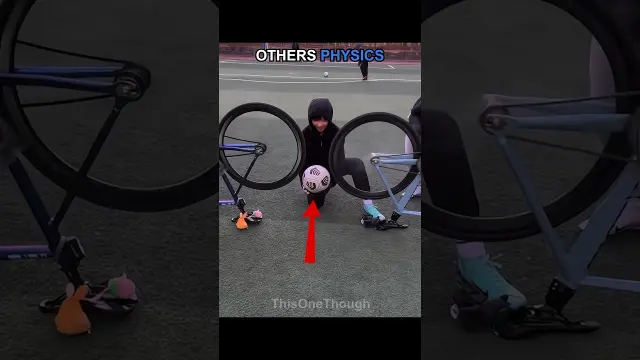
 Physics Moments That Look Fake: Lift, Spin and Inertia
#Everyday Science
1 ideas
Physics Moments That Look Fake: Lift, Spin and Inertia
Get new #Everyday Science ideas by email
Every Thursday: the week's best ideas, with the newest from #Everyday Science.
Related tags
Everyday Science: The Physics and Chemistry All Around You
Science is not something that only happens in laboratories. It happens while you wait for water to boil, when you catch a dropped glass before it hits the floor, when bread dough rises on the counter. Everyday science is simply the habit of looking at ordinary things and asking why they behave the way they do. You already know more of it than you think, because your hands and eyes have been learning the rules of the physical world since you were small. Now and then, it helps to stop and name them.
The physics you already feel
Most of the everyday physics you notice is wrapped up in movement. Inertia is the reason a full cup of coffee sloshes when you start walking and steadies once you're moving at the same pace; nothing wants to change its state until something pushes it. Momentum explains why a heavier object is harder to stop once it's going, and why you instinctively step back when something big is rolling toward you.
Friction is quieter but constant. It's what lets your shoes grip a wet pavement and what wears a hole in the knee of your favourite trousers. Balance works the same way on a ladder as it does on a bicycle: you stay upright by keeping your weight over the base that supports you. None of this needs equations to be useful. Naming it just makes you a little quicker to predict what will happen next.
Read more
Chemistry in the kitchen
Cooking is chemistry with an appetite. Heat changes the structure of proteins and sugars, which is why an egg turns from slippery to firm and why onions sweeten as they brown. Acid and base are the other pairing worth knowing: a squeeze of lemon brightens a heavy dish, while bicarbonate of soda makes a batter rise, because it reacts with an acid and releases bubbles of gas that get trapped in the mixture and lift it as it bakes. Fermentation is the slow chemistry of microbes, and it is behind bread, yoghurt, pickles and vinegar.
Biology at home
You live with an ecosystem. Houseplants lean toward a window because they grow toward light. Mould appears where moisture lingers, because spores are everywhere and only need the right conditions. Your own body is running its own experiments with sleep, hunger and temperature, and it usually tells you plainly what it needs if you pay attention.
How to start noticing
- Ask "why" out loud about one ordinary thing a day, then try to explain it before you look anything up.
- Keep a small notebook for questions you can't answer yet; they're more useful than answers.
- Try a simple experiment with what's in your kitchen, changing one thing at a time so you know what caused what.
- Read past the headline when you meet a scientific claim, and check whether it describes a single study or something well established.
You don't need special equipment to do everyday science, only a bit of patience with your own curiosity. Look closely at what's already in front of you, and the ordinary world gets considerably more interesting.
#Everyday Science: frequently asked questions
How do I start with everyday science if I never studied it?
Begin with something already in front of you rather than with a book — the kettle, the washing-up, the way a door swings shut. Ask why it behaves that way, try to explain it in your own words first, and only then go looking for the accepted answer. Doing this with one ordinary thing a day builds the habit faster than any course would.
What do I need to try simple experiments at home?
Nothing special — kitchen ingredients, a few containers, and something to write on are enough for most of it. The one real requirement is changing a single thing at a time so you can tell what actually caused the result. Patience with your own curiosity matters more than equipment.
Which area of everyday science should I focus on first?
Pick whichever part of your day you already find mildly puzzling, whether that's movement and balance, cooking, or the plants and damp patches around the house. Physics of motion tends to be the most immediately noticeable, while kitchen chemistry rewards you with something you can eat. Interest is a better guide than difficulty here.
How do I keep everyday science going once the novelty wears off?
Keep a running list of questions you couldn't answer instead of chasing answers, because the unanswered ones stay interesting. Revisit the list now and then and see whether anything you've since noticed unlocks one of them. Sharing a puzzle with someone else also tends to keep it alive longer than working on it alone.
What mistakes do beginners make when observing everyday things?
The most common one is changing several things at once and then guessing which one mattered. Another is accepting a headline or a single striking result as settled, when it may be one observation among many. Explaining a thing out loud before checking it is worth the mild embarrassment — it shows you exactly where your understanding is thin.
Can everyday science work as a family or classroom activity?
Yes, and it suits groups well because the questions are things everyone can see for themselves. A shared notebook of puzzles, plus small kitchen experiments where only one variable changes, keeps people comparing notes rather than just watching. The value is in the arguing about explanations, not in getting a tidy answer.
Videos come from YouTube and posts from Instagram; titles and summaries are our own. All rights belong to their creators.