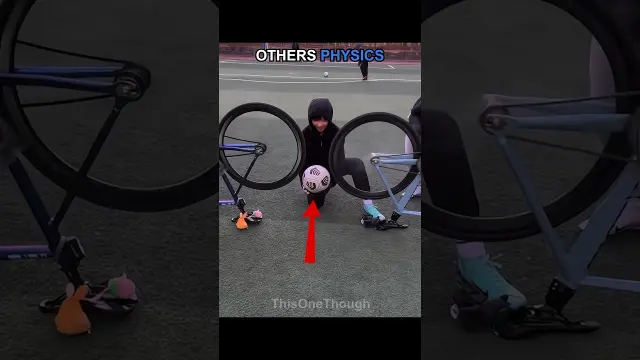
 Physics Moments That Look Fake: Lift, Spin and Inertia
#Inertia
1 ideas
Physics Moments That Look Fake: Lift, Spin and Inertia
Get new #Inertia ideas by email
Every Thursday: the week's best ideas, with the newest from #Inertia.
Related tags
Inertia: The Physics of Things Keeping On
Inertia is the stubbornness built into matter. An object at rest tends to stay at rest; an object already moving tends to keep moving in the same direction at the same speed. Nothing changes that on its own. Something has to push or pull — a force — before the motion changes at all. The idea sounds simple, but it overturned centuries of intuition, because everyday experience is full of friction and drag that hide it. Once you notice inertia, you start seeing it everywhere.
Why it took so long to notice
For a long time, the natural assumption was that motion needs a constant cause: stop pushing a cart and it stops. That is true enough in a world full of friction, but friction is the thing doing the stopping, not the absence of a push. Early modern physicists worked out that an object in motion would carry on forever if nothing interfered. Inertia is the name we give to that resistance to change, and it applies equally to speeding up, slowing down and turning.
Mass is the measure
Read more
How much inertia something has depends on its mass. A loaded trolley takes more effort to start moving and more effort to stop than an empty one. Mass is not the same as weight: weight is the pull of gravity on a mass, which is why your mass stays the same on the Moon while your weight does not. Inertia belongs to the mass itself.
Textbooks often split inertia into three everyday kinds:
- Inertia of rest: a book on a table stays put, and a coin left on a card above a glass drops in when the card is flicked away.
- Inertia of motion: you lurch forward when a bus brakes, because your body was already travelling.
- Inertia of direction: a car turning sharply throws you sideways, since your body wants to continue straight.
The rotational version
Spinning objects resist changes to their spin too, and how that resistance is distributed matters. Mass held close to the axis of rotation is easier to speed up than the same mass held far out. This is why a tightrope walker carries a long pole, why a spinning top stays upright, and why a skater drawing their arms in spins faster. Rotational inertia is the same idea as ordinary inertia, just applied to turning rather than travelling in a line.
Living with it
You cannot remove inertia, but you can work with it. Secure heavy loads in a car so they do not keep moving when you brake. Leave a gap when following another vehicle, since stopping distance grows with mass and speed. Push heavy furniture from low down and close to its base rather than high up, where it is more likely to tip. And when you carry something fragile, move smoothly: sudden starts and stops are exactly what inertia is waiting for.
A few simple experiments make the concept stick — the coin and card, a cloth pulled quickly from under a plate, a raw and a boiled egg spun on a table. Try them, and inertia stops being an abstraction and becomes something you can feel in your hands.
#Inertia: frequently asked questions
What is inertia, in the simplest terms?
Inertia is matter's built-in reluctance to change how it is moving. Something sitting still stays still, and something already travelling keeps going the same way at the same speed, until a push or pull acts on it. It applies just as much to slowing down and turning as it does to starting.
How can I actually see inertia at home instead of just reading about it?
Try the classic tricks: flick a card out from under a coin so the coin drops straight into a glass, or yank a cloth quickly from beneath a plate and watch the plate stay put. Spinning a raw egg and a boiled one side by side is another quick way to feel the difference. Any of these turns inertia from an abstract rule into something your hands understand.
What decides how much inertia an object has?
Mass does. A loaded trolley is harder to get going and harder to bring back to rest than an empty one, because there is simply more matter resisting the change. Weight is a different thing — it is gravity's pull on that mass, which is why your mass is unchanged on the Moon even though you would weigh less there.
Are there different kinds of inertia to know about?
Everyday physics usually points to inertia of rest, of motion, and of direction. A book holding still on a table shows the first, your body lurching forward when a bus brakes shows the second, and being thrown sideways as a car turns sharply shows the third. Spinning objects have their own rotational version, where how far the mass sits from the axis matters.
Which common mistakes make inertia catch people out?
The usual error is assuming stopping happens instantly, so loads are left unsecured in a car or a following distance is cut too fine. Another is pushing heavy furniture high up, where it is far more likely to tip than when pushed low and close to the base. Carrying fragile things with jerky starts and stops hands inertia exactly the moment it needs to ruin your day.
Can inertia be reduced or done away with?
No — it comes with having mass at all, so you work around it rather than against it. Move smoothly with delicate objects, leave room when following another vehicle, and tie down anything heavy that could keep travelling when you brake. Working with inertia instead of fighting it is what keeps everyday situations predictable.
Videos come from YouTube and posts from Instagram; titles and summaries are our own. All rights belong to their creators.