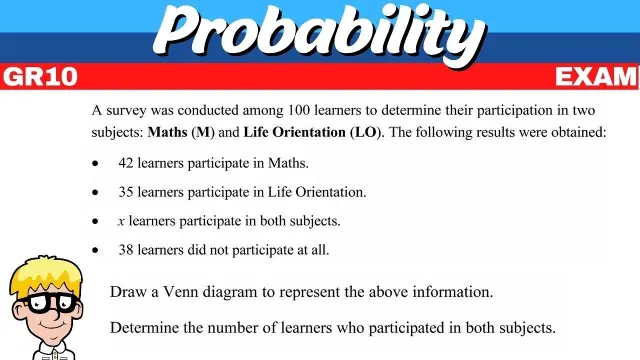
 Grade 10 probability exam question worked through step by step
#Exam Questions
1 ideas
Grade 10 probability exam question worked through step by step
Get new #Exam Questions ideas by email
Every Thursday: the week's best ideas, with the newest from #Exam Questions.
Related tags
How to Read and Answer Exam Questions With Confidence
An exam question is a prompt written to find out what you can do with what you have learned. It is not a trap and not a memory test alone. Most papers are built from a syllabus or course outline, and each question is tied to a specific skill: recalling a fact, explaining a process, comparing two things, applying a rule to a new case, or arguing a position. Understanding that design is half the work of answering well.
The main kinds of question
Multiple-choice questions ask you to choose between close alternatives, so the difference between the right answer and the almost-right one usually comes down to a single word.
Short-answer questions expect a few precise sentences, not a paragraph of everything you know about the topic.
Read more
Essay and long-response questions test structure and judgement. You are being asked to select relevant material, order it, and reach a conclusion.
Data, source and case questions give you material you have not seen before and ask you to interpret it, applying familiar methods to unfamiliar content.
Practical, oral and open-book formats test how you work rather than only what you remember, and they reward preparation of a different kind: knowing where your notes are, and being able to explain your reasoning out loud.
Command words
Most questions turn on a command word, and these are not interchangeable. To describe is to set out what happens. To explain is to say why or how. To compare is to give both similarities and differences. To evaluate is to weigh strengths against weaknesses and come to a view. Answering an "explain" question with a description, however accurate, usually loses marks, because you have answered a slightly different question than the one asked.
Practical habits that help
Read the whole paper first, or at least the questions on the section you are starting, so your mind has time to work in the background. Note how many marks each question carries and let that guide how much you write; a two-mark question rarely needs half a page. Answer the easiest questions first to settle yourself, then return to the harder ones.
Underline the instruction and any limiting words such as "two reasons" or "with reference to the passage". Candidates lose more marks to missed instructions than to gaps in knowledge.
For longer answers, spend a minute sketching a short plan. It keeps your argument in order and prevents repetition.
When practising, work from past papers or question banks under timed conditions, then mark your own answers against the expected points. Reviewing why an answer was marked down teaches more than collecting new questions, and it is the habit that quietly turns steady work into good results on the day.
#Exam Questions: frequently asked questions
How do I start preparing for exam questions?
Begin with the course outline or syllabus, because most papers are built directly from it and every question traces back to a skill you were taught. Group the topics by the kind of task they demand — recalling, explaining, comparing, applying — so you know what each one will actually ask of you. From there, work through past papers or question banks rather than rereading notes, since answering is the skill being tested.
What should I bring or prepare before sitting a paper?
The essentials are knowing the format in advance: which sections are compulsory, how much choice you have, and how the marks are distributed. For open-book, oral or practical formats, preparation is different — you need to know where your notes are and be able to explain your reasoning aloud. Read the whole paper or at least your starting section before writing, so your mind begins working in the background.
How do I choose which questions to answer when there is a choice?
Pick the questions you can answer most fully, not the ones that merely look familiar, because a topic you recognise may still carry a command word you cannot satisfy. Answer the easiest one first to settle yourself, then return to the harder choices with time in hand. Check the mark weighting for each option, since a heavier question well answered is worth more than several rushed ones.
How do I keep my answers focused so I do not lose marks?
Underline the instruction and any limiting words such as how many reasons are wanted, or whether you must refer to a passage — missed instructions cost more marks than gaps in knowledge. Match your length to the marks available; a short-answer question wants a few precise sentences, not everything you know. For longer responses, spend a minute sketching a short plan so your argument stays in order and does not repeat itself.
What is the most common mistake people make with exam questions?
The classic error is answering a slightly different question than the one asked — describing a process when the command word said explain, or listing similarities when it said compare. Command words are not interchangeable, so an accurate answer to the wrong task still loses marks. The second common slip is ignoring the mark scheme's expected points rather than reviewing them when practising.
How can I improve my results while practising?
Work under timed conditions, then mark your own answers against the expected points instead of just collecting more questions. Reviewing why an answer was marked down teaches far more than doing another paper, because it shows you the gap between what you wrote and what was wanted. Over time this habit quietly turns steady practice into better performance on the day.
Videos come from YouTube and posts from Instagram; titles and summaries are our own. All rights belong to their creators.