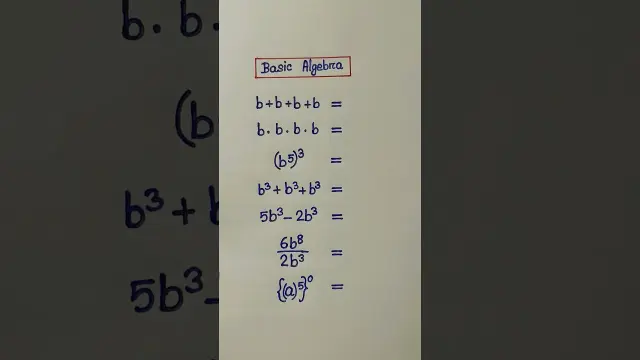
 Quick Basic Algebra Lesson Focused on Exponents and Powers
#Exponents
1 ideas
Quick Basic Algebra Lesson Focused on Exponents and Powers
Get new #Exponents ideas by email
Every Thursday: the week's best ideas, with the newest from #Exponents.
Related tags
Exponents: A Clear Guide to Powers and Rules
Exponents are a compact way to write repeated multiplication. Instead of writing the same factor again and again, you can use a small number called an exponent to show how many times a base is used. For example, in 3^4, the 3 is the base and the 4 tells you to multiply 3 by itself four times.
What exponents mean
Exponents appear in algebra, arithmetic, science, and measurement. They help you write large numbers, compare quantities, and express formulas more clearly. You may also hear them called powers or indices in some contexts.
A few basic examples make the idea easier to see:
Read more
- 2^3 means 2 × 2 × 2
- 5^2 means 5 × 5
- 10^4 means 10 × 10 × 10 × 10
The value of the exponent tells you how many copies of the base are multiplied together, not how many times the number appears in total.
Common kinds of exponents
Most beginners start with whole-number exponents, but you may also meet a few special cases.
- Positive exponents show repeated multiplication
- Zero exponent means the result is 1, as long as the base is not zero
- Negative exponents represent reciprocals, such as 2^-3 = 1/2^3
- Fractional exponents connect powers and roots, such as square roots and cube roots
If you are just getting started, it helps to master whole-number exponents first before moving to the more advanced ones.
Basic rules to know
Exponent rules save time, but they only work when you apply them carefully. The most common ones are:
- When multiplying powers with the same base, add the exponents: a^m × a^n = a^(m+n)
- When dividing powers with the same base, subtract the exponents: a^m ÷ a^n = a^(m-n)
- When raising a power to another power, multiply the exponents: (a^m)^n = a^(m×n)
- A power of one leaves the number unchanged: a^1 = a
- Any nonzero number to the zero power equals 1: a^0 = 1
One important habit is to keep the base and exponent clear. Confusing them can lead to incorrect answers, especially when expressions include parentheses.
Tips for beginners
Start by writing out exponents as repeated multiplication. That simple step helps you see what the power means and prevents common mistakes. Then practice with small numbers before working with variables.
Keep these points in mind:
- Read expressions carefully, especially if parentheses are involved
- Use parentheses when a negative number is the base, such as (-2)^4
- Remember that -2^4 is not the same as (-2)^4
- Check whether the exponent applies to a whole expression or only part of it
Why exponents matter
Exponents make mathematical writing shorter, clearer, and more flexible. They are useful in algebra, formulas, geometry, and many everyday calculations. Once you understand the idea of a base raised to a power, the rules begin to feel natural.
If you practice by expanding powers, simplifying expressions, and comparing similar examples, exponents become much easier to read and use with confidence.
Videos come from YouTube and posts from Instagram; titles and summaries are our own. All rights belong to their creators.