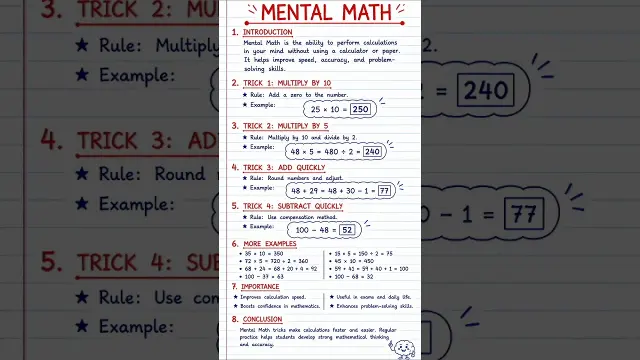
 Fast Calculation Techniques and Mental Math Tricks
#Fast Calculation
2 ideas
Fast Calculation Techniques and Mental Math Tricks
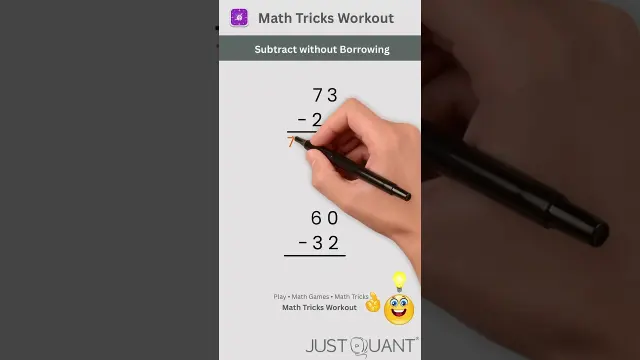 Mental Math Trick for Subtraction Without Borrowing
Get new #Fast Calculation ideas by email
Every Thursday: the week's best ideas, with the newest from #Fast Calculation.
Related tags
Fast Calculation and Mental Math
Fast calculation is the skill of working out numbers quickly and accurately in your head or with only a little written support. It is used in everyday life for shopping, budgeting, cooking, splitting bills, measuring, and checking whether an answer makes sense. The idea is not to replace careful calculation, but to make numbers feel more manageable and less intimidating.
What fast calculation includes
At its heart, fast calculation is about recognizing patterns and using simpler steps. Instead of doing every sum in the most direct way, you break a problem into easier parts. For example, you may round numbers to get a rough answer first, then adjust it. Or you may split a number into tens and ones so the arithmetic becomes more natural.
This kind of thinking has been used for a very long time, long before calculators were common. Mental arithmetic was especially important in trade, schooling, and daily household tasks. Even now, it remains useful because it helps you stay flexible with numbers and catch obvious mistakes.
Read more
Common techniques
There are many ways to speed up calculation, and different people prefer different methods.
- Rounding: turn numbers into close, easier numbers, then correct the result.
- Decomposition: split numbers into parts, such as 47 into 40 and 7.
- Compensation: make one number easier to work with, then balance the change.
- Doubling and halving: useful for multiplication when one factor can be made smaller and the other larger.
- Using complements: helpful for subtraction by counting up to the next ten, hundred, or thousand.
- Estimation first: quickly check the size of the answer before doing exact work.
These methods work best when you understand why they work, not just when you memorize steps.
What beginners should know
If you are just starting, begin with small numbers and simple operations. Accuracy matters more than speed at first. Once a method feels natural, the speed usually follows on its own.
A good habit is to look for friendly numbers. Numbers ending in 0 or 5, or numbers close to a round ten, often make calculations easier. It also helps to say the steps quietly in your head or write down only the hardest part while keeping the rest mentally.
Another useful practice is checking your answer in a different way. For example, if you multiply, you can estimate first. If the final answer is very different from your estimate, it is worth checking again.
Practical tips for getting faster
- Practice a little at a time rather than for too long.
- Work on one type of calculation until it feels comfortable.
- Try to avoid counting from the beginning every time.
- Use patterns you already know, such as times tables and number bonds.
- Stay calm; rushing often causes more errors than it saves time.
Fast calculation becomes easier with repetition. Over time, you start to notice shortcuts automatically. That does not mean you stop being careful. It means you learn to choose the simplest path through a problem.
Videos come from YouTube and posts from Instagram; titles and summaries are our own. All rights belong to their creators.