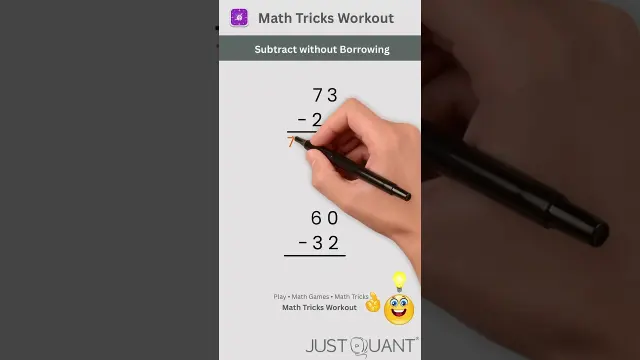
 Mental Math Trick for Subtraction Without Borrowing
#Subtraction Trick
1 ideas
Mental Math Trick for Subtraction Without Borrowing
Get new #Subtraction Trick ideas by email
Every Thursday: the week's best ideas, with the newest from #Subtraction Trick.
Related tags
Subtraction Tricks for Faster Mental Math
What subtraction tricks are
Subtraction tricks are simple ways to make subtraction easier and quicker, especially when you want to calculate in your head. Instead of always using the standard written method, you can break numbers apart, count up, or adjust the numbers in a helpful way. These methods are useful for everyday calculations, homework, shopping, budgeting, and any situation where you want to check an answer without using a calculator.
At its core, subtraction means finding the difference between two numbers. There is one main idea behind every trick: make the numbers easier to work with while keeping the answer the same. Once you understand that, subtraction becomes much less intimidating.
Common ways to make subtraction easier
Read more
One of the most useful methods is to split numbers into place values. For example, you can subtract tens and ones separately, then combine the results. This is often easier than working with the whole number at once.
Another helpful approach is counting up. If the numbers are close together, you can start with the smaller number and count up to the larger one. This is especially useful when subtracting numbers like 52 from 60, because the steps are small and easy to see.
You can also use compensation, which means adjusting a number to make the subtraction simpler, then correcting for the change. For example, if a number is close to a round ten or hundred, you may find it easier to subtract from that round number first.
How to handle subtraction without borrowing
Many people find subtraction harder when borrowing, or regrouping, is involved. A useful trick is to rewrite the numbers so you do not need to borrow in the usual way. This can be done by breaking the top number into parts.
For example:
- 74 - 38 can be thought of as 70 - 30, then 4 - 8
- If that feels awkward, you can adjust the problem: 74 - 40 = 34, then add 2 back to get 36
This kind of flexible thinking helps you choose the easiest path to the answer. With practice, you will start to see which method fits each problem best.
What beginners should know
If you are just learning subtraction tricks, start with small numbers and simple patterns. Make sure you understand place value first, because it is the foundation for all mental subtraction methods. It also helps to estimate before you calculate so you can check whether your answer makes sense.
A few useful habits:
- Work slowly at first
- Say the steps in your head or out loud
- Use round numbers when possible
- Check your result by adding it back to the smaller number
Practical tips
The best subtraction trick is the one that feels natural to you. Some people prefer counting up, while others like splitting numbers into tens and ones. Try a few methods and notice which one is quickest for you.
If you want to get better, practice with everyday examples such as time, money, and small quantity differences. The more familiar you become with number patterns, the easier subtraction will feel. Over time, you will be able to spot simple shortcuts and solve problems with more confidence.
Videos come from YouTube and posts from Instagram; titles and summaries are our own. All rights belong to their creators.