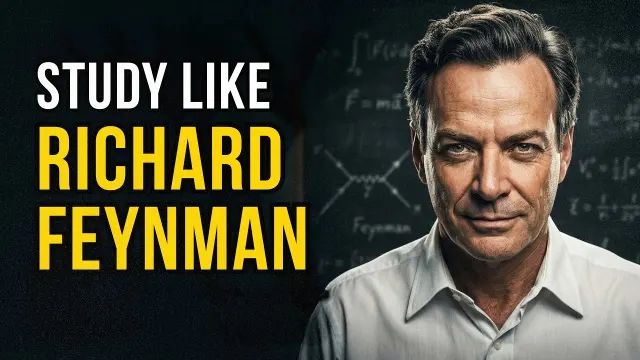
 The Learning System Behind Richard Feynman's Understanding
#Feynman Technique
1 ideas
The Learning System Behind Richard Feynman's Understanding
Get new #Feynman Technique ideas by email
Every Thursday: the week's best ideas, with the newest from #Feynman Technique.
Related tags
The Feynman Technique: Learn Anything by Explaining It
Some ideas feel understood until the moment you try to say them out loud. The Feynman Technique is a way of studying that turns that moment into a test you can use on purpose. It is named after the physicist Richard Feynman, who was known for his insistence on explaining complicated ideas in ordinary language, and it has since become one of the most widely borrowed study routines among people who teach themselves things.
The premise is simple: if you can explain something clearly to someone who knows nothing about it, you understand it. If you cannot, you have found the edge of your knowledge — which is exactly where the useful work begins.
The four steps
- Choose one idea. Not a whole subject, not a chapter — a single concept you want to be able to use, such as how interest compounds or why a particular chord resolves the way it does.
- Explain it in plain words. Write it out as if you were teaching a friend who has no background in the field. Use short sentences. Avoid the vocabulary of the subject where you can, and when you must use a term, define it in the same breath.
- Notice where you stall. Vague phrases, borrowed jargon and abrupt jumps in logic are the signs. Mark those spots instead of smoothing over them.
- Return to the source and fill the gaps. Read, ask, or look it up until you can answer your own hesitation — then rewrite the explanation from the beginning without looking at your notes.
Read more
Why it works
Much of what passes for learning is recognition. A page looks familiar, a formula feels known, and the feeling of familiarity is mistaken for understanding. Explaining removes that comfort, because producing language forces you to supply the connections that recognition lets you skip. The gaps you meet are not failures; they are the most informative thing the exercise produces.
Getting started
Beginners tend to make two mistakes. The first is keeping an audience in mind who already knows the subject, which lets jargon stand in for thought. Imagine instead someone intelligent but entirely outside the field. The second is writing an explanation once and calling it done. The technique works in rounds: explain, find the gap, learn, explain again more simply.
Write by hand if you can, in a notebook you keep for one topic, and keep every draft. Comparing an early attempt with a later one shows you plainly what changed.
Ways to use it
You can apply the technique to almost anything — a grammar rule, a historical argument, a piece of software, a craft technique, a recipe's underlying logic. It is especially valuable before an exam or an interview, when the temptation to reread notes is strong and the value of testing yourself is higher.
It also pairs well with teaching. Explaining something to a real person, and watching where their questions land, is the same exercise with a live audience.
The habit is modest and takes only a pen and a little honesty. What it asks is that you stop at the moment you would rather keep going, and look at what you cannot yet say.
#Feynman Technique: frequently asked questions
How do I actually start using the Feynman Technique?
Pick one single concept you want to be able to use, rather than a whole subject or chapter, and write an explanation of it as if teaching a friend with no background in the field. Then read your own draft and mark the places where you went vague, leaned on jargon, or jumped over a logical step. Go back to your source for those spots and rewrite the explanation from the beginning without looking at your notes.
What do I need to practise it?
Very little — a pen, a notebook kept for that one topic, and whatever source you are learning from. Writing by hand is worth it if you can, and keeping every draft lets you compare an early attempt with a later one and see exactly what changed. The real requirement is honesty about the moment you would rather keep going than stop and look at what you cannot yet say.
Is there only one correct version of the technique?
The core is a loop rather than a fixed ritual: explain simply, notice the gap, learn what fills it, then explain again more plainly. How you run that loop is yours to adapt — in a notebook, out loud, or with a live listener whose questions show you where your explanation breaks. Variations differ in format, not in what they are testing.
How do I know it is working?
Your explanations get shorter and plainer, and the questions you used to stumble over become ones you can answer without reaching for the subject's vocabulary. The gaps you find along the way are not a sign of failure — they are the most useful thing the exercise produces, because they tell you where to spend your time. If every draft feels smooth and easy, you are probably still writing for someone who already knows the subject.
When is it most useful?
It pays off whenever the temptation to reread notes is strong, such as preparing for an exam or an interview, because rereading mostly produces a feeling of familiarity rather than understanding. It works just as well on a grammar rule, a historical argument, a craft technique, or the logic behind a recipe. It also pairs naturally with teaching: explaining to a real person and watching where their questions land is the same exercise with a live audience.
What mistakes should beginners avoid?
The most common is keeping an expert audience in mind, which lets jargon stand in for thought — imagine instead someone intelligent but entirely outside the field. The other is treating one written explanation as the finish line; the technique works in rounds, so expect to explain, find the gap, learn, and explain again more simply. Smoothing over the places where you stall, instead of marking them, removes the whole benefit.
Videos come from YouTube and posts from Instagram; titles and summaries are our own. All rights belong to their creators.