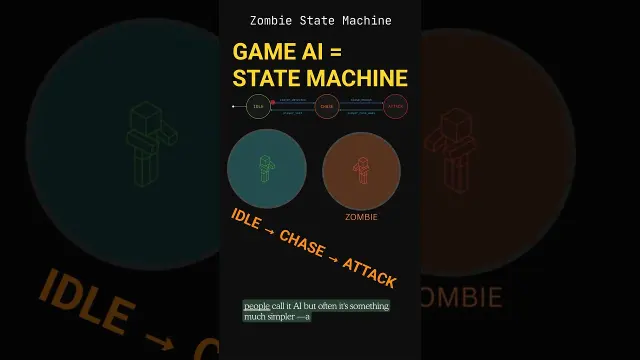
 Finite State Machines Explained Using Game AI
#Finite State Machines
1 ideas
Finite State Machines Explained Using Game AI
Get new #Finite State Machines ideas by email
Every Thursday: the week's best ideas, with the newest from #Finite State Machines.
Related tags
Finite State Machines Explained
Finite state machines are a simple way to describe how something behaves when it can only be in one state at a time. You can think of a state as a mode or condition, such as idle, active, waiting, or finished. A finite state machine defines the states something can have, the events that move it from one state to another, and the rules that decide those transitions.
What a finite state machine is
At its core, a finite state machine is a model for orderly behavior. It helps you break a process into clear steps instead of letting everything happen at once. This makes it useful anywhere you need predictable sequences, from software logic and user interfaces to simple game behavior, workflow design, and even everyday systems like traffic lights or vending machines.
The word finite means there is a limited number of states. That limit is what keeps the model easy to understand and control. Each state has a clear meaning, and each transition has a clear trigger.
Read more
Why people use them
Finite state machines are popular because they make complex behavior easier to reason about. Instead of writing many tangled conditions, you describe what should happen in each state and what causes a change.
They are especially helpful when:
- a system should only do certain things in certain conditions
- behavior needs to be predictable and testable
- you want to avoid confusing logic spread across many places
- you need to show the flow of actions clearly
Main parts of a finite state machine
A basic finite state machine usually includes:
- States: the possible modes or conditions
- Events or inputs: things that happen from outside or inside the system
- Transitions: the moves from one state to another
- Actions: things that happen when entering, leaving, or staying in a state
Some models also include a start state and one or more end states, depending on how they are used.
Common kinds and styles
There are a few common ways to think about finite state machines. In a simple version, every input leads to one clear result. In a more practical version, a state may stay active until a specific event occurs. Some systems use outputs that depend only on the current state, while others let outputs depend on both the state and the input.
You may also hear about state diagrams, which are drawings that show states as circles and transitions as arrows. These diagrams are often the easiest way to plan a machine before building it.
What beginners should know
When you design one, start small. Choose only the states you truly need. If you create too many, the machine becomes harder to manage. It also helps to make each state distinct, with one clear purpose.
A good question to ask is: “What needs to be true for this state to make sense?” Another useful question is: “What event should move it to the next state?” If you can answer those simply, your model is probably on the right track.
Practical tips
- Keep states mutually clear, so one state does not overlap too much with another
- Use transitions only when a real change is needed
- Make the start point obvious
- Check for missing transitions, especially in unusual cases
- Keep the design readable, so future changes are easier
Finite state machines are powerful because they are simple. When you need structure, clarity, and predictable behavior, they are often one of the best ways to model the problem.
Videos come from YouTube and posts from Instagram; titles and summaries are our own. All rights belong to their creators.