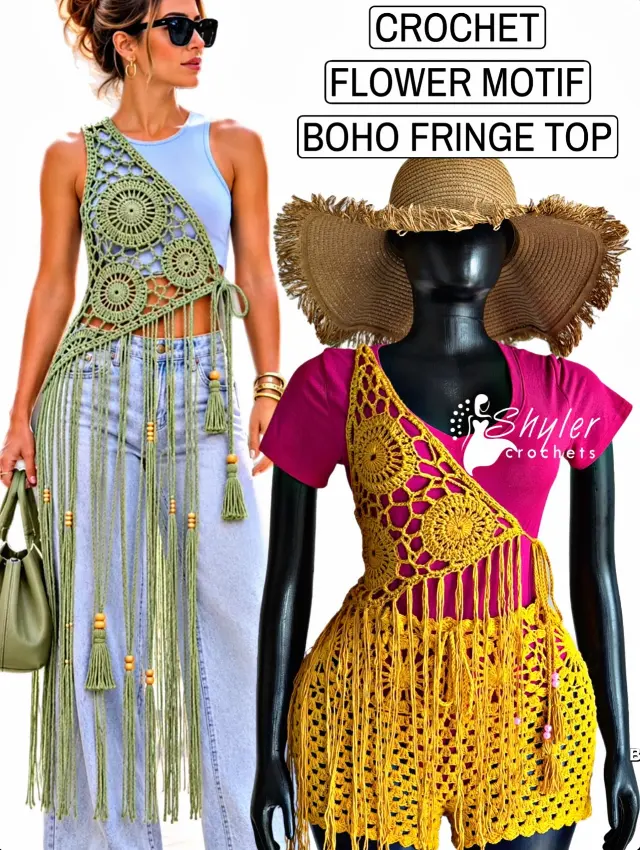
 Flower motif boho fringe crochet top tutorial
#Flower Motif
1 ideas
Flower motif boho fringe crochet top tutorial
Get new #Flower Motif ideas by email
Every Thursday: the week's best ideas, with the newest from #Flower Motif.
Related tags
Flower Motifs: A Guide to Blooms in Craft and Design
A flower motif is a single, repeatable bloom — stitched, crocheted, printed, carved, or painted — that can stand alone or be joined with others to make something larger. The idea is old and almost universal. People have decorated cloth, pottery, furniture and walls with flowers for as long as they have decorated anything at all, and the reasons have stayed remarkably consistent: a flower is a shape everyone recognises, it is forgiving to draw and to sew, and it carries meaning without needing words.
Where the motif comes from
Floral ornament appears across nearly every craft tradition, from embroidered household linens to painted ceramics to woven textiles. Different cultures developed their own vocabularies — stylised blossoms, symmetrical rosettes, trailing vines, single blooms worked in a neat circle — and many of those shapes travelled along trade routes and were copied, adapted and renamed. That is why a motif you learn from one tradition often looks familiar in another. You are not borrowing from nowhere; you are joining a very long conversation.
The main kinds
Read more
Flower motifs vary mostly by technique, and each one shapes the result:
- Embroidery motifs, worked on their own or scattered across a piece, from simple daisy stitch to dense satin-petalled blooms.
- Crochet and knitted motifs, usually worked in the round as a small medallion, then joined into blankets, bags, garments or edgings.
- Appliqué and patchwork, where fabric flowers are cut and stitched onto a ground, often with a contrast between print and plain.
- Printed and painted motifs, repeating across wallpaper, ceramics or stationery.
- Carved and relief motifs in wood, stone and metal, where the same shapes are cut rather than threaded.
Within each of these there is a further choice: naturalistic flowers that imitate real petals and leaves, or stylised ones built from simple geometric repeats. Neither is better. Naturalistic work rewards patience and observation; stylised work rewards rhythm and consistency.
What beginners should know
Start with one motif and repeat it rather than collecting many. Repetition is what makes a flower look deliberate, whether you are scattering embroidered daisies across a napkin or joining crocheted squares.
Choose a simple shape first. A five-petal flower with a round centre teaches you tension, spacing and joining without demanding precision in every curve.
Work a sample before you commit. A single motif on scrap fabric or a spare ball of yarn tells you whether the size, colour and weight suit the project you have in mind.
Sketch before you stitch. Drawing a flower a few times in pencil is the fastest way to understand how its petals sit, and it costs nothing.
Keep your colours limited. Two or three tones per motif usually reads more clearly than many, especially in small-scale work.
Practical tips
If you are joining motifs, check that they are the same size before you make twenty of them. If you are embroidering, keep your starting and finishing threads tidy at the back, since floral work is often seen from both sides. And leave room around a bloom: a flower surrounded by empty space reads as a motif, while one crowded by neighbours turns into pattern.
Above all, let the flower be simple. A few well-placed petals will always look more confident than a complicated bloom you fought with.
#Flower Motif: frequently asked questions
How do I start with a flower motif if I have never made one before?
Pick a single simple bloom and learn it thoroughly instead of sampling many different ones. A rounded centre with a few soft petals lets you practise tension, spacing and joining without needing every curve to be exact. Work it once on scrap fabric or a spare ball of yarn so you can judge the size and weight before committing to a real project.
What supplies or skills do I actually need?
It depends on the technique you choose, but the essentials stay modest: thread or yarn that suits your fabric, a needle or hook in a matching size, and something to work on. A pencil and paper are worth having too, since sketching the flower a few times teaches you how the petals sit faster than any instruction. Beyond that, patience with repetition matters more than a large stash of materials.
Which kind of flower motif should I choose?
Let the finished object decide for you. Embroidered and appliqué blooms suit linens, garments and soft furnishings, crocheted or knitted medallions are best when you want pieces you can join into something larger, and printed, painted or carved motifs belong on surfaces rather than cloth. Then choose between a naturalistic bloom that copies real petals and a stylised one built from simple geometric repeats — neither is superior, they just reward different habits.
How do I keep a motif looking crisp and well made?
Keep the palette narrow, since a limited range of tones usually reads more clearly than many colours crowded together, especially at a small scale. Leave empty space around each bloom so it stays a motif rather than dissolving into overall pattern, and if you are joining pieces, confirm they match in size before you make a whole batch. Tidy thread ends at the back are also worth the effort, as floral work is often seen from both sides.
What are the common mistakes beginners make?
The usual trap is collecting lots of different flowers instead of repeating one well — repetition is what makes a motif look intentional. Another is crowding motifs together with no breathing room, which turns a design into a busy texture. Fighting an over-complicated bloom is the third: a few confident petals nearly always look better than an elaborate shape you struggled with.
Where can I use a flower motif once I have mastered it?
Almost anywhere, which is part of their appeal — household linens, bags, garments, edgings, ceramics, stationery and furniture all carry them comfortably. Because the same shape can be stitched, crocheted, printed or carved, a motif you learn in one material translates easily into another. Try it on something small and low-stakes first, then scale it up.
Videos come from YouTube and posts from Instagram; titles and summaries are our own. All rights belong to their creators.