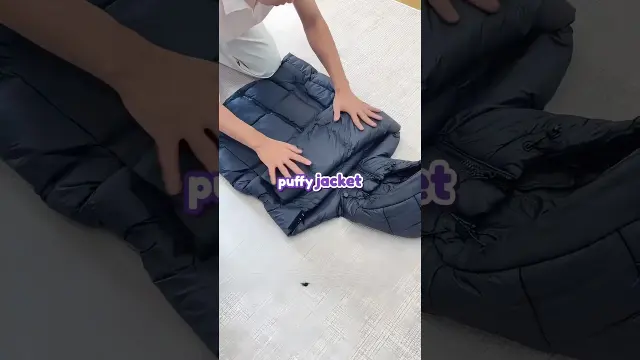
 How to Fit Twice as Much Into Your Suitcase
#Folding
1 ideas
How to Fit Twice as Much Into Your Suitcase
Get new #Folding ideas by email
Every Thursday: the week's best ideas, with the newest from #Folding.
Related tags
Folding: Clothes, Linens and Paper, Done Neatly
Folding is the act of bending something flexible back on itself so it takes up less room and holds its shape. We do it mostly with two materials: cloth and paper. Both reward the same habits — a flat surface, a little patience, and creases made deliberately rather than by accident.
Folding clothes
The everyday fold is the one most of us learned first: lay the garment face down, smooth out the wrinkles with your palm, fold the sides in toward the middle, then bring the bottom edge up. Done consistently, it produces a stack of even rectangles that sit calmly on a shelf. Keep the fold lines on the sides rather than down the centre of a shirt front, and match the folded width of each item to the ones beneath it so the pile doesn't lean.
A variation worth learning is vertical, or file, folding. Instead of stacking garments flat on top of each other, you fold each one into a compact rectangle firm enough to stand on its edge, then line them up in the drawer like cards in a box. You see everything at once, and lifting one piece out doesn't disturb the rest.
Read more
Rolling suits soft things — knitwear, pyjamas, scarves, anything going into a bag. Rolled items fill gaps well and tend to crease less than sharply folded ones. Structured pieces, jackets and anything with a defined shoulder are better hung than folded, while fine knits are better folded than hung, since a hanger can pull the shoulders out of shape.
Linens and packing
Fitted sheets fold most easily when you tuck one corner into another, then fold the resulting bundle into a neat rectangle. A whole set stays together if you store it inside its own pillowcase. For a suitcase, roll the soft items, fold the stiff ones, and place heavier things low and near the wheels.
Folding paper
Paper folding, or origami, begins with two moves: the valley fold, which brings the paper toward you, and the mountain fold, which bends it away. Almost every model grows from a handful of starting shapes — a square base, a triangle base, a waterbomb base — built up from those two creases. Press each fold firmly, running a fingernail along the edge, because a sharp crease holds the next step in place.
What beginners should know
Work on a hard, flat surface rather than a soft one. Smooth the fabric or paper as you go, so you're never folding air. Don't press delicate textiles along the same line every time — fibres weaken where they're repeatedly creased, so alternate the fold or store loosely. And give yourself permission to refold: the first attempt is only a rehearsal.
Videos come from YouTube and posts from Instagram; titles and summaries are our own. All rights belong to their creators.