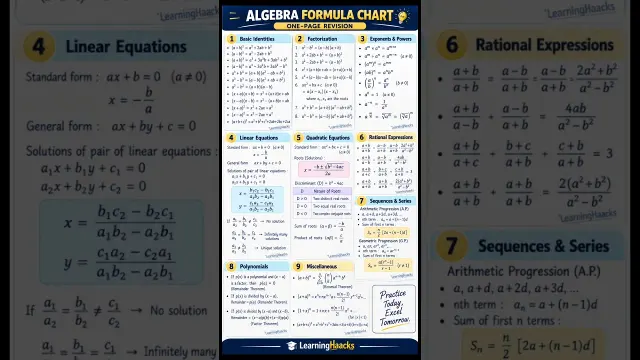
 All important algebra formulas in one revision sheet
#Formula Sheet
2 ideas
All important algebra formulas in one revision sheet
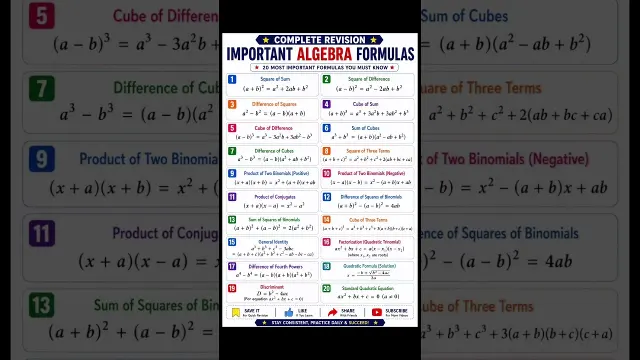 One-page algebra formula sheet for fast revision
Get new #Formula Sheet ideas by email
Every Thursday: the week's best ideas, with the newest from #Formula Sheet.
Related tags
How to Make a Formula Sheet That Actually Works
A formula sheet is a compact reference that collects the equations, identities and constants of a subject onto one or two pages, arranged so you can find what you need at a glance. It exists for a simple reason: no one carries a whole textbook in their head, but during practice you constantly need to check whether the area of a circle uses the radius or the diameter. A good sheet answers that question in seconds and keeps you in the flow of solving rather than flipping pages.
What belongs on it
The core of a formula sheet is the small set of expressions you reach for over and over: the standard forms, the rearrangements that come up again and again, and the conditions under which each one holds. Conditions matter more than people expect. An equation that is only valid for right-angled triangles, or only for ideal gases, or only when a quantity stays constant, is a trap if you have memorised it without its assumptions.
Besides the formulas themselves, most useful sheets include:
Read more
- the units each quantity is measured in, and any constant you keep forgetting
- a short note on when to use one relation rather than a near-identical one
- one worked example of a formula being rearranged, if the algebra is the hard part
- the definitions of the symbols, so nothing is ambiguous later
Leave out anything you already know cold. A sheet padded with obvious material stops being a quick lookup and becomes a second textbook.
Build it yourself
Copying someone else's sheet saves an evening but loses most of the value. The act of deciding what to include, writing it out and organising it is where the learning happens. Write your own, even if you later compare it with a friend's.
Structure helps retrieval. Group formulas by topic rather than by the order they appeared in lessons, and keep the layout consistent from section to section. Handwriting on paper works well because drawing a diagram beside an equation is often faster than describing it in words. A digital document is easier to search and update, and typing formulas forces you to be precise about symbols. Either is fine, as long as you can scan it quickly.
Getting real use from it
A formula sheet is a tool, not a talisman. Having one on your desk does not replace understanding why an equation is true; it should support your practice, not substitute for it. Use it while solving problems, and notice which entries you consult repeatedly: those are the ones worth understanding more deeply so you stop needing the sheet for them.
Revise the sheet as your course progresses. Add formulas when you meet them, remove the ones you have truly absorbed, and tidy the layout when it starts to sprawl. A sheet that shrinks over a term is a quiet record of progress.
Finally, use it in self-testing. Cover the right-hand side and try to recall it, or work a problem with the sheet closed and check afterwards. That small discomfort is where memory forms.
#Formula Sheet: frequently asked questions
What is a formula sheet, and how do I start making one?
It is a short personal reference that gathers the equations, identities and constants of a subject in one place, so you can check a detail without breaking your concentration. Start by working through your own notes and exercises and writing down only the formulas you actually reach for, rather than copying a ready-made sheet. The deciding, writing and grouping is where most of the learning happens.
What should I include on it, and what should I leave off?
Include the standard forms, the rearrangements that keep coming up, the conditions each one is valid under, plus units, symbol definitions and any constant you keep forgetting. Add a short note on when to use one relation instead of a near-identical one, and a worked rearrangement if the algebra is the hard part. Leave out anything you already know cold, because padding it turns a quick lookup into a second textbook.
Is a handwritten sheet better than a digital one?
Both work, and the choice comes down to how you use it. Paper is good because sketching a diagram next to an equation is often quicker than describing it in words, while a digital document is easier to search, update and reorder as your course moves on. Pick whichever you can scan at a glance during practice.
How should I organise the formulas so I can find them quickly?
Group them by topic rather than by the order they appeared in your lessons, and keep the layout the same from section to section so your eye knows where to go. Write the symbol definitions nearby so an entry is never ambiguous later. The real test is whether you can locate a formula in seconds while solving.
What mistakes do people make with formula sheets?
The most common one is memorising an expression without its assumptions, so it gets applied to situations it was never valid for, such as a relation that only holds under a particular condition. Another is treating the sheet as a substitute for understanding why the equation is true. A third is never revising it, so it fills with material already absorbed and stops being quick to read.
How can I use it to actually study, not just to look things up?
Notice which entries you consult again and again, and work on understanding those deeply until you no longer need them. Cover the right-hand side of an entry and try to recall it, or solve a problem with the sheet closed and check afterwards. That slight discomfort is where memory forms, and a sheet that shrinks over a term is a quiet record of progress.
Videos come from YouTube and posts from Instagram; titles and summaries are our own. All rights belong to their creators.