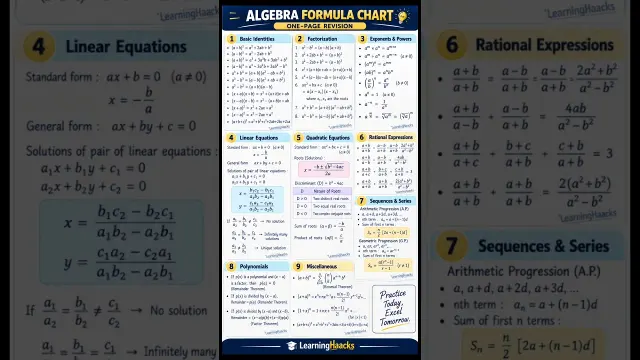
 All important algebra formulas in one revision sheet
#Quadratic Equations
3 ideas
All important algebra formulas in one revision sheet
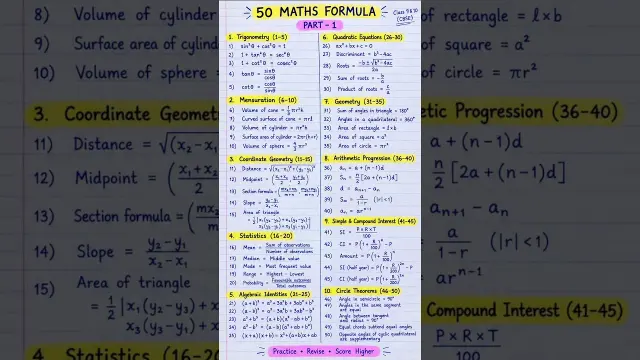 Fifty Math Formulas Every Student Should Know
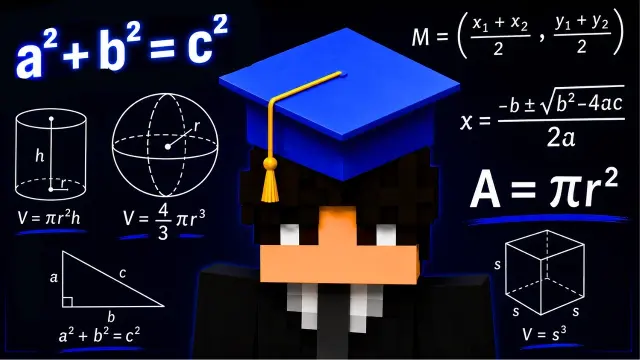 Complete List of Math Formulas to Memorize for the SAT
Get new #Quadratic Equations ideas by email
Every Thursday: the week's best ideas, with the newest from #Quadratic Equations.
Related tags
Quadratic Equations: A Practical Guide
What a quadratic equation is
A quadratic equation is an equation in which the highest power of the variable is 2. The standard form is usually written as ax² + bx + c = 0, where a, b, and c are numbers and a cannot be 0. Quadratic equations appear in algebra, geometry, physics, and many everyday problem-solving situations whenever a quantity depends on a square term.
The word “quadratic” comes from the idea of a square. That is why these equations are closely tied to parabolas, the U-shaped curves you see when a quadratic function is graphed.
Why quadratics matter
Read more
Quadratic equations are used to find unknown values, model motion, compare areas, and describe curved relationships. In mathematics, they are important because they connect algebra and graphing in a very direct way. If you understand quadratics, you also get a better feel for roots, symmetry, and turning points.
For beginners, the main goal is not to memorize one trick, but to recognize the structure of the equation and choose a suitable method.
Common ways to solve them
There is more than one way to solve a quadratic equation, and the best method depends on the form of the equation.
- Factoring: If the quadratic can be rewritten as a product of simpler expressions, set each factor equal to zero.
- Completing the square: This method rewrites the equation to create a perfect square trinomial, which can then be solved more directly.
- Quadratic formula: This works for any quadratic equation and is especially useful when factoring is difficult.
- Graphing: The solutions are the x-intercepts of the graph, if the parabola crosses the x-axis.
A useful habit is to check your answer by substituting it back into the original equation. That helps catch sign mistakes and arithmetic errors.
What the graph tells you
The graph of a quadratic equation is a parabola. If the leading coefficient a is positive, the parabola opens upward; if a is negative, it opens downward. The graph has a vertex, which is its highest or lowest point, and an axis of symmetry, which splits it into two matching halves.
The solutions of the equation are also called roots or zeros. These are the values of x that make the equation equal to zero. A quadratic may have two real solutions, one real solution, or no real solutions, depending on how the graph sits relative to the x-axis.
Tips for working with quadratics
- Always rewrite the equation in standard form before solving, if possible.
- Watch signs carefully, especially when using the quadratic formula.
- If factoring seems possible, try it first.
- Remember that not every quadratic has neat integer solutions.
- Practice with a variety of examples so you can recognize patterns quickly.
With practice, quadratic equations become much easier to understand. They are one of the most useful tools in algebra because they combine structure, logic, and graphing in a single topic.
#Quadratic Equations: frequently asked questions
How do I start solving a quadratic equation if I’m a beginner?
First, rewrite the equation in standard form so the terms are easier to compare. Then look at the shape of the expression and choose a method that fits it, such as factoring, completing the square, or the quadratic formula.
What is the easiest method to use for a quadratic equation?
There is no single easiest method for every problem, because the best approach depends on the equation itself. Factoring is often the quickest when it works, while the quadratic formula is the most reliable when the equation does not factor neatly.
How do I know which method to choose for a quadratic equation?
If the expression factors cleanly, that is usually the simplest choice. If it does not factor easily, use the quadratic formula, and if you want to see the graph or understand the turning point, graphing can help too.
What does the graph of a quadratic equation tell me?
A quadratic graph is a parabola, and its x-intercepts show the solutions when the curve crosses the x-axis. The graph also shows whether it opens upward or downward, plus its vertex and symmetry.
What are the most common mistakes to avoid when solving quadratics?
A common mistake is forgetting to put the equation into standard form before solving. Another is handling signs incorrectly, so it helps to check your answer by substituting it back into the original equation.
How can I make quadratic equations easier to understand and remember?
Focus on the structure of the equation, not just one memorized trick. Practicing different forms helps you recognize patterns, and remembering the relationship between the equation and its graph makes the topic much clearer.
Videos come from YouTube and posts from Instagram; titles and summaries are our own. All rights belong to their creators.