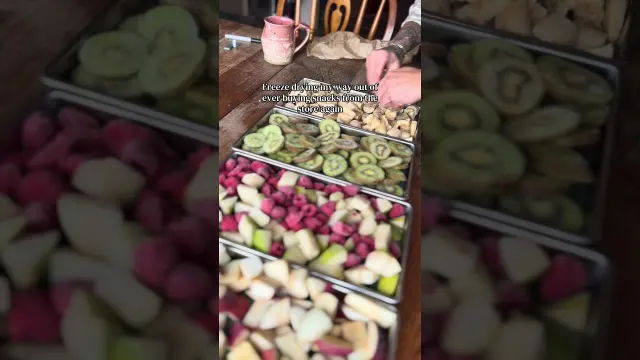
 Freeze-Dried Fruit Straight From a Home Freeze Dryer
#Freeze Dried Fruit
1 ideas
Freeze-Dried Fruit Straight From a Home Freeze Dryer
Get new #Freeze Dried Fruit ideas by email
Every Thursday: the week's best ideas, with the newest from #Freeze Dried Fruit.
Related tags
Freeze-Dried Fruit: A Complete Guide
Freeze-dried fruit is fruit that has had nearly all of its water removed while frozen, leaving behind a light, crisp piece that looks much like the fresh original. It is one of the more remarkable things to come out of food-preservation research, and it is now a pantry staple in its own right: a snack, an ingredient, a decoration for cakes and a piece of camping kit all at once.
How the process works
The technique is different from ordinary drying. Fruit is first frozen solid, then placed under low pressure so that the ice inside it turns directly into vapour without passing through a liquid stage. Because the fruit never thaws during drying, its cell structure stays largely intact. That is why a freeze-dried raspberry still looks like a raspberry and a slice of apple keeps its shape, instead of collapsing into a shrivelled, leathery piece. The result is extremely light, dry and crisp, and it reabsorbs moisture very quickly.
Main kinds
Read more
- Whole and halved pieces, such as berries, which hold their shape and make striking garnishes.
- Slices and chunks of apple, banana, mango, peach or pear, good for snacking and for cereal.
- Crumbles and broken pieces, useful in baking and for coating.
- Powder, made by grinding the dried fruit, which dissolves into yoghurt, smoothies and icings.
Berries, stone fruit, apple and banana take to the process particularly well. Very watery fruits are harder, since there is so much moisture to remove and the texture suffers.
What beginners should know
Expect a texture that is crunchy rather than chewy, and a flavour far more concentrated than fresh fruit. A piece can feel surprisingly intense, because the sugars and acids are no longer diluted by water. Freeze-dried fruit is not the same as the soft, leathery dried fruit sold for baking; the two behave differently and are not always interchangeable in a recipe.
Storage matters more than people expect. The pieces are hygroscopic, meaning they pull moisture out of the air, so keep them in an airtight container in a cool, dark place and close it promptly after serving. A tin left open on a humid day will turn crisp fruit soft and stale within hours. Whole pieces keep their character longest; powder is best used within a reasonable time, as its flavour fades before its texture does.
Ways to use it
Eat it straight from the container, stirred into yoghurt or porridge, or scattered over a bowl of ice cream where the contrast of crisp and cold is the point. It holds up unusually well in melted chocolate and in biscuit dough, staying crunchy where fresh fruit would release juice. Crushed to a powder, it colours and flavours buttercream and meringue without extra liquid. And because it rehydrates readily, a handful dropped into a little warm water or juice will plump back into something close to soft fruit within minutes, which makes it handy for cooking away from home.
Treat it as a concentrated fruit rather than a free-for-all snack, and it earns its place in a varied kitchen.
Videos come from YouTube and posts from Instagram; titles and summaries are our own. All rights belong to their creators.