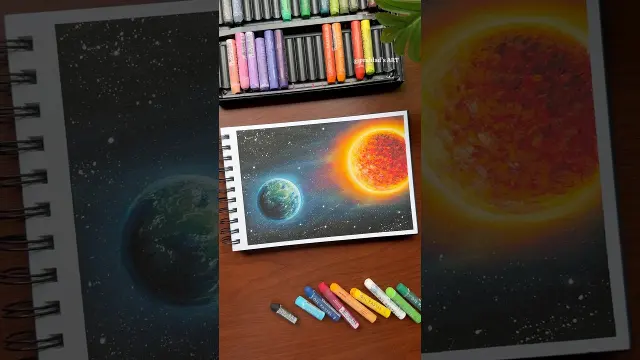
 Step by Step Solar System Drawing with Oil Pastels
#Galaxy Art
1 ideas
Step by Step Solar System Drawing with Oil Pastels
Get new #Galaxy Art ideas by email
Every Thursday: the week's best ideas, with the newest from #Galaxy Art.
Related tags
Galaxy Art: A Beginner's Guide to Painting the Cosmos
Galaxy art is a broad name for artwork that takes the night sky as its subject: swirling clouds of colour, dense fields of stars, luminous dust, and the dark shapes of planets and moons. It is less a single technique than a theme, which is why it appears in watercolour sketchbooks, on canvas, on walls, in digital illustrations and on painted furniture. Anyone who has looked up at a clear sky away from city lights already understands the appeal — the sense of scale, the quiet, the colours that seem almost invented.
The imagery has a long history. Star charts and celestial maps from many cultures treated the sky as something worth drawing carefully, part record and part decoration. In the twentieth century, space exploration gave artists a new vocabulary of photographs and imagined landscapes, and the idea of the galaxy as a backdrop for fantasy and science fiction took hold. Alongside that, a simpler tradition grew: painting the sky not as a scientific diagram but as a mood.
Several approaches are common. Realistic space illustration tries to stay close to what telescopes reveal, with careful attention to the way light falls and shadow behaves. Impressionistic galaxy painting leans on colour and softness instead, letting clouds of pigment stand in for dust and gas. Silhouette pieces place a dark foreground — trees, hills, a figure, a distant city — against a glowing sky, a trick that makes the sky feel enormous. Flat, graphic styles reduce the galaxy to bands, circles and dots, and work well for posters, textiles and digital pieces.
Technique matters most in the sky itself. The soft, drifting look of a nebula usually comes from wet-on-wet work, where pigment is dropped into damp paper or canvas and allowed to spread. Texture comes from dry brushing, spattering, salt, or lifting colour away with a cloth. Stars are almost always added last, in an opaque white, occasionally with a faint halo scratched or painted around the brightest ones. Layer light over dark rather than the reverse; it is far easier to build brightness up than to reclaim it.
Read more
If you are starting out, keep the palette simple. Two or three colours plus white will carry a whole painting, and a limited palette keeps mixes from turning muddy. Work on a surface that tolerates water if you plan to blend. Practise the sky on a small piece of spare paper first, so you know how your colours behave before committing to a composition. Keep the foreground dark and uncluttered, and resist filling every empty space with stars — a galaxy reads better when some areas stay calm.
Above all, galaxy art rewards patience with drying times and a willingness to let accident do some of the work. Blooms, uneven edges and unexpected blends are part of the charm, not mistakes to be corrected.
#Galaxy Art: frequently asked questions
How do I start making galaxy art if I've never painted a sky before?
Begin by treating the sky as a practice subject rather than a finished project: work on a scrap of spare paper and simply watch how your colours bleed, blend and dry before you commit anything to a final piece. Once you know how your paints behave, build a small composition with a dark, simple foreground and one glowing patch of sky above it. The sky is forgiving of accident, so a first attempt is more useful for learning than for framing.
What supplies do I actually need for galaxy art?
You need very little beyond something to paint on that can take water, a few pigments including a strong white, and a couple of brushes — one soft for blending and one stiffer for texture. If you want the drifting nebula look, damp paper or canvas does most of the work, while salt, a cloth or an old brush can add speckle and lift. A limited palette is genuinely an advantage here, because too many colours turn muddy when they mix.
Which style of galaxy art should I choose?
It depends on what you want the piece to do. If you like accuracy and detail, a realistic approach that follows how light and shadow behave will suit you; if you want mood, an impressionistic sky built from soft colour is faster and more forgiving. Silhouette pieces are the easiest way to make a sky feel vast, while flat graphic styles — bands, circles, dots — transfer well onto posters, fabric and digital work.
How do I get that soft, cloudy nebula effect?
The trick is wet-on-wet work: drop pigment into damp paper and let it spread on its own instead of brushing it out. Texture comes afterwards, from dry brushing, spattering, salt or lifting colour away with a cloth. Add your stars at the very end with an opaque white, and always build light on top of dark, since brightness is far easier to add than to recover.
What are the most common mistakes beginners make with galaxy art?
The usual ones are working with too many colours at once, filling every inch with stars, and building a busy foreground that competes with the sky. Leaving areas quiet is what makes the bright parts read as bright, and a dark, uncluttered foreground is what makes the sky feel enormous. Rushing the drying stages is the other frequent slip — uneven blooms look intentional only when you let them happen rather than fight them.
How should I care for a finished galaxy painting?
Keep it out of direct sunlight and away from damp, since strong light fades pigments and moisture damages the surface over time. Frame or mount it behind glass where possible, and handle the piece by its edges so oils from your hands don't dull the sky. If it is a piece you made on paper, storing it flat rather than rolled will protect the surface texture.
Videos come from YouTube and posts from Instagram; titles and summaries are our own. All rights belong to their creators.