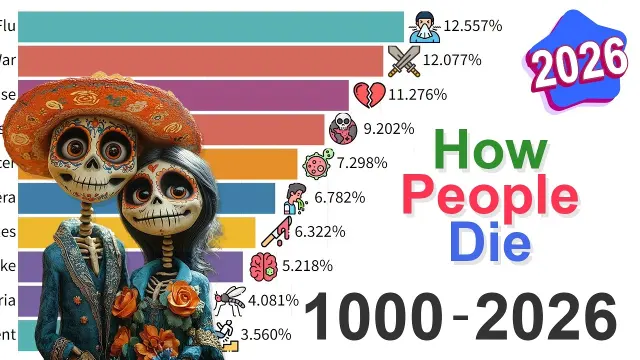
 Global Causes of Death Traced Across a Thousand Years
#Global Health
1 ideas
Global Causes of Death Traced Across a Thousand Years
Get new #Global Health ideas by email
Every Thursday: the week's best ideas, with the newest from #Global Health.
Related tags
Global Health: A Beginner's Guide to Wellbeing Worldwide
Global health is the study and practice of improving health for people everywhere, with particular attention to the parts of the world where health outcomes are poorest. It sits at the meeting point of medicine, public health, economics, sociology and environmental science, and it asks a question that goes beyond any single clinic: why do some communities live longer, healthier lives than others, and what can be done about it?
Prevention before treatment
Much of global health work happens before anyone becomes a patient. Clean water, safe sanitation, decent housing, reliable food, clean air and vaccination programmes prevent illness on a scale no hospital can match. This is why global health is often described as public health practised across borders: the unit of concern is the population, not only the individual. A clinician treats the person in front of them; a public health approach asks what made that illness common in the first place.
The main areas of concern
Read more
Work in the field tends to cluster around a few broad themes:
- Maternal and child health, including safe pregnancy, delivery and early childhood care.
- Infectious disease, from longstanding threats such as malaria and tuberculosis to newly emerging infections.
- Non-communicable conditions — heart disease, diabetes, cancer and respiratory illness — which now weigh heavily on health systems everywhere.
- Nutrition, water, sanitation and hygiene, which underpin almost everything else.
- Mental health, increasingly recognised as inseparable from physical wellbeing.
- Health systems: how care is funded, staffed, supplied and made reachable by the people who need it.
Equity is the organising idea
Global health is less about geography than about fairness. A disease that is rare in one country and common in another is usually not a difference of biology but of money, infrastructure, climate and political priority. That is why the field pays close attention to social determinants: income, education, gender, migration status, and whether a family lives near a functioning clinic or a day's walk from one.
Ideas beginners should know
Epidemiology is the basic toolkit — measuring how often disease occurs, in whom, and where. The distinction between incidence (new cases) and prevalence (all existing cases) matters more than it first appears. So does the difference between a health system's inputs (doctors, beds, medicines) and its outcomes (are people actually healthier?). Cost-effectiveness is used to compare interventions, and it is a useful discipline even when it makes uncomfortable reading.
Practical habits for anyone interested
Read critically: a single number rarely tells you much without knowing how it was collected and who was left out. Learn to think in systems — a vaccine that cannot be kept cold is not yet a working vaccine. Respect local knowledge; programmes designed far from the community they serve tend to fail quietly. And remember that global health is not something done by wealthy countries to poor ones. Every country has gaps, and every country has something to teach.
Small, sustained improvements in water, nutrition, immunisation and access to care have done more for human longevity than any single breakthrough. That is the quiet lesson of the field.
#Global Health: frequently asked questions
How do I start learning about global health if I have no background in medicine?
Begin with the ideas rather than the vocabulary: learn how epidemiology measures who gets sick and where, and get comfortable with the difference between new cases and all existing cases. From there, follow one topic that interests you — water and sanitation, maternal care, nutrition — and read about it across several countries rather than just one. The field is deliberately interdisciplinary, so economics, sociology and environmental science are all legitimate entry points.
What is actually needed to work in global health?
More than clinical skill: the work calls for systems thinking, since an intervention only counts once it reaches people reliably — a vaccine that cannot stay cold does not protect anyone. Just as important is the habit of respecting local knowledge, because programmes designed far from the community they serve tend to fail without anyone announcing it. Curiosity about why health differs between places matters more than any single qualification.
Which area of global health should I focus on?
There is no single best choice — the field clusters around maternal and child health, infectious disease, non-communicable conditions, nutrition and water, mental health, and the strength of health systems themselves. Pick the one where you can see the link between the problem and the fix, whether that is prevention at population level or making care reachable. It also helps to remember that these areas overlap in practice far more than they do on a list.
Is global health only about poor countries?
No — it is organised around fairness rather than geography, and every country has gaps as well as lessons worth sharing. A disease common in one place and rare in another usually reflects money, infrastructure, climate and political priority rather than biology. That is why the field looks closely at social determinants such as income, education, gender and how far a family lives from a working clinic.
What are the common mistakes beginners make?
Trusting a single figure without asking how it was gathered and who was left out is the most frequent one, since a number alone rarely tells you much. Another is treating global health as something wealthy places do to poor ones, which tends to produce programmes that quietly fail. Assuming a breakthrough matters more than steady improvements in water, nutrition and access to care is a third.
How can someone get involved without working in the field professionally?
Start locally: the same questions about prevention, access and equity apply to your own community, and looking at them closely builds the instinct the field depends on. Read critically, follow one area consistently rather than skimming everything, and pay attention to how prevention — clean air, decent housing, food, vaccination — shapes outcomes before anyone becomes a patient. Small, sustained efforts of this kind are how the field's biggest gains have actually come about.
Videos come from YouTube and posts from Instagram; titles and summaries are our own. All rights belong to their creators.