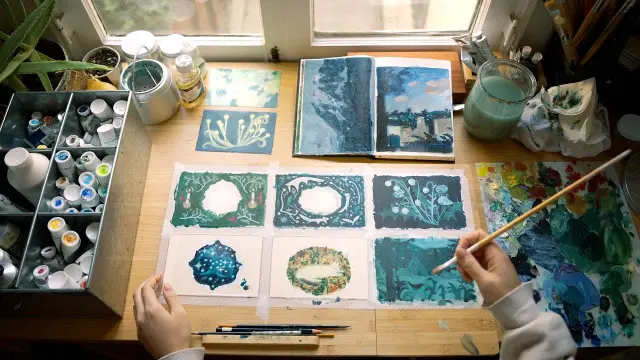
 Calm Oil and Gouache Holiday Card Painting Process
#Gouache
1 ideas
Calm Oil and Gouache Holiday Card Painting Process
Get new #Gouache ideas by email
Every Thursday: the week's best ideas, with the newest from #Gouache.
Related tags
Gouache Painting: A Beginner's Guide to Opaque Watercolor
Gouache is a painting medium made of pigment bound with gum arabic, much like watercolor, but with a higher proportion of pigment and often a chalk or white extender. That extra body is what sets it apart: where watercolor is transparent and relies on the white of the paper to shine through, gouache is opaque. A stroke laid over a dry stroke stays visible on top of it, which makes it possible to paint light over dark, to correct mistakes, and to build flat, even areas of colour with clean edges.
The medium has a long history. It was used for centuries in manuscript illumination and in European poster and theatre design, and it later became a staple of commercial illustration because it reproduces well in print. Many mid-century children's books and advertising artworks were painted in gouache for exactly that reason. Today it sits comfortably between watercolor and acrylic: portable and quick-drying like watercolor, but forgiving and graphic like acrylic.
Beginners usually meet two kinds of gouache. Designer's or poster gouache is fully opaque and dries to a matte, flat finish, ideal for bold shapes and graphic work. Artist's gouache, sometimes called acrylic gouache when the binder is acrylic, behaves similarly but can be rewetted or, in the acrylic version, dries permanently. A small set of primary colours plus white, black, and a couple of earth tones is enough to begin mixing most colours you need.
How to work with it
Read more
Gouache is reworked with water, so consistency changes everything. Thick paint straight from the tube gives strong coverage; add a little water and it becomes creamy and flows better; too much water and it turns translucent and can lift the layer beneath. Knowing which of these you want for a given passage is most of the skill.
A few practical habits help:
- Keep two water pots, one for rinsing and one for clean mixing, so colours stay bright.
- Mix more paint than you think you need, since matching a dried gouache colour exactly is difficult.
- Work from light to dark or from background to foreground, letting each layer dry before the next.
- Avoid overbrushing a wet area, which can lift and streak the paint underneath.
- Store tubes capped and upright, and be aware that gouache dries with a slight shift in value, usually lighter.
Papers and brushes
Gouache suits cold-pressed watercolour paper, illustration board, or mixed-media paper heavy enough not to buckle. A rough surface shows texture through thin passages; a smooth surface supports crisp lines. Synthetic brushes hold up well, and a flat brush of medium size, a round for detail, and one small pointed brush cover most needs. A palette with wells and a flat mixing area is useful, and a spray bottle keeps colours workable between sessions.
Why people paint with it
Gouache rewards decisiveness. It forgives, it layers, it works small and large, and it needs only a table, water, and paper. If you are learning to see colour and shape, it is one of the friendliest teachers you can pick up.
#Gouache: frequently asked questions
What exactly is gouache, and how is it different from watercolour?
Gouache is pigment bound with gum arabic, like watercolour, but it carries more pigment along with a chalk or white extender that gives it body. That extra body makes it opaque, so a new stroke sits visibly on top of a dry one instead of letting the paper glow through. In practice this means you can paint light over dark, cover a mistake, and lay down flat colour with clean edges.
What supplies do I actually need to start painting with gouache?
You need paint, a brush or two, paper and water — nothing elaborate. A small range of primaries plus white, black and an earth tone mixes most colours, and a medium flat brush, a round for detail and one small pointed brush cover nearly everything. Cold-pressed watercolour paper, illustration board or a sturdy mixed-media paper works well, along with a palette and a spray bottle to keep paint workable.
Which kind of gouache should a beginner pick?
The main choice is between a fully opaque designer's or poster gouache that dries matte and flat, and an artist's gouache that behaves similarly but can be rewetted and reworked. Acrylic-bound gouache looks the same going on but dries permanently, so it will not lift once set. Pick based on whether you want the freedom to rework an area or a finish that stays put.
Why does my gouache look streaky or patchy, and how do I avoid it?
Streaking usually comes from too much water or from brushing repeatedly over a wet passage, which lifts the layer underneath. Keep the paint creamy rather than runny, lay each stroke down and leave it, and let a layer dry before going over it again. Mixing more paint than you think you need also helps, since matching a dried colour exactly is fiddly.
Can I use gouache for cards, small illustrations and other projects?
Yes — gouache is a natural fit for cards, small paintings and graphic illustration because it dries quickly, travels easily, and reproduces well in print. Working light to dark, or background to foreground, keeps the layers clean and lets the design stay crisp at a small size. It only asks for a table, water and paper, so it suits short sessions and holiday projects alike.
How should I store gouache and care for it between sessions?
Keep tubes capped and standing upright, and mist your palette colours with water so they stay workable for the next sitting. Expect a slight shift in value as the paint dries, usually toward lighter, which is worth remembering when you mix. Rinse brushes well and use clean water for mixing so your colours stay bright.
Videos come from YouTube and posts from Instagram; titles and summaries are our own. All rights belong to their creators.