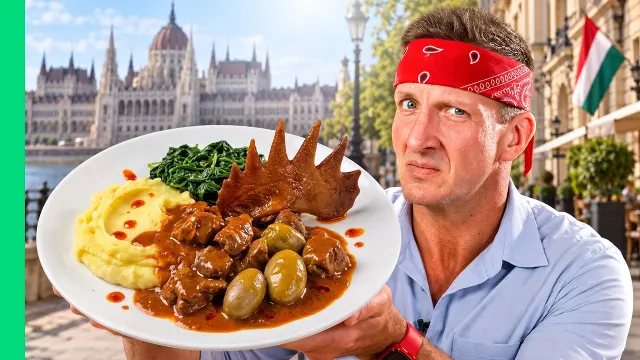
 Exploring traditional Hungarian cuisine in Budapest
#Goulash
1 ideas
Exploring traditional Hungarian cuisine in Budapest
Get new #Goulash ideas by email
Every Thursday: the week's best ideas, with the newest from #Goulash.
Related tags
Goulash: A Guide to Hungary's Paprika-Rich Classic
Goulash is one of those dishes that carries a whole country inside it. In Hungary it is gulyás, a hearty soup of beef, onions, paprika and vegetables, and it takes its name from the gulyás — the cattle herdsmen of the Great Plain who cooked their food outdoors in heavy kettles over open fire. What began as practical camp cooking for men working far from a kitchen slowly became a national dish, carried from the countryside into town restaurants and, eventually, far beyond Hungary's borders.
What it actually is
Outside Hungary, the word has drifted. In many places "goulash" means a thick stew, or a pasta dish with beef and tomato. In Hungary itself the distinctions are firm, and knowing them helps you understand the whole family of dishes:
- Gulyás (goulash) is a soup, thin enough to eat with a spoon, built on meat, onion, paprika and root vegetables, often finished with small pinched noodles called csipetke.
- Pörkölt is a stew, with much less liquid, served with potatoes, noodles or bread.
- Paprikás is similar to pörkölt but enriched with sour cream, most famously with chicken or veal.
Read more
All three share the same foundation: onion softened slowly in fat, meat browned, and paprika stirred in to give colour and fragrance.
The paprika question
Paprika is not a garnish here, it is the backbone. Hungarian shops sell it in grades, from mild and sweet through to pungent and hot, and a cook often mixes two kinds for depth. The one rule worth remembering is heat control: paprika turns bitter if it burns, so the pan is usually taken off the heat, or the fire lowered, just before it goes in, and a splash of water or stock follows quickly after. Treat it gently and it rewards you with sweetness rather than scorch.
Cooking it well
Goulash is forgiving, which makes it a good dish for a beginner. Choose beef with some marbling, or shin, which softens into something gelatinous and rich. Give the onions real time — fifteen or twenty minutes over gentle heat — before anything else joins them. Add the meat, then the paprika, then water or stock, and let it simmer quietly rather than boil hard. Root vegetables such as carrot and potato go in later so they hold their shape, and the csipetke cook in the pot in the last few minutes.
At the table
Goulash is served with bread, sometimes with a spoonful of sour cream, and often with hot paprika on the side for those who want it. It tastes better the next day, which is worth remembering: make more than you need.
#Goulash: frequently asked questions
How do I start making goulash if I've never cooked Hungarian food before?
Begin with the soup version: soften a generous pile of onions slowly in fat, brown beef with some marbling, then stir in paprika off the heat. Add water or stock and let it simmer gently, adding root vegetables later so they keep their shape. It is a forgiving dish, so the first attempt is usually close enough to be worth eating.
What ingredients and equipment do I actually need?
Beef, onions, paprika, fat, and root vegetables such as carrot and potato cover the core, with small pinched noodles for the finish. A heavy pot with a lid is the one piece of equipment worth having, since it holds steady low heat the way the herdsmen's kettles did. Bread and sour cream on the side complete the table.
Should I make goulash, pörkölt or paprikás?
Choose goulás if you want a spoonable soup, pörkölt if you want a thick stew to serve with potatoes or bread, and paprikás if you like the softer, creamier version. All three rest on the same base of onion, meat and paprika, so the choice is really about how much liquid and richness you want.
How should I handle the paprika so it doesn't ruin the dish?
Paprika burns easily and turns bitter, so take the pan off the heat or lower the flame just before adding it. Follow immediately with a splash of water or stock to cool things down. Mixing a mild paprika with a hotter one gives more depth than using either alone.
What's the most common mistake people make with goulash?
Rushing the onions and boiling the pot hard are the usual culprits — the onions need a long gentle softening, and the soup should barely simmer. Adding the vegetables too early is another one, since they break down before the meat is tender. Also worth remembering: it tastes better reheated, so make more than you need.
Is goulash a good dish to serve at a gathering?
Yes — it suits a crowd because it can be made ahead and improves overnight, which takes pressure off the day itself. Serve it with bread, sour cream, and hot paprika on the side so guests can adjust their own bowl. It is also a natural fit for a themed evening built around Hungarian cooking.
Videos come from YouTube and posts from Instagram; titles and summaries are our own. All rights belong to their creators.