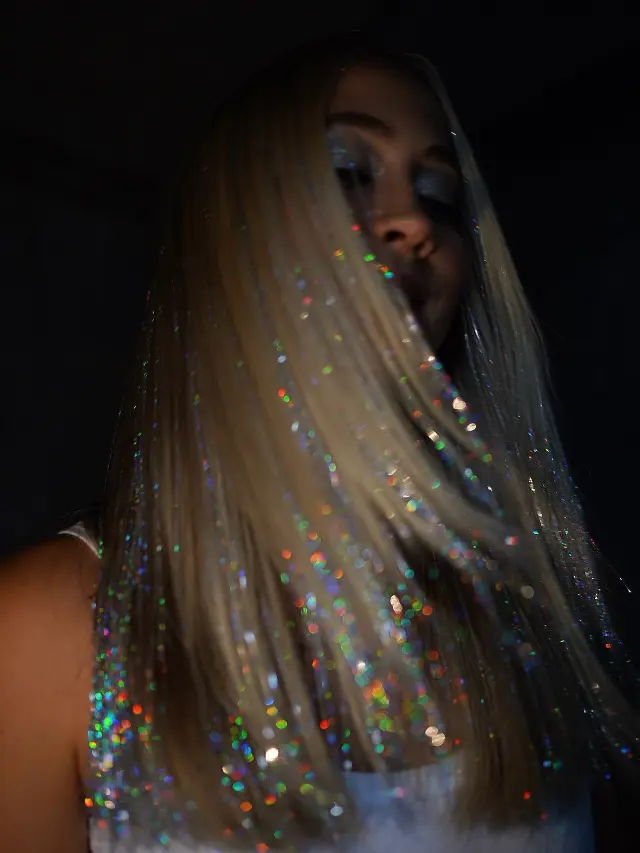
 Holographic hair tinsel installation for a sparkly finish
#Hair Tinsel
1 ideas
Holographic hair tinsel installation for a sparkly finish
Get new #Hair Tinsel ideas by email
Every Thursday: the week's best ideas, with the newest from #Hair Tinsel.
Related tags
Hair Tinsel: A Guide to Sparkling Strands
Hair tinsel is one of those small additions that changes an entire look. It is made of very fine, hair-thin strands of a shiny material — metallic foil, holographic film, silk or a soft synthetic — tied into your own hair a few millimetres from the scalp so that the strands hang loose alongside your natural hair and catch the light as you move. It is not a dye and not an extension: nothing is glued to your scalp, nothing changes the structure of your hair, and the whole thing comes out again when you want it to. Think of it as jewellery you wear in your hair rather than a permanent change.
What it is used for
Most people reach for hair tinsel when they want a little shimmer for a specific occasion: a party, a wedding, a festival, a photo shoot, a birthday, a school event. But it also works quietly in everyday life — a few strands tucked into a ponytail or a braid read as a subtle glint rather than a statement, and children in particular tend to love it. Because it can be applied in small amounts or all over, the effect scales from almost invisible to genuinely dramatic.
The main kinds
Read more
- Metallic foil tinsel: the classic option, reflective and bright, usually gold, silver, copper or rose gold.
- Holographic and iridescent tinsel: shifts colour depending on the angle and light, so it looks different in daylight and indoors.
- Silk or satin tinsel: softer, flatter in shine, closer to a glossy hair strand and gentler on fine hair.
- Glitter and confetti-style strands: textured and slightly more noticeable, often chosen for events.
- Clip-in and tape-in versions: pre-attached to a small band or strip, useful when you want sparkle for a single evening and no commitment.
How it goes in
The traditional method is a simple knot: a single tinsel strand is folded in half, looped around a small section of hair close to the scalp, and pulled through itself. A practised hand can tie dozens in a short time. The alternative is a micro-ring or bead, crimped flat with a tool — faster and more uniform, and easier to remove cleanly. Both are gentle when done without pulling, and both should be placed on a section of hair you can afford to lose a few strands from if the knot slips.
Practical tips and aftercare
Start with a test strand and see how it behaves in your hair type before committing to a full head. Choose a shade one or two steps away from your own colour for something subtle, or a strong contrast if you want it noticed. Keep the knots away from the parting and the hairline so they do not catch or show.
Washing is the main thing to get right: be gentle, do not scrub the knots, and let the hair air-dry rather than rubbing it with a towel. Brush from the ends upward and stop when you meet a knot. Keep straighteners and hot tools away from the tinsel itself, since most materials will melt or crimp. At night, a loose braid keeps the strands from tangling. Tinsel loosens on its own over time; when you want it gone, a micro-ring can be squeezed open and a knot can be undone with a pin.
#Hair Tinsel: frequently asked questions
How do you put hair tinsel in?
The simplest method is a knot: fold a single strand in half, loop it around a small section of hair close to the scalp, and pull the ends through the loop. A micro-ring or bead crimped flat with a small tool is the other common route, and it gives a neater, more even finish that is easier to take out later. Either way, work on a section you could afford to lose a few strands from if the knot slips.
What do I need to get started with hair tinsel?
You need tinsel strands in the material and shade you like, plus something to section and hold the hair — a comb, a couple of clips, and a mirror you can see the back of your head in. If you are going the bead route, add a few micro-rings and the crimping tool that matches them. A pin helps for undoing knots when you are finished with the look.
Which kind of hair tinsel should I choose?
Metallic foil is the brightest and most classic, while holographic and iridescent strands shift colour with the light and look different indoors and out. Silk or satin tinsel is softer and flatter in shine, which suits fine hair and people who want a glint rather than a statement. If you only want sparkle for one evening, clip-in or tape-in pieces let you skip the commitment entirely.
How do you wash and care for hair tinsel?
Be gentle around the knots, don't scrub them, and let your hair air-dry instead of rubbing it with a towel. Brush from the ends upward and stop when you reach a knot rather than pulling through it, and keep straighteners and other hot tools off the tinsel since most materials will melt or crimp. A loose braid at night keeps the strands from tangling while you sleep.
What occasions is hair tinsel good for?
It is most often reached for when you want a little shimmer for something specific — a party, a wedding, a festival, a photo shoot, a birthday or a school event. It also works in everyday life: a few strands tucked into a ponytail or braid read as a subtle catch of light, and children tend to enjoy it especially. Because you can add a handful or cover the whole head, the effect scales from barely there to full-on.
What are the common mistakes with hair tinsel?
Tying the knots too close to the parting or the hairline is the usual one — they catch, pull and show, so keep them a little way back. Skipping a test strand is another; a strand behaves differently on curly, fine or very straight hair, and one trial tells you more than guessing. Pulling too tightly when installing, or brushing straight through a knot instead of stopping at it, is what causes tangles and breakage.
Videos come from YouTube and posts from Instagram; titles and summaries are our own. All rights belong to their creators.