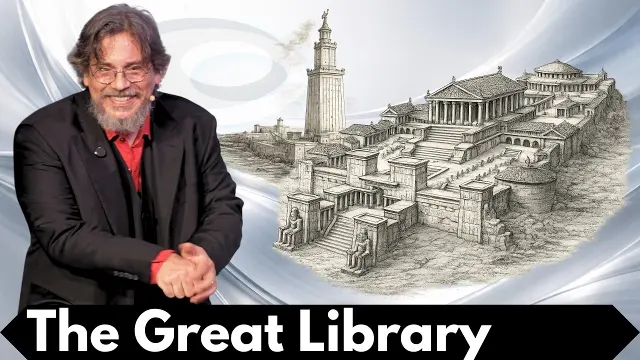
 The Great Library of Alexandria: A History Lecture by Roy Casagranda
#History of Science
2 ideas
The Great Library of Alexandria: A History Lecture by Roy Casagranda
 What Energy Is Made Of, From Caloric to Quantum Fields
Get new #History of Science ideas by email
Every Thursday: the week's best ideas, with the newest from #History of Science.
Related tags
A Beginner's Guide to the History of Science
The history of science is the study of how people have tried to understand the natural world, and of how those attempts changed over time. It is not a list of discoveries in the order they happened. It is the story of questions, tools, arguments and institutions, and of why one explanation was accepted while another was set aside.
What counts as science
One of the first things a beginner learns is that the boundary is not obvious. For most of history, the people we would now call scientists studied the heavens, plants, metals and the human body without drawing a firm line between observation, philosophy and practical craft. Alchemy and astrology were serious intellectual pursuits long before chemistry and astronomy emerged from them. Reading them as failed versions of modern science misses the point; they were coherent systems for their own time, and much of the later work grew out of their techniques and records.
The main periods
Read more
Broadly, the field traces a path from ancient natural philosophy, through the medieval and Islamic world's preservation and extension of that learning, into the European Renaissance, the mathematical and experimental turns that followed, the professionalisation of science in universities and academies, and the specialised disciplines of the modern era. Each period is studied both for its ideas and for the conditions that made them possible: literacy, patronage, printing, instruments, trade routes, warfare and religion.
Two useful angles
Historians usually work from at least one of two directions. The internal view follows the content of ideas — how a theory was argued, tested and replaced. The external view asks how funding, politics, religion, gender, class and geography shaped which questions got asked at all. Most good work combines them.
The trap of hindsight
The most common beginner's mistake is what historians call whiggish history: telling the past as a march toward the present, praising whoever guessed right and mocking whoever did not. A better habit is to ask what a theory was trying to explain, what evidence was available, and what competing explanations it beat. Caloric theory, for instance, treated heat as a fluid; it was wrong, but it organised real experiments and posed questions that later work had to answer.
Practical tips
- Read primary sources where you can, even in excerpts. A short passage from an old text tells you more about its assumptions than any summary.
- Follow instruments and techniques as well as ideas. Better telescopes, clocks and microscopes changed which questions were answerable.
- Notice who was excluded. Household experimenters, craftspeople, translators and colonial intermediaries often did the work that carried a name.
- Distrust tidy stories of lone geniuses. Discovery is usually contested, gradual and argued over.
- Keep a timeline of your own, but let it grow from what you read rather than imposing it first.
Why it matters
The history of science is a practical education in how knowledge is made, corrected and sometimes resisted. It teaches patience with people who were wrong and scepticism toward the idea that the present has finished the argument.
#History of Science: frequently asked questions
How should a complete beginner start studying the history of science?
Start with one period or one discipline you already find interesting rather than trying to cover the whole sweep at once. Pair a short overview with an excerpt from an original text from that era, because a few pages of an old source reveal its assumptions far better than any summary. Let your reading spread outward from there instead of beginning with a rigid timeline.
Do I need a science degree to follow the history of science?
No. The field is less about redoing calculations and more about asking what a past theory was trying to explain and what evidence was available to the people proposing it. Curiosity about arguments, instruments and institutions matters more than technical training, and much of the best work is readable without specialist background.
What is the difference between the internal and external approaches, and which should I pick?
The internal approach follows the content of ideas, tracing how a theory was argued, tested and eventually replaced. The external approach asks how funding, politics, religion, class and geography shaped which questions were even asked. You do not have to choose permanently, since the strongest accounts usually weave the two together.
Were older traditions like alchemy and astrology just mistakes?
Treating them as failed versions of modern science misses what they were doing. They were coherent systems of their own time, and much later work grew directly out of their techniques, instruments and record-keeping. Read them on their own terms first, then ask how and why the questions shifted.
What is the most common mistake beginners make?
Telling the past as a march toward the present, praising whoever happened to guess right and mocking whoever did not. A better habit is to ask what a theory was trying to explain, what evidence existed, and which rival explanations it beat at the time. Theories that turned out wrong often organised real experiments and posed questions later work had to answer.
How do I keep track of what I am learning without flattening the story?
Keep a timeline of your own, but let it grow from what you actually read rather than sketching it out in advance. Alongside ideas, note the instruments and techniques that made certain questions answerable, and pay attention to the craftspeople, translators and household experimenters whose work often carried someone else's name.
Videos come from YouTube and posts from Instagram; titles and summaries are our own. All rights belong to their creators.