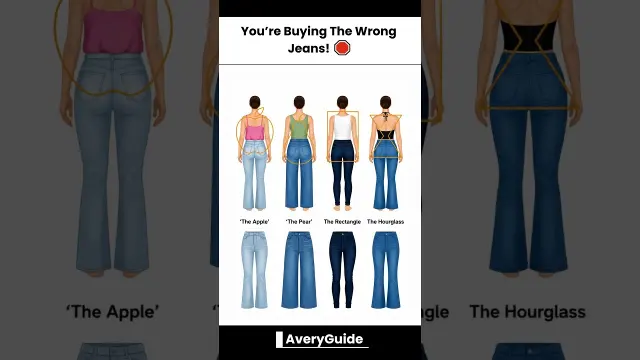
 Best Jeans For Your Body Shape and Denim Styling Guide
#Jeans Fit
1 ideas
Best Jeans For Your Body Shape and Denim Styling Guide
Get new #Jeans Fit ideas by email
Every Thursday: the week's best ideas, with the newest from #Jeans Fit.
Related tags
How to Find Jeans That Fit: A Complete Guide
Jeans are one of the few garments almost everyone owns, and one of the few that can feel either effortless or completely wrong depending on a centimetre or two. Fit is not a matter of having the "right" body; it is a matter of matching the construction of the garment to the shape of the person wearing it. Once you understand how a pair of jeans is built, shopping becomes far less mysterious.
The parts of a pair of jeans
Every pair is defined by a few measurements. The rise is the distance from the crotch seam to the top of the waistband: low, mid and high rise sit at different points on the torso and change how the whole leg looks. The waist and hip measurements determine whether the jeans close comfortably and drape cleanly. The inseam runs from the crotch to the hem and decides whether a pair ends at your ankle, stacks at your shoe or needs shortening. Finally, the leg opening shapes the silhouette.
The main cuts
Read more
Skinny jeans follow the leg closely from thigh to ankle. Straight jeans keep a similar width from knee to hem, which makes them a steady, forgiving choice. Slim cuts are narrower than straight but not tight. Bootcut and flared jeans widen below the knee, balancing a wider shoulder or hip. Tapered jeans are roomy at the thigh and narrow toward the ankle. Relaxed, boyfriend and wide-leg cuts use extra fabric for a looser line, while mom jeans sit high and taper slightly. Cropped jeans end above the ankle on purpose, so they work best with the shoes you plan to wear.
Fabric matters as much as cut
Denim is a twill weave, traditionally cotton, and its behaviour comes from the balance of stiffness and stretch. Rigid, all-cotton denim holds its shape, moulds to you over time and shows wear honestly, but it gives little at first. Denim blended with a small amount of elastane feels softer and moves with you, though it can relax and lose shape through the day. A general rule: the more stretch, the more likely the jeans will feel looser by evening, so try them on and move around rather than judging from a mirror pose.
Practical advice for trying jeans on
Measure yourself at the waist, the fullest part of the hip and the inseam, and note the numbers; they make online sizing far less of a gamble. When trying a pair, sit down, squat and walk. Check that the waistband does not gape at the back, that the pockets lie flat, and that the fabric does not pull into creases across the hips or crotch. If the waist fits and everything else is close, a tailor can shorten the hem or take in the waist. Wash jeans inside out, in cold water, and sparingly; hanging them to air between wears keeps the colour and the fit for longer.
Good jeans are the ones you forget you are wearing. Take the time to find that pair, and you will reach for it for years.
#Jeans Fit: frequently asked questions
How do I figure out which jeans will actually suit me?
Start from the construction rather than from the label or the size on the tag: where the rise sits on your torso, how the waist and hip measure up, and how wide the leg opening is all change the line of the whole body. Then match that to what you want to balance — a wider leg can soften a broader shoulder, a tapered cut can keep a roomy thigh from looking shapeless. Fit is about matching the garment to the person, not about finding the 'right' body.
What should I check when I try a pair on?
Don't judge from a mirror pose alone — sit down, squat and walk a few steps, because jeans behave very differently in motion than standing still. Look for a waistband that gapes at the back, pockets that lift away from the body, and fabric that pulls into creases across the hips or crotch. If the waist is right and the rest is close, a tailor can usually shorten the hem or take in the waist.
Is rigid denim better than stretch denim?
Rigid all-cotton denim holds its shape, moulds to you over time and ages honestly, but it gives very little at first, so it needs breaking in. Stretch blends feel softer immediately and move with you, but they tend to relax as the day goes on, which is why jeans can feel looser by evening. Choose based on whether you want a pair that adapts to you or one that stays put.
How should I wash jeans so they keep their fit?
Turn them inside out, use cold water, and wash them sparingly rather than after every wear. Between washes, hang them to air out — that preserves both the colour and the shape of the denim far better than frequent cleaning. Stretch pairs in particular benefit from less washing and gentler handling.
What are the most common mistakes people make when buying jeans?
The biggest one is shopping by size number instead of by measurement, which makes both in-store and online buying a gamble. The second is buying for how the jeans look in a static mirror pose rather than how they feel when you sit and move. The third is ignoring length and leg opening, when a simple hem or a different leg shape would have made an almost-right pair perfect.
Can I wear jeans for a dressy occasion?
Yes — the key is a clean, dark, well-fitted pair in a cut that reads intentional rather than slouchy, with a crisp hem that ends where you want it to. Pair them with smarter shoes and a top that lifts the outfit, and let the denim be the relaxed element rather than the whole story. Choosing the shoe first and then the length of the jeans around it makes the whole thing look considered.
Videos come from YouTube and posts from Instagram; titles and summaries are our own. All rights belong to their creators.