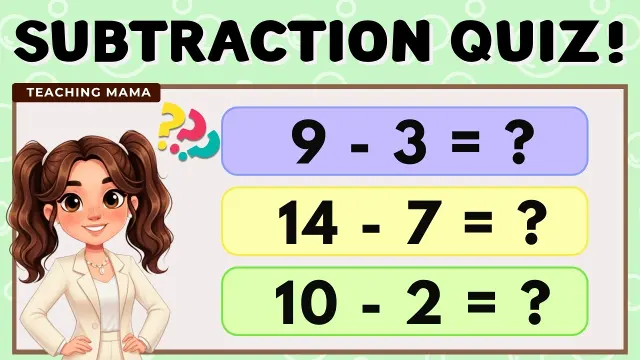
 Basic Subtraction Math Quiz Activity for Young Learners
#Learning Activities
1 ideas
Basic Subtraction Math Quiz Activity for Young Learners
Get new #Learning Activities ideas by email
Every Thursday: the week's best ideas, with the newest from #Learning Activities.
Related tags
Learning Activities for Curious Minds
Learning activities are purposeful ways of helping someone build knowledge, skills, and confidence through doing, exploring, and practising. They can be used at home, in classrooms, or in childcare settings, and they work for many ages, especially young learners. A good learning activity is clear enough to guide the child, but open enough to keep curiosity alive.
At their best, learning activities connect new ideas to something the learner can see, touch, say, move, or make. That is why they often include games, sorting, matching, drawing, songs, stories, role play, building, counting, writing, and simple experiments. Children usually learn well when they are active participants rather than passive listeners.
Common types of learning activities
Learning activities can be grouped in many ways, depending on the goal.
Read more
- Language activities: listening games, letter recognition, storytelling, rhyming, vocabulary practice, and early reading
- Math activities: counting objects, sorting by size or shape, simple addition and subtraction, patterns, and measuring
- Fine motor activities: cutting, gluing, tracing, threading, and manipulating small objects
- Creative activities: colouring, painting, collage, music, movement, and pretend play
- Science and discovery activities: observing nature, classifying objects, exploring cause and effect, and simple hands-on experiments
- Social and emotional activities: turn-taking games, identifying feelings, cooperative play, and talking about daily routines
What makes a good learning activity
A strong activity usually has one clear purpose. It should match the child’s age and attention span, and it should feel manageable rather than overwhelming. If the task is too hard, break it into smaller steps. If it is too easy, add a small challenge, such as more items to sort or a new rule to follow.
Children often learn best when they can repeat an activity in different ways. For example, counting can be practised with buttons, blocks, fingers, or pictures. Repetition helps skills become familiar, but variety keeps interest alive.
Helpful ideas for beginners
If you are planning learning activities, start simple.
- Choose one goal at a time
- Use everyday materials when possible
- Keep instructions short and clear
- Show an example before asking the child to begin
- Praise effort, not just correct answers
- Let the child make small choices to stay engaged
It also helps to watch how the child responds. Some children like active movement, while others prefer quiet table tasks. Some need lots of talking and encouragement; others focus better with less distraction. You do not need expensive materials to create meaningful learning. A few familiar objects, a little time, and a clear idea are often enough.
Making learning feel natural
The best learning activities fit into ordinary life. Counting steps, naming colours during a walk, sorting laundry, reading a story aloud, or baking together can all become rich learning moments. When children see that learning is part of everyday life, they often become more confident and interested.
What matters most is not perfection, but connection. A simple activity done with patience and attention can support real growth, one small step at a time.
Videos come from YouTube and posts from Instagram; titles and summaries are our own. All rights belong to their creators.