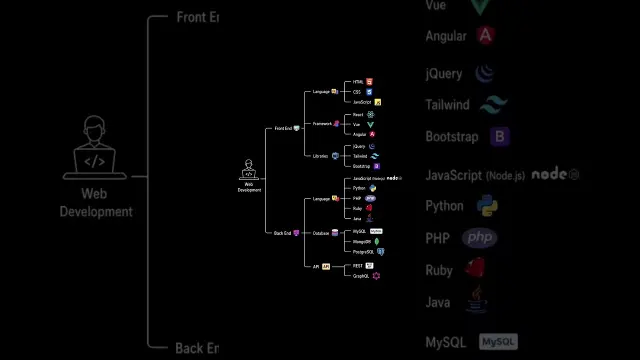
 Web Development Roadmap for Beginners: Frontend and Backend
#Learning to Code
1 ideas
Web Development Roadmap for Beginners: Frontend and Backend
Get new #Learning to Code ideas by email
Every Thursday: the week's best ideas, with the newest from #Learning to Code.
Related tags
Learning to Code: A Practical Guide for Beginners
Coding, or programming, is the craft of writing instructions that a computer can carry out. A computer has no intuition and no common sense: it does exactly what it is told, in the order it is told, using the vocabulary it has been given. Learning to code means learning to break a task into steps small and precise enough that a machine can follow them. That is a skill of thinking as much as of typing.
Where it comes from
Programming grew out of mathematics and engineering, and its basic building blocks are older than the machines themselves: sequences of steps, conditions, repetition, and stored values. What changed over time was not the underlying logic but the tools built around it, from punch cards to the editors and languages used now. Beginners often assume they must understand the whole history to start. They do not, but knowing that the field rests on a small set of ideas repeated at every scale is reassuring.
What people build with it
Read more
The paths are broad and overlapping. Web development covers the parts of a site you see and the parts that work behind the scenes. Mobile development focuses on apps for phones and tablets. Data work uses code to clean, query and interpret information. Automation and scripting use short programs to handle repetitive tasks on a computer. Games, embedded devices, scientific computing and design tools each have their own conventions. Most beginners discover that the fundamentals travel well: once loops and functions make sense in one context, they make sense in another.
Choosing where to start
Pick one language and stay with it long enough to become comfortable. A language designed to be readable is often a gentler first step; a language used widely on the web gives quicker visible results. Both are valid. What matters far more than the choice is finishing something with it. Following several tutorials at once in different languages feels productive and usually produces no working knowledge.
How progress actually happens
Expect confusion. It is the normal state of learning to code, not a sign that you are unsuited to it. Errors are not punishments but messages; reading them carefully, and learning to search for the exact wording, is a core skill. Small programs written from scratch teach more than large ones copied from a tutorial. When something breaks, changing one thing at a time and observing the result is the fastest route to understanding.
Practical habits
- Write a little often rather than a lot rarely; regularity matters more than session length.
- Keep your own notes on syntax and concepts you had to look up twice.
- Read other people's code, even before you fully understand it.
- Build something you actually want: a small tool, a simple page, a way to sort your files.
- Ask for help with a specific question and show what you have tried.
Learning to code is slow at the start and then surprisingly fast, because the same patterns reappear everywhere. Give yourself permission to be a beginner for a while, and let curiosity about how things work carry you further than any plan.
#Learning to Code: frequently asked questions
How do I actually start learning to code?
Begin with a language designed to be readable, and learn the small set of ideas underneath every program: steps in order, conditions, repetition and stored values. Then finish one small program of your own rather than working through many tutorials. Finishing something is what turns watching into knowing.
What do I need before I begin?
A computer and a code editor are enough; the logic of programming does not require an engineering or maths background. What it does require is patience for detail, since a machine follows your instructions exactly, including the mistakes. Curiosity about how things work carries you further than any elaborate setup.
Which language or path should I choose first?
Choose by what you want to build: web pages, phone apps, data work or short scripts that automate repetitive tasks all have natural starting points. Whichever you pick, stay with it long enough to become comfortable rather than sampling several at once. The fundamentals travel between contexts, so the choice matters far less than seeing one thing through.
Why is coding so confusing at first, and is that normal?
Confusion is the ordinary state of learning to code, not evidence that you are unsuited to it. Errors are messages rather than punishments, and reading them carefully, along with searching for their exact wording, is a core skill. When something breaks, change one thing at a time and watch what happens.
What habits make progress faster?
Write a little often instead of a lot rarely, since regularity matters more than the length of a session. Keep your own notes on syntax and concepts you had to look up repeatedly, and read other people's code even before it fully makes sense. Build something you actually want, and when you ask for help, ask a specific question and show what you have tried.
What are the most common beginner mistakes?
Following several tutorials in different languages at once feels productive but usually produces no working knowledge, and copying large programs teaches less than writing small ones yourself. Another common trap is treating an error as a verdict on your ability instead of a clue. Asking vague questions without showing your attempt also slows help down considerably.
Videos come from YouTube and posts from Instagram; titles and summaries are our own. All rights belong to their creators.