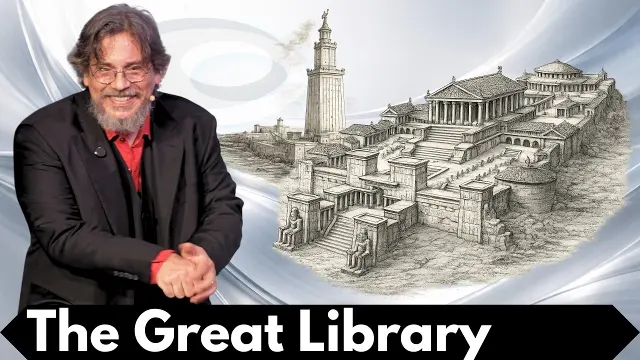
 The Great Library of Alexandria: A History Lecture by Roy Casagranda
#Libraries
1 ideas
The Great Library of Alexandria: A History Lecture by Roy Casagranda
Get new #Libraries ideas by email
Every Thursday: the week's best ideas, with the newest from #Libraries.
Related tags
Libraries: A Guide to the World's Shared Knowledge
A library is a collection of recorded knowledge organised so that other people can find and use it. That simple idea — gathering texts, arranging them, and keeping them for anyone who comes looking — is one of the oldest and most durable institutions humans have built. Libraries appear wherever people write things down and want those things to outlast them.
From archives to public shelves
The earliest libraries were archives: clay tablets, papyri and scrolls kept by temples, palaces and governments to record taxes, laws, rituals and correspondence. Over centuries the idea widened from storing records to collecting the whole of written culture, and from serving a court or a priesthood to serving anyone who could read. The great libraries of the ancient and medieval world — royal collections, monastic scriptoria, the libraries of the Islamic golden age, university libraries in Europe — each added something: cataloguing, copying, translation, lending. The modern public library, free at the point of use and open to everyone in a community, is a comparatively recent development, but it follows directly from that older ambition.
Kinds of libraries
Read more
Most libraries fall into a few broad types. Public libraries serve a general community and lend books, media and often much else besides. Academic libraries support schools and universities, with deeper collections and research help. Special libraries sit inside museums, hospitals, law firms, companies or governments and focus narrowly on one field. National libraries act as legal depositories, keeping a copy of everything published in a country. Alongside these are private collections, subscription libraries, and the informal shelves of schools, prisons, ships and villages.
How a library actually works
Behind the shelves is a system. Books are classified so that related subjects sit together, catalogued so that a record of each item exists somewhere, and arranged by a call number that tells you exactly where to walk. Reference works stay in the building; circulating items go home with you. Modern catalogues are searchable online, and many libraries now lend e-books and audio while offering databases, computers and quiet rooms.
If you are new to libraries
Get a card first — it is usually free and unlocks far more than borrowing. Learn the classification scheme your library uses; half an hour spent understanding it saves years of wandering. Ask the staff questions, including vague ones: helping you turn a fuzzy interest into a findable subject is a core part of the job. Use interlibrary loan when your branch lacks a title. Return things on time and treat shared copies gently, since a library's whole value depends on items coming back. And check what else is on offer: reading groups, talks, local history archives, study space and help with research or digital skills are often included.
A library is not a warehouse of books so much as an agreement that knowledge should be shared and kept. Using one is a small act of participation in something very old.
#Libraries: frequently asked questions
How do I start using a library if I have never been to one?
Begin by signing up for a card, which is usually free and unlocks far more than borrowing alone. Once you have it, take a short walk through the building to see how the shelves are laid out and where the staff desk is. Then simply ask for help turning whatever interests you into something findable.
What do I actually need to get a library card?
Most libraries ask for something that shows who you are and where you live, so bring identification and proof of address. Requirements differ from place to place, so it is worth checking with the branch before you go. Staff can also tell you what your card covers, including online catalogues and digital lending.
Which kind of library should I choose?
It depends on what you need it for: a public library suits general reading, borrowing and community events, while an academic library serves students and researchers with deeper collections. Special libraries concentrate on a single field, and national libraries keep a copy of what is published in a country. For most everyday purposes the nearest public branch is the right starting point.
How should I look after the things I borrow?
Treat shared copies gently, since a library's whole value depends on items coming back in usable condition. Keep them away from food, water and pets, and avoid marking or folding pages. Return them on time so the next person is not left waiting.
What can I do at a library besides borrow books?
Plenty: many offer reading groups, talks, study space, local history archives and help with research or digital skills. You can also use reference works in the building, search catalogues online and borrow e-books or audio. It is worth asking what is included, because much of it costs nothing extra.
What mistakes do newcomers to libraries commonly make?
The most frequent one is wandering the shelves without understanding the classification scheme, which turns a quick search into a long hunt. Another is hesitating to ask staff, even vaguely, when that is exactly what they are there for. Forgetting that interlibrary loan exists, or returning items late, are the other easy ones to avoid.
Videos come from YouTube and posts from Instagram; titles and summaries are our own. All rights belong to their creators.