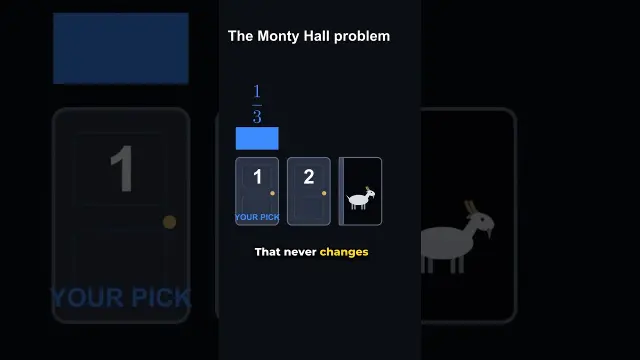
 Monty Hall Problem Explained: Why Switching Doors Wins Two Times in Three
#Math Puzzles
1 ideas
Monty Hall Problem Explained: Why Switching Doors Wins Two Times in Three
Get new #Math Puzzles ideas by email
Every Thursday: the week's best ideas, with the newest from #Math Puzzles.
Related tags
Math Puzzles: A Beginner's Guide to Thinking in Numbers
A math puzzle is a small, self-contained problem with a definite answer, dressed up so that finding it takes a little imagination. What separates a puzzle from an exercise is that the method is not given to you. You are handed a situation, a few constraints, and left to work out the route. That gap between the question and the trick is where the pleasure lives.
Where they come from
Puzzles are old and stubbornly persistent. Riddles involving numbers and weights appear in ancient Chinese, Indian, Greek and Arabic collections, often passed between merchants and scholars as a way to sharpen reasoning and show off. The classic river-crossing and weighing problems have been retold for centuries with different animals and coins. In the twentieth century the form found a natural home in recreational mathematics, where professional mathematicians wrote puzzles for fun and discovered that a well-posed riddle can open a door onto serious ideas.
The main kinds
Read more
- Logic puzzles: you are given statements, some possibly false, and must deduce who is who or who did what. Grid-based puzzles belong here.
- Number puzzles: sequences, magic squares, cryptarithms where letters stand for digits, and odd sums with a hidden pattern.
- Geometric puzzles: dissections, tangrams, folding, and questions about area that look impossible until you cut and rearrange.
- Probability puzzles: these unsettle most people, because intuition about chance is often wrong. The Monty Hall problem and the birthday question are famous for exactly that reason.
- Word-and-number hybrids: alphametics, cross-number grids, and riddles that turn on precise reading rather than arithmetic.
What beginners should know
Almost every puzzle is easier once you accept that the obvious reading may be a trap. Read the wording twice and write down what is fixed and what is free. Try a smaller version of the same problem: if eight people are too many, see what happens with three. Draw it, even badly. Guessing is not cheating; a wrong guess tells you something.
Resist the urge to look at the answer too quickly, but do not grind indefinitely either. Put the puzzle down and come back later. A surprising number of solutions arrive while you are doing something else.
Practical tips
- Keep a notebook of puzzles that beat you, and revisit them a week later.
- Explain your reasoning aloud. Explaining exposes the step you skipped.
- Check your answer against the question, not against your intuition.
- When you find a solution, ask whether it is the only one.
- Share the good ones. A puzzle half-solved by a friend is twice as interesting.
Above all, treat being wrong as part of the design. Puzzles are built to mislead you briefly; that is the courtesy they do you.
Videos come from YouTube and posts from Instagram; titles and summaries are our own. All rights belong to their creators.